Testimonials
Services
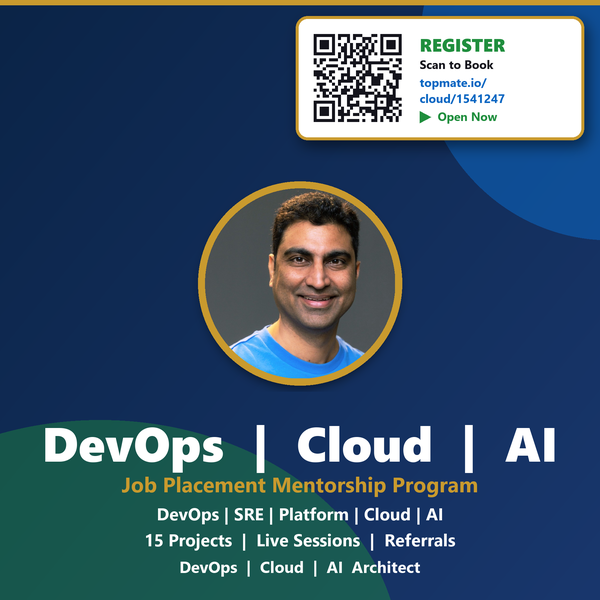
DevOps Cloud AI - Job Placement Mentorship Program
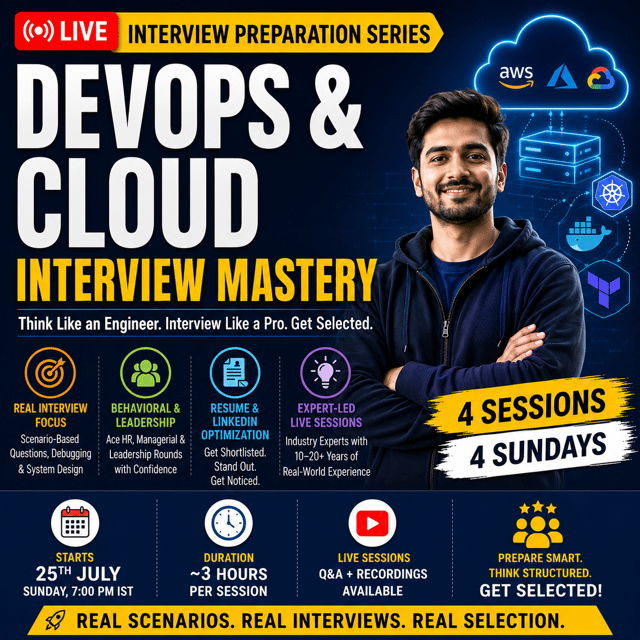
DevOps & Cloud Interview Preparation Program
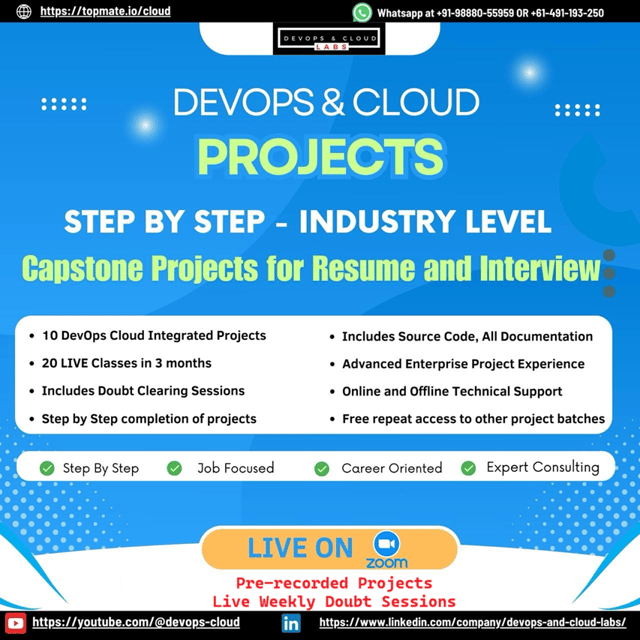
15 Recorded DevOps Cloud AI Industry Level Project
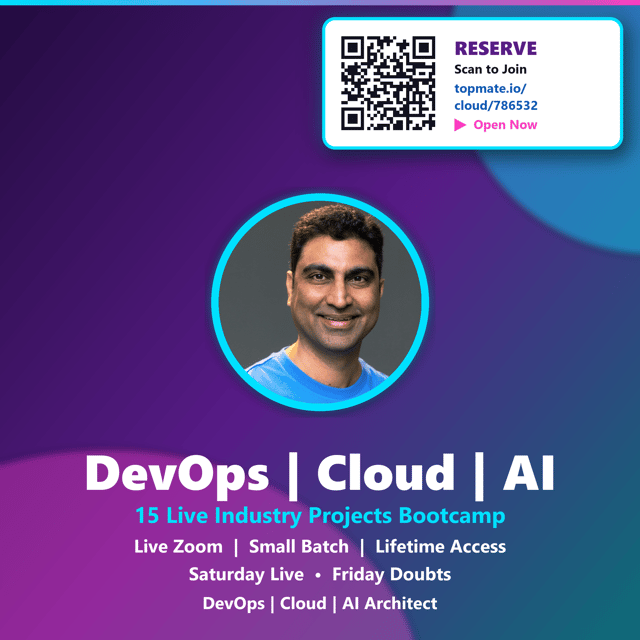
15 LIVE Hands-On DevOps Cloud AI Projects Bootcamp
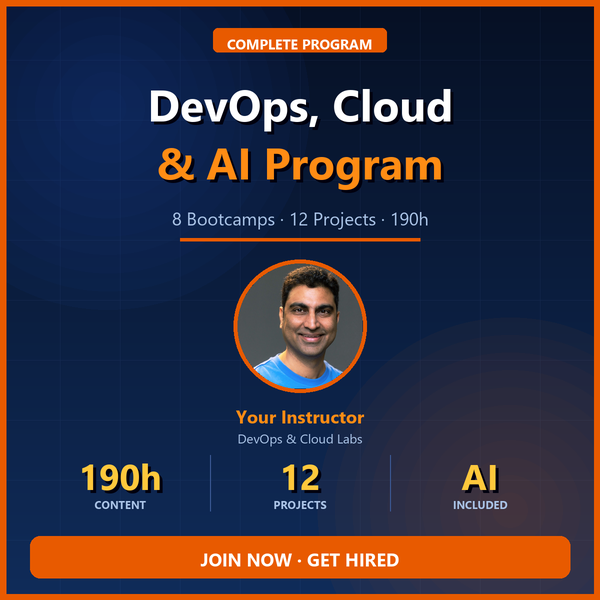
ALL My Job Ready Programs - Self Paced Recorded
Mock interview - For ANY DevOps, Cloud, AI Roles
About me
- My YouTube Channelhttps://www.youtube.com/@DevOps-Cloud-ai
- WhatsApp Group Invitehttps://chat.whatsapp.com/DqDDN2oi8OI4TguTpV43a3


Frequently asked questions
What are the most common DevOps interview questions and answers?
Most DevOps interview questions and answers revolve around a few core areas: Linux and networking fundamentals, Git and branching strategies, CI/CD pipeline design, Docker and Kubernetes, Infrastructure as Code with Terraform or Ansible, and core AWS or Azure services. Interviewers also love scenario questions like "a deployment failed in production — what do you do?" The best preparation is to learn the concept, build it once hands-on, and practise explaining your reasoning out loud rather than memorising definitions.
Which topics do DevOps interview questions and answers for freshers usually cover?
DevOps interview questions and answers for freshers in India usually stay fundamentals-heavy: what DevOps is and why it exists, basic Linux commands, Git operations like merge vs rebase, the stages of a CI/CD pipeline, containers vs virtual machines, and basic AWS or Azure services. Freshers are rarely expected to have production experience — interviewers check whether your concepts are clear and whether you have genuinely practised, even if only on free-tier cloud accounts or Docker installed on your laptop.
How should I prepare for DevOps interview questions for 5 years experience?
At the 5-year mark, prepare for DevOps interview questions for 5 years experience that are scenario- and design-based: architecting multi-environment CI/CD setups, handling failed production releases, managing secrets securely, optimising cloud costs, or migrating a monolith to Kubernetes. Use real examples from your projects with measurable outcomes like deployment frequency or rollback time, and revise Kubernetes troubleshooting, Terraform state handling, and GitOps patterns — these come up repeatedly at senior levels in Indian product and services companies.
Is it enough to prepare from a DevOps interview questions and answers PDF?
A DevOps interview questions and answers PDF is useful for quick revision, but on its own it is rarely enough. Interviewers today follow up with "why" and "how" questions or give you a live scenario, which quickly exposes memorised answers. Use a PDF as a checklist of topics, make sure you can demonstrate each one hands-on, and practise answering aloud. Pairing a question bank with one or two real end-to-end projects works far better than reading lists alone.
What are the top Azure DevOps interview questions?
Frequently asked Azure DevOps interview questions include the difference between classic and YAML pipelines, Microsoft-hosted vs self-hosted agents, service connections and variable groups, branching policies in Repos, how Boards track work items, and how approvals and gates work in releases. Interviewers often ask you to walk through a pipeline you have actually built, so create at least one working YAML pipeline from commit to deployment before your interview.
What is an Azure DevOps project?
An Azure DevOps project is the basic container inside an Azure DevOps organisation that holds everything for one product or team — Git Repos, Boards for work tracking, Pipelines for CI/CD, Test Plans and Artifacts. If you are wondering how to create a DevOps project in Azure, you simply open your organisation, choose New Project, give it a name and set visibility to private or public, and Azure DevOps instantly provisions the repo and board so you can start pushing code and building pipelines.
What are some good DevOps projects for beginners?
Good DevOps projects for beginners start small and grow step by step: containerise a simple web app with Docker, build a CI/CD pipeline with GitHub Actions or Jenkins to build and deploy it automatically, then move the deployment to AWS or Azure. After that, write the same infrastructure using Terraform and deploy the app on Kubernetes. Each step adds one new tool, and completing the full chain teaches you more than ten disconnected tutorials.
Which DevOps projects for resume actually impress recruiters?
The DevOps projects for resume that stand out are end-to-end, industry-style builds — a microservices app deployed on Kubernetes with a full CI/CD pipeline, GitOps using Argo CD, Terraform-managed infrastructure, monitoring with alerting, and a security scan inside the pipeline. Strong DevOps project ideas solve a visible problem: automated deployments, zero-downtime releases, faster rollbacks. Document the architecture, tools and results in a README, because recruiters and interviewers judge the write-up almost as much as the working code.
Where can I find DevOps projects with source code?
You can find DevOps projects with source code in public GitHub repositories, curated "awesome DevOps" lists, and the sample applications provided by tool vendors. The catch is that copying a repo teaches very little — pick a project whose code you can read, redeploy it yourself, and then modify it: change the cloud provider, add a pipeline stage, or swap Jenkins for GitHub Actions. Guided, mentor-led project programs are another option if you want industry-level source code with step-by-step walkthroughs.
How to showcase DevOps projects in an interview?
To showcase DevOps projects well, host them on GitHub with a clean README, an architecture diagram and pipeline badges, then reference them on your resume with one-line outcomes such as "cut deployment time from 40 minutes to 6". In the interview, explain the business problem first, then your architecture, then the trade-offs — why that tool, why that branching strategy, what broke and how you fixed it. Interviewers hire the story behind your decisions, not just the tool names.
Which AWS certification path should I follow?
The standard AWS certification path starts with the foundational AWS Certified Cloud Practitioner, moves to associate level — Solutions Architect Associate for architecture-oriented roles or Developer Associate for DevOps-leaning careers — and then progresses to Professional or Specialty exams such as DevOps Engineer Professional or Security Specialty. For a DevOps career in India, Cloud Practitioner → Solutions Architect Associate → DevOps Engineer Professional is the most widely followed and recognised route.
What is the AWS certification cost in India?
The AWS certification cost in India is billed in US dollars: roughly USD 100 for the foundational Cloud Practitioner exam, USD 150 for associate-level exams, and USD 300 for professional and specialty exams, plus applicable taxes. Practice exams usually cost extra. Fees are revised periodically, so confirm the current amount on the official AWS certification pricing page before booking your exam.
How to get AWS certification as a fresher?
To get AWS certification as a fresher, pick one exam — usually Cloud Practitioner, or Solutions Architect Associate if you already know the basics — prepare for 4–8 weeks using free digital training and hands-on labs on the free tier, then schedule the exam online or at a test centre through Pearson VUE. The exam is multiple choice with a scaled passing score of 700 out of 1000, and the certification is valid for three years. Building real things on the console matters far more than passively watching videos.
Is there any AWS certification for free?
No AWS certification for free exists — every exam carries a fee. However, the preparation can be completely free: AWS Skill Builder's free courses, official exam guides and sample questions, and hands-on practice through the free tier. Students get additional support through AWS Educate, and occasional full exam-fee vouchers are offered during AWS events and programs like AWS re/Start, so it is worth watching for those opportunities while budgeting for the exam fee itself.
Can I switch to DevOps and cloud from a non-IT background?
Yes — many professionals in India successfully move into DevOps from mechanical, civil, oil and gas, support, testing or manual operations backgrounds. A practical transition path is: Linux and networking basics, one cloud platform (AWS or Azure), Git, Docker, then CI/CD and Terraform — backed by two or three hands-on projects. Your domain experience is actually an advantage in industries like manufacturing, energy and BFSI, where engineers who understand the business context are highly valued. Expect around 6–12 months of consistent, project-driven effort to become job-ready.