Testimonials
Services
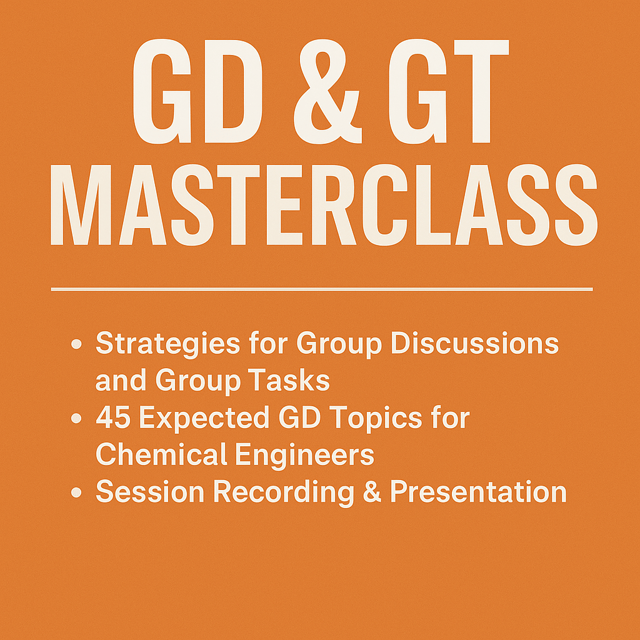
GD> Complete Guidance Session
Fluid Mechanics for Interviews (Mini-Course)
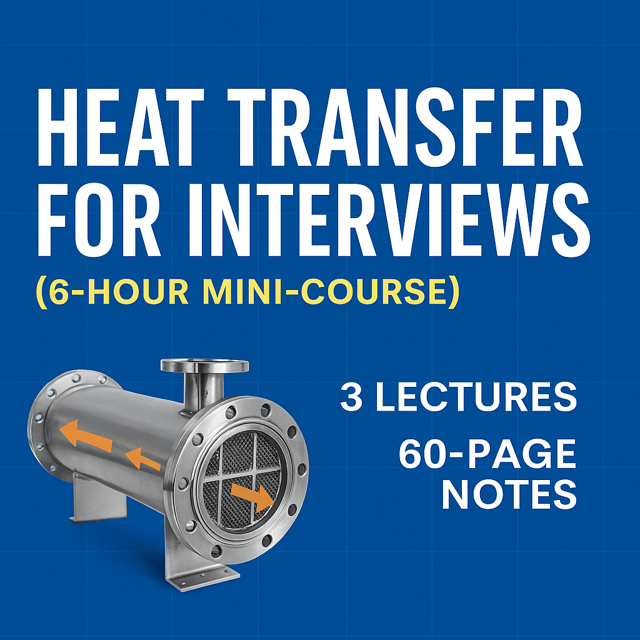
Heat Transfer for Interviews (6 Hours Mini-Course)
Career Guidance in Chemical Engineering
Build and Grow Your Topmate Page
Mock Interview with Detailed Analysis
Get strategy for Interview Preparation
Resume Review for Chemical Engineers
Mock Interview for Chemical Engineers
Compressors Masterclass Recording
Get strategy for Interview Prep. Lite
Thermodynamics for Interview (4 Hours Mini-Course)
Online Assessments Masterclass for Chemical Engg.
Mass Transfer for Interview (10 Hours Full-Course)
Mock Interview for Working Professionals
Interview Preparation in 20 Hours Package
Complete GATE Self-Study Excel Sheet Package
Crack BARC Interview Masterclass Recording
GATE Chemical Complete Strategy Planning
Fluid Mechanics Excel Sheet
About me
- Who am I?https://www.linkedin.com/in/chirag-jain-855028194/

- Chirag is lauded for clear, informative sessions that simplify complex topics, aiding in professional and academic growth.
 AI-generated based on testimonials
Frequently asked questions
How to prepare for a chemical engineering interview?
If you are wondering how to prepare for a chemical engineering interview, start with your core subjects — mass transfer, heat transfer, thermodynamics, fluid mechanics and chemical reaction engineering — because most interviewers begin with fundamentals from these areas. Then prepare your resume and projects in depth, since interviewers probe everything you have written, whether it is a final-year project or your current plant experience. Finally, practise mock interviews and go through previously asked questions so you can think aloud with confidence instead of reciting memorised answers.
What are the most common chemical engineering interview questions and answers?
Most chemical engineering interview questions and answers come from core subjects and practical understanding — expect questions on distillation and mass transfer equipment, heat exchangers, reactors, pumps and compressors, fluid flow and basic thermodynamics, usually linked to something on your resume or your project. Freshers should also be ready for standard HR questions like "tell me about yourself" and "why chemical engineering". Instead of memorising replies, understand the principle behind every question, because interviewers keep extending a question until they find the limit of your concepts.
Where can I download a chemical engineering interview questions and answers PDF for freshers?
You will easily find a chemical engineering interview questions and answers PDF for freshers on educational websites and student groups, and downloading one or two for a first overview is completely fine. Just remember that these PDFs are generic — the same list of questions for every company — while actual interviews at PSUs, private core companies and research organisations go much deeper into your resume, projects and fundamentals. Use the PDF as a checklist of what to cover, and then build your own subject-wise notes for real depth.
How to get a chemical engineering job as a fresher in India?
There is no single formula for how to get a chemical engineering job in India — most freshers get in through campus placements, off-campus drives by core sector companies in oil and gas, EPC, fertilizers and specialty chemicals, GATE-based PSU recruitment, and research programmes such as BARC OCES. Whatever the route, the interview is the final filter where companies check your basics in core subjects, clarity about your projects and confidence in communication. Working on these three areas through mock interviews and an honest resume review improves your selection chances more than adding another certificate.
Is GATE Chemical Engineering tough?
GATE Chemical Engineering is tough mainly because of competition and the depth of concepts — the paper spans the entire CH syllabus from thermodynamics and mass transfer to process control, and negative marking punishes half-knowledge. That said, it is very doable for a prepared candidate: a subject-wise study plan, chapterwise PYQ practice and regular mock tests consistently produce ranks good enough for PSUs and IITs. So, is GATE Chemical Engineering tough? Only if you prepare without a plan.
What is the GATE syllabus for Chemical Engineering?
The GATE syllabus for Chemical Engineering has three broad parts: General Aptitude (15 marks), Engineering Mathematics, and the core CH sections — Process Calculations and Thermodynamics, Fluid Mechanics and Mechanical Operations, Heat Transfer, Mass Transfer, Chemical Reaction Engineering, Instrumentation and Process Control, and Plant Design and Economics. The structure has remained stable across recent years, so aspirants looking for the GATE Chemical Engineering syllabus 2027 will find the same sections, but always download the official brochure of your attempt year, since topic-level details and weightage can change.
Are GATE Chemical Engineering PYQs enough for preparation?
GATE Chemical Engineering PYQs are the single most valuable resource, but they are not enough on their own. Solving the last 15–20 years of papers chapterwise shows you which topics repeat, how questions are framed and where the difficulty lies, yet you still need standard books or a structured course to build concepts first, and full-length mock tests to build speed. The sequence that works for most toppers is concepts first, then GATE Chemical Engineering PYQ practice chapterwise, and finally full-syllabus mock tests.
Which GATE Chemical Engineering book should I use for self-study?
There is no single best GATE Chemical Engineering book that covers the entire paper — successful candidates usually keep one standard textbook per subject, for example Geankoplis or Treybal for mass transfer, Levenspiel for reaction engineering and Smith, Van Ness and Abbott for thermodynamics, and pair them with a chapterwise PYQ book for practice. Collecting multiple books for the same subject only fragments your preparation; one book revised three times beats three books read once.
How to get a PSU through GATE 2026?
If you are unsure how to get a PSU through GATE, the route is: appear for GATE in your own engineering discipline, score above the cutoff set by the company, and apply when its recruitment notification opens — many PSUs shortlist candidates directly on GATE score, while some conduct an additional group discussion or interview round. For PSU through GATE 2026 recruitment, keep tracking the career pages of companies such as GAIL, IOCL, ONGC, NTPC, HPCL and BPCL from around the time results are declared, because each PSU releases its own notification and application window.
What is a PSU in GATE?
A PSU in GATE refers to a public sector undertaking — a government-owned company such as GAIL, IOCL, ONGC, NTPC, BHEL or HPCL — that recruits graduate engineers on the basis of GATE scores instead of conducting its own written exam. Some PSUs shortlist purely on the GATE score, while others add a GD and interview round, which is why GATE has become the main gateway into PSU jobs for engineering graduates in India.
What is the age limit for PSU through GATE?
There is no single age limit for PSU through GATE because every company sets its own eligibility in its recruitment notification. Most PSUs keep the general-category limit roughly in the 26–30 years range, with standard relaxations for OBC, SC and ST candidates and sometimes a higher limit for experienced professionals, so always check the latest notification of the specific PSU you are targeting rather than relying on old figures.
What is the salary in a PSU through GATE?
The salary in a PSU through GATE depends on the company and the grade you join at — most PSUs hire at E1 or E2 level, where the CTC generally falls roughly between ₹8 and ₹15 lakh per annum including basic pay, DA, HRA and performance-related pay. Maharatna companies such as GAIL and ONGC are among the better payers, and since pay scales are revised periodically, the latest recruitment notification is the most reliable source for the current figure.