Testimonials
Services
Recruitment Agencies Hiring - submission links
Product Management Career Roadmap
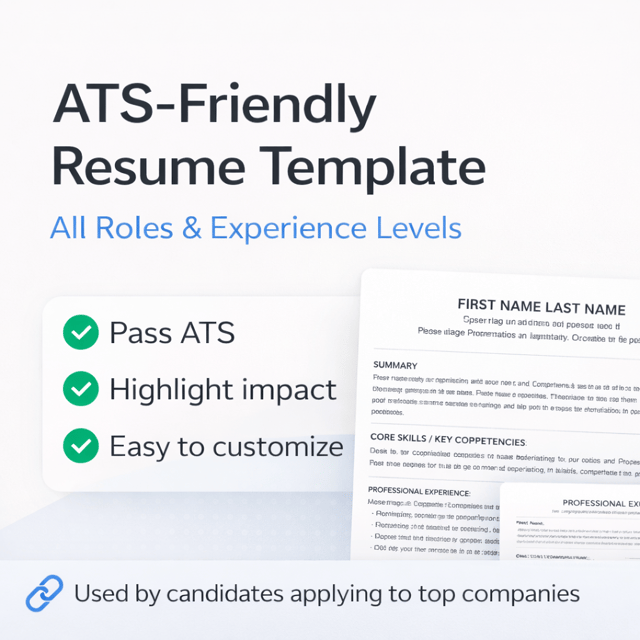
ATS-Friendly Resume Template (0–15 Yrs Exp)
1:1 Career Guidance Call (40 Minutes)
B.Com Career Starter Pack
Google SWE Internship 2027 Roadmap
Fresher CV – NO Internship (ATS Friendly)
HR Internship Roadmap + ATS Resume Template
Creator OS | Build Your Brand & Creator Business
50+ Remote Companies Hiring in India
Product Management + ATS Resume Bundle
ATS Resume Review by HR | Get Shortlisted Faster
Google Internship Success Kit 2027
Finance Roadmap + ATS Resume for Freshers
Fresher CV – With Internship (ATS Friendly)
After B.Com – Complete Career Roadmap
Priority DM – Quick Career Advice (Urgent Queries)
1:1 Personal Brand & Creator Strategy
About me
Frequently asked questions
What is the ATS resume full form?
ATS stands for Applicant Tracking System. It is software that most companies in India and abroad use to scan, filter, and rank resumes before a recruiter actually opens them. So an ATS resume simply means a resume that this software can read correctly — clean formatting, standard section headings, and keywords that match the job description. If your resume is not ATS-friendly, it can get rejected automatically, even if you are a good fit for the role.
What is an ATS resume checker?
An ATS resume checker is a tool that scans your resume the way a company's Applicant Tracking System would and shows you what could get it filtered out. It typically checks whether your resume parses correctly, whether your section headings are standard, whether key skills from the job description are missing, and often gives an overall score. Running your resume through a checker before every application helps you fix problems early instead of losing opportunities silently.
How to make an ATS resume that gets shortlisted?
Keep the layout simple: single column, standard fonts, and no photos, tables, graphics, or decorative templates. Use clear section headings like Summary, Skills, Work Experience/Internships, Projects, and Education. Most importantly, mirror the exact keywords from the job description — if the posting says "MySQL", don't write only "SQL databases". Save it in the format the employer asks for, keep it to one or two pages, and get it reviewed by someone with real hiring experience to spot what you're missing.
What is the correct ATS resume format for freshers?
For freshers, the safest ATS resume format is reverse-chronological on a single page: contact details, a short summary, then Education (since it's your strongest section), followed by Internships, Projects, Skills, and Certifications. Use standard headings, simple bullet points, and keywords taken from the job description. Avoid skill bars, icons, multi-column layouts, and photo-heavy designs — they look impressive but often break ATS parsing.
How to improve ATS resume score?
Score drops usually happen for three reasons: missing keywords, non-standard formatting, and poor parsing. Tailor your resume to each job description using the exact skill names and role-related terms from the posting. Fix your headings to standard ones like Skills, Experience, and Education, remove graphics and tables, and keep date formats consistent. Re-run your score after each change, and remember the goal is not a perfect number — it is matching what the specific job is asking for.
Does using an ATS resume template alone guarantee shortlisting?
No. A good template solves only the formatting half of the problem — making sure the ATS can read your resume. The other half is content: your keywords, skills, and achievements must actually match the role you are applying to. A template filled with generic descriptions will still get filtered out, so customise it for every application, and ideally have it reviewed by someone who has worked in hiring so nothing important is missing.
What does interview preparation for freshers actually involve?
It usually covers five things: knowing your own resume inside out, researching the company and role, preparing answers for common HR and role-specific questions, building examples from projects or internships using the STAR method, and practising out loud through mock interviews. Freshers often skip the last part and lose confidence in the real interview, so rehearsing with someone who can give honest feedback makes a big difference.
How to answer interview questions when you have no work experience?
Use what you do have: college projects, internships, freelance work, volunteering, or leadership roles in clubs and events. Structure your answers with the STAR method — Situation, Task, Action, Result — so even a small experience sounds concrete and organized. Focus on transferable skills like problem-solving, communication, and learning quickly, and never bluff experience you don't have; interviewers notice it immediately, while honesty with a genuine learning attitude lands much better.
Do I need interview preparation classes near me, or is online mentoring enough?
For most people, online mentoring works just as well — sometimes better — because you can learn from professionals with actual hiring experience regardless of which city you live in. Offline classes near you make sense if you need a fixed schedule or prefer group practice. What matters more than the mode is personalisation: generic lectures help far less than one-on-one mock interviews and feedback based on your target role and your specific gaps.
Can an interview preparation AI tool replace practising with a real HR professional?
AI tools are genuinely useful for practising common questions, structuring answers, and rehearsing without fear of judgement. But they cannot fully replace feedback from a real HR professional — someone who has actually sat on interview panels knows what gets a candidate selected or rejected in the final round. The best approach is to use AI tools for volume practice and take at least a few mock interviews with an experienced HR mentor for honest, role-specific feedback.
What is a career roadmap?
A career roadmap is a step-by-step plan that connects where you are now to where you want to be. It typically includes your target role, the skills and certifications needed for it, the entry points such as internships, entry-level jobs, or freelancing, and milestones for every few months. It is useful because it turns a vague goal like "I want a good job" into clear next actions — and helps you notice early if you are drifting off track.
How do I build a career roadmap after 12th?
Start by shortlisting two or three career directions that genuinely interest you, then research what qualifications, skills, and entry-level roles each one requires. Work backwards from the goal: pick the right degree, add certifications and internships alongside college, and build projects or portfolios early. Review the plan every six months, because hiring trends change fast — especially in fields like product, finance, HR, and tech. If you feel stuck, a mentor who works in hiring can help you avoid months of trial and error.
What should a career roadmap for students include?
A practical student roadmap should include a target role with one or two backup options, semester-wise skill goals, internship applications starting early in college, two or three solid projects or certifications, and a basic network of seniors and professionals in your field. It should also account for alternatives like freelancing or remote work if full-time roles take time. Keep it realistic — a roadmap you actually follow beats a perfect one you ignore.