Testimonials
Services
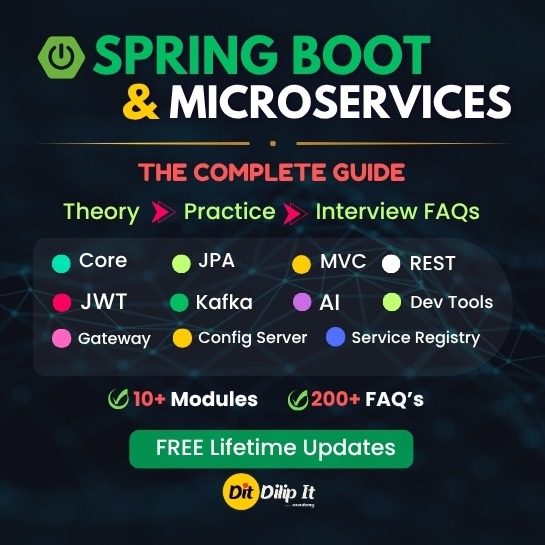
Spring Boot 3 & Microservices - Complete Guide
About me
Frequently asked questions
What is Spring Boot and how does it work?
Spring Boot is a framework built on top of the Java Spring ecosystem that makes it faster to build production-ready backend applications. It works through auto-configuration — instead of manually wiring up datasources, servers and libraries, Spring Boot detects what your project needs and configures it automatically. It ships with an embedded server like Tomcat, so your app runs as a standalone JAR, and "starter" dependencies pull in compatible versions of everything for you. In short, plain Spring gives you the building blocks; Spring Boot removes the setup pain so you can focus on business logic.
What is microservices architecture in Java?
Microservices architecture in Java means breaking a large application into small, independently deployable services, each owning one business capability (orders, payments, notifications) and often its own database. Services communicate over REST APIs or through event streaming tools like Kafka. In the Java ecosystem this is typically built with Spring Boot for individual services, Spring Cloud for configuration, gateway and service discovery, and Docker/Kubernetes for deployment — the same model most enterprises use for large-scale Java systems today.
How to design microservices architecture?
Start by identifying business capabilities and drawing service boundaries around them — for example user, catalogue, orders and payments. Give each service its own data store so teams can build and deploy independently, then decide how services communicate: synchronous REST for request-response flows, asynchronous messaging like Kafka for events and decoupling. Add an API gateway for clients, centralized configuration, service discovery, and resilience patterns such as circuit breakers. Plan observability (logs, tracing, metrics) and CI/CD pipelines before adding more services, and start with fewer, coarser services rather than splitting too early.
How to implement microservices architecture in Java with Spring Boot?
A standard implementation stack looks like this: build each microservice as a Spring Boot application exposing REST APIs, use Spring Cloud for the config server, API gateway and service discovery, and Kafka for event-driven communication between services. Containerize each service with Docker, deploy on Kubernetes, and automate builds and releases through CI/CD pipelines to AWS or Azure. A good way to learn is to start with two or three services (order, payment, notification) and get communication and error handling right before expanding — the Dilip IT Academy YouTube channel walks through exactly this stack with hands-on tutorials.
Microservices architecture vs monolithic architecture: which one should I choose?
A monolith is a single codebase deployed as one unit — simpler to develop, test and debug, ideal for early-stage products and small teams. Microservices split the system into independent services that scale and deploy separately, which pays off with larger teams, different scaling needs per component and faster release cycles. Choose a monolith when the product and team are small; move to microservices when deployment bottlenecks, scaling limits or team growth start hurting. In real jobs you often do both — refactoring legacy monoliths into cloud-ready microservices is a very common backend task, which is why interviewers test both models.
What are the important microservices architecture patterns?
The patterns that come up repeatedly are: API Gateway (a single entry point for clients), Database per Service (independent data ownership), Circuit Breaker (fail fast when a downstream service is down), Saga (managing distributed transactions across services), event-driven communication, Service Discovery, and the Strangler Fig pattern for gradually migrating a monolith. You won't need all of them in every project, but knowing which problem each pattern solves — and where you have applied one — is exactly what interviewers look for in experienced backend roles.
How do I create a microservices architecture diagram?
Keep it simple: place clients at the top, then the API gateway, then your individual services with their own databases below them. Add the message broker (Kafka or RabbitMQ) alongside, with arrows showing event flows, and clearly mark which calls are synchronous (REST) and which are asynchronous (events) — solid lines for sync, dashed for async works well. Tools like draw.io, Lucidchart or Excalidraw are enough; interviewers care far more about whether your service boundaries and data flows make sense than about the quality of the drawing.
How to explain microservices architecture in an interview?
Use a three-part structure: define it in one line (small, independently deployable services, each owning a business capability), sketch the flow (client → API gateway → services → their own databases, with Kafka for events), and then explain the trade-offs — independent scaling and deployments versus the complexity of network calls, data consistency and debugging. Always anchor it to your own project: which services you had, how they communicated, and one problem like a distributed transaction that you solved. Rehearsing this out loud, ideally in a mock interview setting, separates candidates who have read definitions from those who have actually worked with the architecture.
What are the most asked microservices architecture interview questions?
Expect variations of: microservices vs monolithic architecture, how services communicate (REST vs messaging), what database-per-service means and how to query across services, distributed transactions and the Saga pattern, the purpose of an API gateway, circuit breakers and resilience, service discovery, and how Kafka fits in. For senior roles, add Docker, Kubernetes and CI/CD. The safest way to answer is a short definition followed by a real example from your own work — practising this pattern with a mentor or through a mock interview makes your answers far more convincing.
What are the most common Java interview questions for freshers?
Freshers are usually tested on core Java fundamentals: the four OOP pillars with real examples, String immutability, equals and hashCode, Collections (ArrayList vs LinkedList, how HashMap works), exception handling, basic multithreading, and JVM vs JRE vs JDK. You will also be asked about a project you have built — a small Spring Boot CRUD application with a database is the single best project to talk about. Focus on understanding concepts rather than memorizing answers, because interviewers almost always probe one level deeper to check whether you truly get it.
What are the common Java interview questions for 5 years of experience?
At five years, the focus shifts from syntax to depth and design: JVM internals and garbage collection, concurrency (thread pools, CompletableFuture, volatile vs synchronized), HashMap internals, design patterns, Spring Boot internals like auto-configuration and bean lifecycle, REST API design, and microservices — including handling distributed transactions, idempotency and failure scenarios. You will also face system design questions and questions about production issues you have debugged. Prepare three or four detailed stories from your own work, because at this level experience-based answers carry far more weight than textbook theory.
Which is the best Spring Boot tutorial for beginners?
The best Spring Boot tutorial for beginners is one that is project-based, updated for Spring Boot 3, and builds gradually — starting with a simple REST API, then adding a real database, validation, exception handling and finally deployment. Avoid tutorials that jump straight into advanced cloud setup or that still rely on outdated configuration styles. Most importantly, code along with every step instead of watching passively; on the Dilip IT Academy YouTube channel, for example, every Spring Boot concept is taught through hands-on tutorials for exactly this reason.
Where can I find a good Spring Boot tutorial PDF?
A structured Spring Boot tutorial PDF is genuinely useful for revision since you can read offline and highlight important sections. Look for one that covers Spring Boot 3, includes interview FAQs, and has been updated recently — many free PDFs still target older Spring versions. The Spring Boot 3 & Microservices Complete Guide e-book available on Dilip's Topmate is continuously updated with the latest content and interview FAQs, and pairs well with the free hands-on tutorials on his YouTube channel.
Is there a good Spring Boot tutorial in Hindi?
Yes — YouTube has plenty of Spring Boot tutorials in Hindi, and they can be a big help if you grasp technical concepts faster when they are explained in Hindi. Apply the same filters you would to any tutorial: is it project-based, is it updated for Spring Boot 3, and does the instructor explain the reasoning behind configurations rather than just clicking along? A good starting point is Dilip IT Academy's YouTube channel, which teaches Spring Boot and microservices through hands-on, beginner-friendly tutorials.