Testimonials
Services
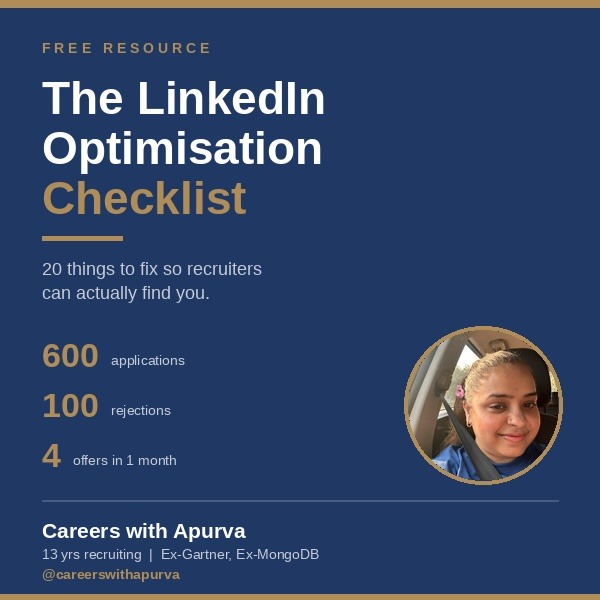
The LinkedIn Optimisation Checklist(Free Resource)
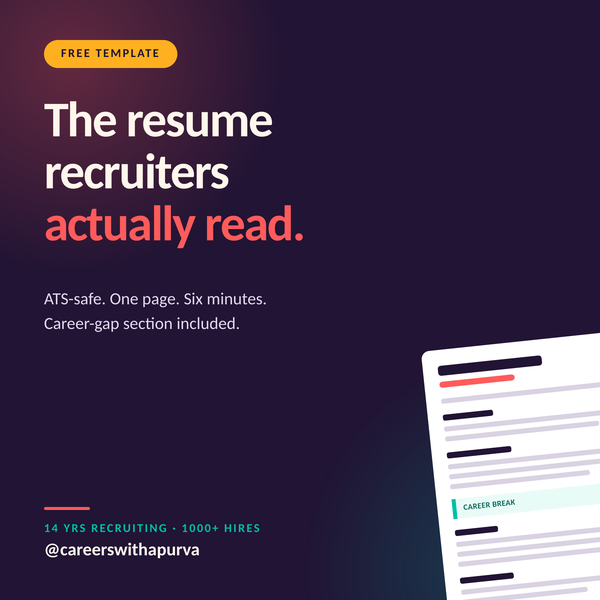
Recruiter-Approved Resume Template (Free)
Resume Optimisation – ATS & Recruiter Ready
Resume+LinkedIn Optimisation+Inbox Magnet Playbook
Career Strategy Session
Discovery Call

The Complete Job Search Toolkit
LinkedIn Optimisation- Profile Transformation
Interview Strategy/Mock interview
“Career Reset Blueprint”
About me
- Apurva is highly praised for her honest, personalized career guidance, resume/LinkedIn optimization, and practical advice that delivers real results.
 AI-generated based on testimonials
Frequently asked questions
What is CV optimization?
CV optimization is the process of restructuring your CV so it clearly communicates your value to a recruiter instead of just listing job responsibilities. It usually involves rewriting bullet points around measurable achievements, aligning your skills and titles with the roles you are targeting, and formatting the document so both human reviewers and screening software can read it easily. In the Indian job market, where a single opening can attract hundreds of applications, optimization is often what decides whether your CV gets shortlisted or ignored.
How to optimize your resume for ATS?
To optimize your resume for ATS, mirror the exact keywords and job title used in the job description, use standard section headings like Experience, Education and Skills, and avoid tables, columns, graphics and text boxes that parsing software cannot read. Save the file in the format the application asks for, usually .docx or a clean, single-column PDF. Most ATS rejections happen because of formatting and keyword mismatch, not because a candidate lacks the experience. A quick test: if your resume looks broken when pasted as plain text, it will likely confuse an ATS too.
How to optimize your resume for AI screening?
Many companies now use AI screening tools to score and rank resumes before a human ever opens them, so you need to optimize your resume for AI screening in addition to ATS. Write in natural, complete sentences rather than keyword lists, because AI models read context, mirror the language of the job description, and lead each bullet with a quantified result. Avoid keyword stuffing, as modern AI models are trained to detect it. In simple terms, ATS checks whether your resume can be read, while AI screening judges whether it looks like a strong match for the role.
What is the best AI for resume optimization?
ChatGPT, Claude and Gemini are all capable, and the honest answer is that the tool matters less than what you feed it — the job description, your real achievements and the roles you are targeting. Most people begin with a resume optimization prompt for ChatGPT, which works fine for cleaning up wording, but generic AI output often sounds polished while saying very little. AI cannot tell you how recruiters for your specific role and market actually shortlist candidates, so use it for drafts and rewrites, and get recruiter-level feedback for positioning before you apply.
What is resume optimization for job descriptions?
Resume optimization for job descriptions means tailoring your resume to each specific role instead of sending one generic version everywhere. It involves matching the keywords in the job posting, reordering your bullets so the most relevant experience appears at the top, and removing details that do not matter for that role. Both recruiters and screening systems compare your resume against the job description, so a tailored resume almost always outperforms a generic one, even when the generic version is objectively stronger.
What is LinkedIn profile optimization?
LinkedIn profile optimization is the process of improving your profile so it ranks higher in recruiter searches and convinces viewers to reach out. It covers your headline, About section, experience descriptions, skills and keywords — all aligned to the roles you want next. Unlike a resume, which you send out, an optimized LinkedIn profile works passively: recruiters searching for candidates like you find you first, which is why it has become the foundation of a serious job search.
How do you optimize your LinkedIn profile?
You optimize your LinkedIn profile by working top-down: start with a headline that states your domain and value instead of just your job title, rewrite your About section as a clear career story, add measurable achievements to each role, align your skills with the keywords recruiters actually search for, and stay active so the algorithm keeps your profile visible. Most profiles fail not because the person lacks experience, but because the profile never clearly says what role they should be considered for.
How to check LinkedIn profile optimization?
The quickest way to check LinkedIn profile optimization is to look at four signals: whether your headline and skills match the keywords in your target job descriptions, whether your search appearances and profile views are growing, whether recruiters are actually messaging you, and whether your profile reads as one coherent story for a specific direction. If you are applying regularly but getting almost no recruiter views or InMails, your profile is not appearing in the right searches — the clearest sign that optimization is missing.
Do free LinkedIn profile optimization tools and prompts actually work?
A free LinkedIn profile optimization tool can be a useful first check — most flag a weak headline, missing keywords or an empty About section. A LinkedIn profile optimization prompt works similarly and can rewrite your summary into something cleaner. What neither can do is positioning: deciding which role you are actually targeting, which keywords recruiters in your market search for, and how your experience should be framed. Tools fix surface issues, but strategy is what decides whether the right recruiters find you.
Are LinkedIn profile optimization services worth it?
If you understand how recruiter search works and enjoy writing, you can optimize your profile yourself using free checklists. LinkedIn profile optimization services make sense when you have solid experience but low visibility — few profile views, no recruiter messages, or rejections that do not match your skill level. A good service goes beyond editing: it repositions your profile around the roles you want and the keywords recruiters use to find candidates like you. If you are already getting profile views but no interviews, the weak link is usually your resume or interview performance instead.
What is job interview preparation?
Job interview preparation is the structured work you do before an interview: researching the company and role, mapping your experience to the job description, preparing five or six achievement stories you can adapt to different questions, practising your answers out loud, and deciding what to ask the interviewer. Reading common questions is not preparation on its own — being able to deliver specific, confident answers under pressure is what interviewers actually assess.
How to answer interview questions?
The most reliable way to answer interview questions is to give a direct answer first, then support it with one specific example — the situation, what you did, and the measurable result. Keep answers to roughly one or two minutes, choose examples that match the core requirements of the role, and avoid memorised scripts, which sound rehearsed. Practising out loud, ideally in a mock interview with honest feedback, improves your answers far faster than writing them down.
What is the best interview preparation for freshers with no experience?
Interview preparation for freshers works best when it focuses on three things: a strong self-introduction, complete command over the projects and internships on your resume, and clear reasons for why you want that specific role and company. Interviewers do not expect freshers to have work experience — they assess communication, fundamentals and how seriously you prepared. Practising common fresher questions out loud, ideally in a mock interview with someone who gives honest feedback, matters far more than reading through long question banks.
Is an interview preparation course worth it?
An interview preparation course helps when you need structure — frameworks for common questions, practice discipline, and a starting point if interviews make you nervous. The limitation is that courses are generic by design, while interviews are decided on how well your answers fit the specific role. If you are already getting shortlisted, targeted mock interviews with personalized feedback usually deliver more improvement than another recorded module. If your basics are weak, a course is a reasonable first step, followed by live practice.
Can an interview preparation AI tool replace a mock interview with a real person?
An interview preparation AI tool is useful for volume practice — generating likely questions, refining your answers and reducing nervousness through repetition. What it cannot recreate is the pressure of a real interviewer: unexpected follow-up questions, silence, and judgment of how you think on your feet. The most effective approach is to use AI for daily practice and do at least one or two mock interviews with an experienced professional before an important interview, because that is where you discover the gaps you could not see on your own.