Testimonials
Services
AI/ML Career Roadmap in VLSI
Silicon Validation Interview Prep & Career Guide
Pre Si Mock Interview + Resume Building
Comprehensive Resume Review
GATE Preparation
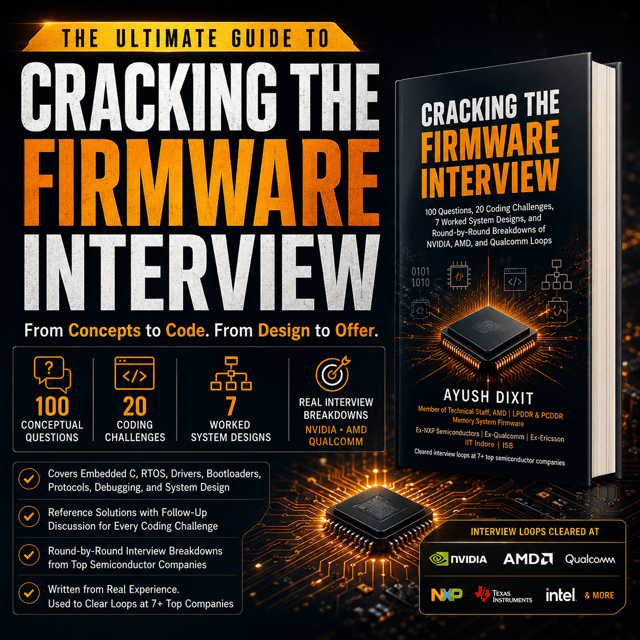
Cracking the Firmware Interview (100 Q&A)
Embedded Systems Roadmap
Complete Embedded Systems Interview Preparation
Mentorship Call
About me
- Testimonials praise Ayush's insightful guidance, strategic advice for job interviews, and impactful resource sharing.
 AI-generated based on testimonials
Frequently asked questions
What is pre silicon validation?
Pre silicon validation is the testing done on a chip design before it is actually manufactured. Engineers check the RTL and IP blocks through simulation, emulation, and FPGA prototyping so that functional bugs are caught before fabrication, when they are still cheap to fix. Only after the design clears this stage does the chip go for manufacturing, followed by post silicon validation on real hardware.
What is a pre silicon validation engineer?
A pre silicon validation engineer ensures that a chip or IP block behaves as intended before it is sent for fabrication. Day-to-day work includes writing test plans and testbenches, running simulations and emulation, debugging failures with the design team, and signing off coverage. Most roles expect strong digital design fundamentals, SystemVerilog/UVM knowledge, and scripting skills in Python or shell.
Which topics do most VLSI interview questions and answers cover?
Most VLSI interview questions and answers centre on digital design fundamentals such as flip-flops, setup and hold violations, and metastability, along with CMOS basics, Verilog/SystemVerilog coding, static timing analysis, and low-power design. Senior roles add architecture, bus protocols, and system-level questions, so it is best to tailor preparation to the specific profile you are targeting.
How should freshers start preparing for interviews in this field?
VLSI interview questions for freshers mostly test fundamentals, so begin with digital electronics, CMOS basics, and Verilog before choosing a specialization like design, verification, or validation. Build at least one strong project or internship, solve previous company-wise questions, and rehearse a few mock interviews so you can explain your thought process confidently.
Which is the best VLSI interview questions book?
There is no single VLSI interview questions book that covers everything, so most candidates combine a digital design text such as Morris Mano, a CMOS VLSI reference like Weste and Harris, and company-specific question sets shared on GitHub and Medium. Use books to build concepts, then practise writing answers and solving numericals under time pressure.
Where can I find a VLSI interview questions with answers PDF?
If you are looking for a VLSI interview questions with answers PDF, the most common sources are GitHub repositories, university course notes, and technical blogs on Medium. Treat these as revision material rather than your main preparation, since interviews test depth of understanding, and pair them with standard textbooks and hands-on practice.
Which topics are covered in silicon validation interview questions?
Silicon validation interview questions typically cover validation planning, test case development, debug methodology, and standard protocols such as PCIe, DDR, USB, or I2C. Interviewers also probe hands-on skills, including reading schematics, using oscilloscopes and logic analyzers, and isolating whether a failure lies in the silicon, the software, or the test setup.
What do post silicon validation interview questions focus on?
Post silicon validation interview questions focus on working with actual manufactured chips: silicon bring-up, bench debugging, clocking and power issues, and validating the chip against the product specification. A very common question is how you would debug an issue that never appeared in simulation, because that is exactly the challenge post silicon teams face on real hardware.
Which pre silicon validation interview questions are asked for freshers?
For freshers, pre silicon validation interview questions generally start with digital design basics, Verilog and SystemVerilog coding exercises, and simple testbench scenarios before moving to UVM components such as drivers, monitors, and sequences. Be ready for questions on functional and code coverage, assertions, and waveform-based debugging puzzles as well.
How do I become a pre silicon verification engineer?
To become a pre silicon verification engineer, first strengthen digital design and Verilog fundamentals, then learn SystemVerilog and UVM, which most verification teams in India work on. Add Python or shell scripting, complete verification projects or a VLSI internship, and apply through off-campus drives and referrals; an M.Tech in VLSI improves shortlisting chances, though well-prepared B.Tech candidates with strong projects do get selected too.
What is the pre silicon verification engineer salary in India?
The pre silicon verification engineer salary in India depends mainly on company type and experience. Service-based companies offer lower fresher packages, while product companies such as Intel, Qualcomm, AMD, and NVIDIA pay noticeably more, with fresher roles often starting in double-digit LPA, and mid-level engineers with strong UVM, low-power, or protocol skills commonly crossing ₹30 LPA.
How do I find pre silicon validation jobs in India as a fresher?
Pre silicon validation jobs in India are concentrated in Bangalore, Hyderabad, Pune, and Noida, with product companies like Intel, Qualcomm, AMD, NVIDIA, and Texas Instruments hiring alongside large service firms. Track company career pages and LinkedIn for titles such as silicon validation engineer or design verification engineer, and strengthen your profile with Verilog/UVM or FPGA projects, since freshers are shortlisted mainly on fundamentals and hands-on work.
How are VLSI interview questions for experienced candidates different from fresher interviews?
VLSI interview questions for experienced candidates go much deeper into specialization, with detailed project discussions, architecture and trade-off decisions, real debugging experiences, and cross-domain topics like low power or DFT, while fresher rounds stay limited to fundamentals and basic coding. Senior candidates should also prepare for system-level rounds and questions on the measurable impact of their work rather than just concepts.