Testimonials
Services
PM Configuration_TOOL
Discovery Call
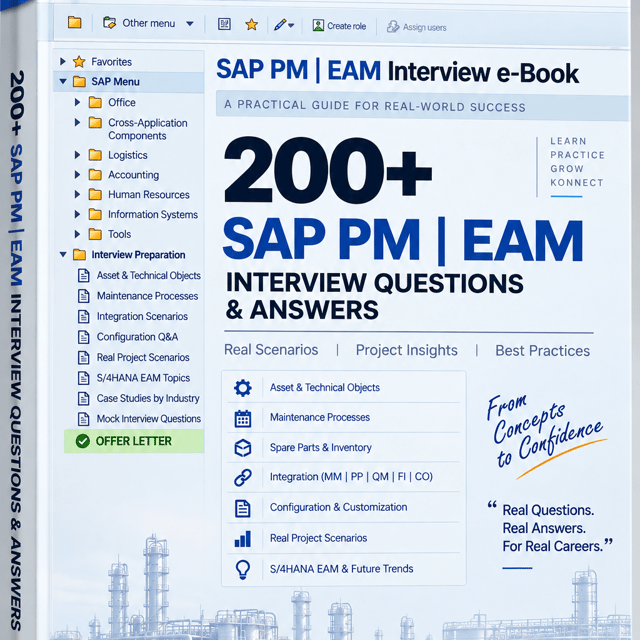
SAP PM / EAM Interview Playbook
BOOK ME to LISTEN your PAIN
25+ SAP PM Real Support Tickets
INDTRODUCRY session//Quick chat- KNOW each other
About me
- My All topmate Earnings goes to charity and this is just toTrack and respect time and knowledge

Frequently asked questions
What is SAP Plant Maintenance?
SAP Plant Maintenance (commonly called SAP PM) is the module in SAP ERP and S/4HANA that companies use to manage the upkeep of their machines, equipment, and infrastructure. It handles breakdowns, repairs, inspections, and preventive maintenance, and keeps a complete service history of every asset. The SAP Plant Maintenance module is widely used in manufacturing, pharma, oil and gas, power, and other asset-heavy industries.
What is the purpose of SAP Plant Maintenance?
The main purpose is to reduce unplanned downtime and equipment failures by planning and scheduling maintenance work properly. It helps companies create notifications for problems, convert them into maintenance orders, track spare parts and costs, and move from reactive repairs to planned preventive maintenance. This improves equipment life, safety, and compliance while keeping maintenance costs under control.
What is the SAP Plant Maintenance process flow?
A typical flow starts when a problem is reported through a maintenance notification, which is then converted into a maintenance order. The order is planned with tasks, spare parts, and work centers, scheduled, executed by technicians, and finally technically completed so the history is saved against the equipment. On the preventive side, maintenance plans and strategies automatically generate orders based on time schedules or measuring counter readings.
What are the main SAP Plant Maintenance roles and responsibilities?
An SAP PM consultant gathers requirements from maintenance teams, configures the solution (functional locations, equipment, catalogs, order types), runs testing, trains users, and supports the system after go-live. In support projects, the consultant handles tickets, enhancements, and incident resolution. End users like maintenance planners and technicians use the system daily to raise notifications, process orders, and confirm completed work.
What kind of SAP Plant Maintenance jobs are available in India?
Common roles include SAP PM functional consultant, application support consultant, asset management consultant, maintenance planner (SAP end user), and SAP PM business analyst. Opportunities exist in manufacturing, automotive, pharma, oil and gas, power, cement, and FMCG companies. Freshers usually enter through support projects, while mechanical, electrical, or production engineers with plant experience transition into functional consultant roles faster.
How do I choose the right SAP Plant Maintenance course?
Look for a program that gives hands-on practice on a sandbox system instead of only recorded theory. Good SAP Plant Maintenance training should cover real business scenarios, configuration practice, integration with MM and QM basics, updated S/4HANA content, and mentor feedback on your work. Ask whether you will see real support tickets and end-to-end scenarios, because interviewers test practical understanding, not just definitions.
Is SAP Plant Maintenance certification worth it?
Certification helps freshers get shortlisted because it signals structured knowledge, but it rarely gets you a job on its own. Companies give far more weight to hands-on configuration skills, scenario-based answers, and communication. Certification makes the most sense for freshers and for maintenance engineers moving into IT. Also note that SAP now groups much of this area under asset management, so the same learning path may appear as an SAP EAM certification — always check the current exam names on SAP Learning before enrolling.
How do I prepare for SAP Plant Maintenance interview questions?
Build strong clarity on master data (functional locations, equipment, work centers), notification and order processing, maintenance plans and strategies for preventive maintenance, and integration with other modules. Practice explaining configuration you have actually done, and rehearse scenario questions like "a machine breaks down — what do you create first and why?" Practicing out loud or doing a mock interview with an experienced consultant helps you find gaps before the real interview.
Which SAP PM configuration interview questions are most commonly asked?
Interviewers frequently ask about the difference between functional location and equipment, maintenance plant vs planning plant, configuring notification types and order types, number ranges, catalogs and coding, maintenance strategies and packages, measuring points and counters, and status management. They often ask you to walk through the configuration steps you personally performed, so be ready to explain the "why" behind each setting, not just the menu path.
What are the basic SAP PM configuration steps?
A typical sequence is: define maintenance planning plants and maintenance plants, build the functional location structure with categories, define equipment categories and number ranges, set up catalogs for damage and cause codes, create maintenance work centers, configure notification and order types with number ranges, and finally set up maintenance strategies, task lists, and maintenance plans for preventive maintenance. The exact sequence always follows the project's blueprint.
Where can I find an SAP PM configuration step by step PDF?
Reliable options include the official SAP Help Portal, SAP Community blogs, and structured configuration guides prepared by experienced consultants. Random free downloads are often outdated or incomplete, so check that the document matches your SAP version and includes screenshots with business context. Many mentors and trainers also share their own SAP PM configuration step by step PDF documents with students, which is often more practical than scattered online material.
What is the SAP EAM full form?
SAP EAM stands for Enterprise Asset Management. It refers to managing a company's physical assets across their entire lifecycle — from installation and operation to maintenance and retirement. In SAP, EAM capabilities are largely delivered through the Plant Maintenance functionality, which is why job postings and courses often use EAM and PM interchangeably.
SAP EAM vs PM: What is the difference?
PM is the classic name of the SAP module for maintenance, while EAM is the broader business concept of managing assets across their lifecycle, which SAP uses especially in the S/4HANA era. In daily project work, the SAP EAM module and the SAP PM module refer to the same core maintenance functionality — notifications, orders, preventive maintenance, and reporting. For your career, the configuration and domain skills matter far more than the label on the job posting.
What does an SAP EAM consultant do?
An SAP EAM consultant helps companies run their maintenance operations on SAP. This includes gathering requirements from maintenance and plant teams, configuring the system, conducting workshops, performing testing, training end users, resolving support tickets, and helping businesses improve processes such as moving from breakdown-based to preventive maintenance. Strong consultants combine configuration knowledge with real plant maintenance domain understanding, which is why experienced professionals are valued in this area.