Testimonials
Services

FAANG-Level ATS Resume for Developers & SDETs
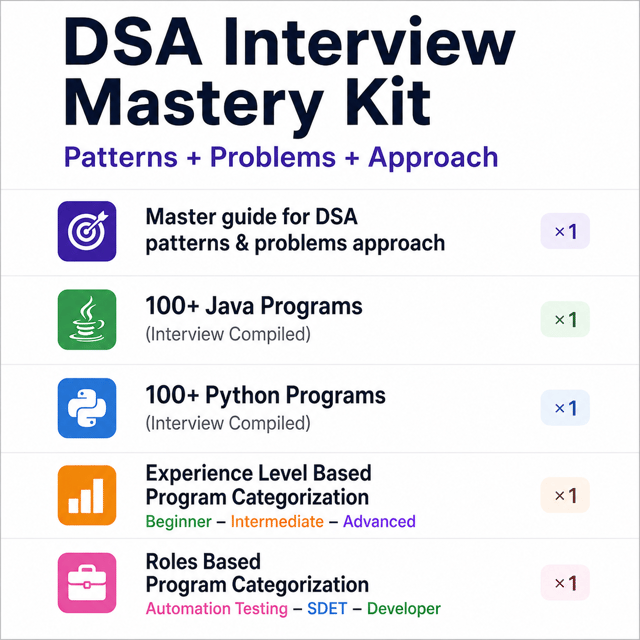
Clear Coding Round in 3 Days (Java & Python)
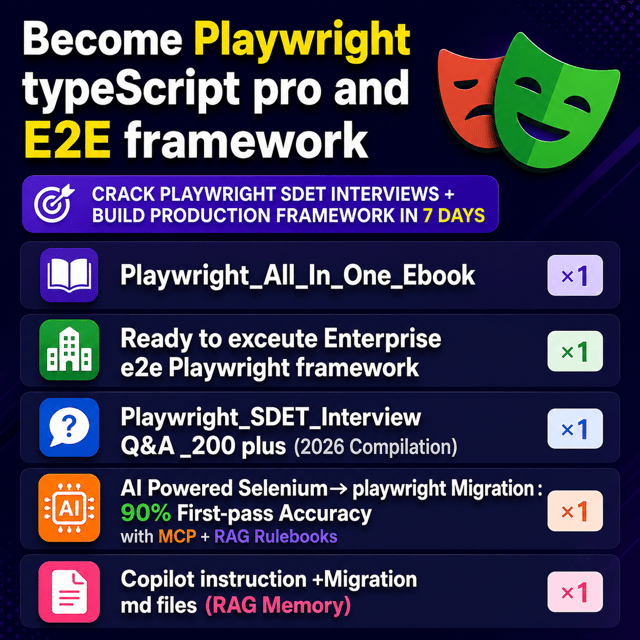
Become Playwright typeScript pro and E2E framework
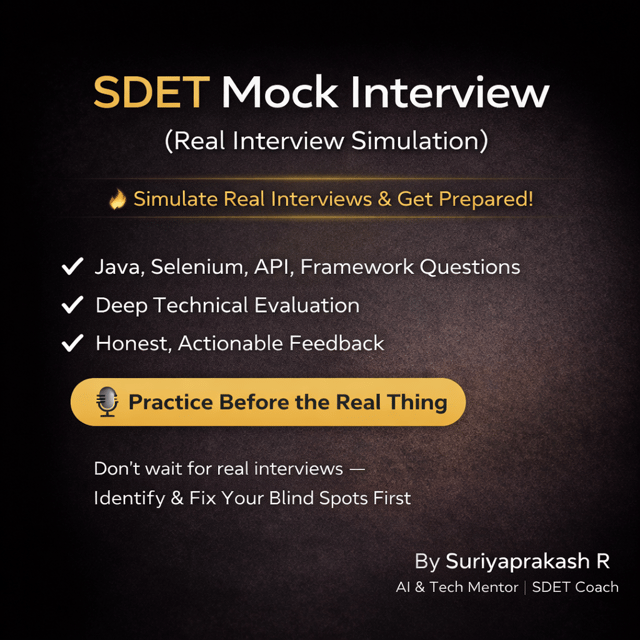

SDET Complete Material + Most Asked Automation Q&A
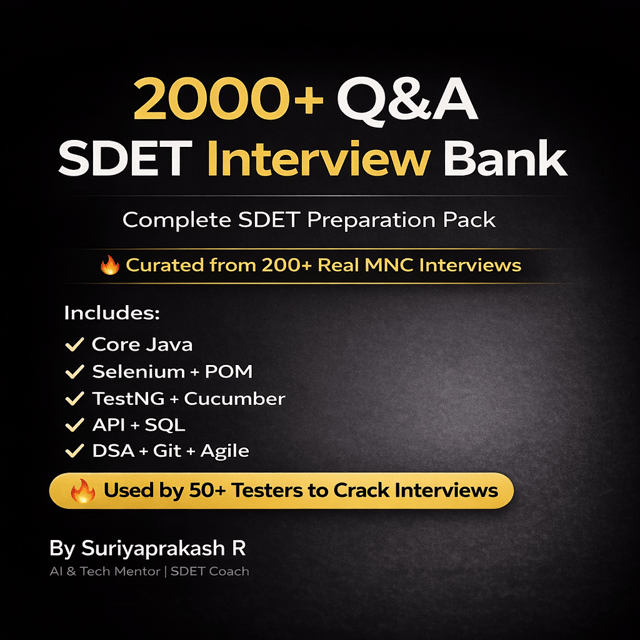
Crack SDET Interview Series — 2000+ Q&A Bank
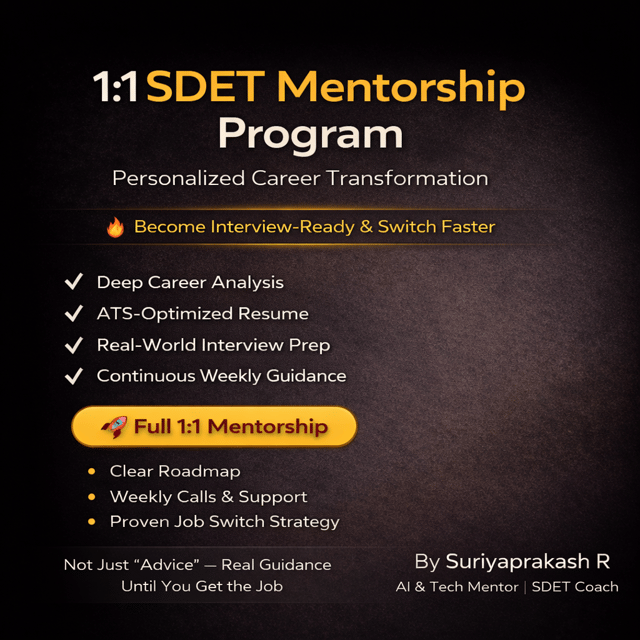
About me
- I am incredibly grateful to surya for his invaluable guidance and support in helping me crack my interview. I highly recommend them to anyone seeking career advice or mentorshipRecommended by Janani on

- Add note...

Frequently asked questions
What is automation testing and manual testing, and which one should I learn first?
Manual testing is when a person manually executes test steps and checks the application against expected behaviour, while automation testing uses scripts and tools to run those checks automatically. Manual testing works best for exploratory, usability and one-time checks, while automation is used for repetitive regression suites, API validation and CI pipelines. When weighing automation testing and manual testing, the practical answer is that teams use both — but in India, most mid-level and senior QA openings expect automation skills, so manual testers benefit most from adding automation first.
What is playwright automation testing, and why are product companies adopting it?
Playwright automation testing is end-to-end testing done with Microsoft's Playwright tool, which automates Chromium, Firefox and WebKit through a single modern API. Its auto-waits, fast execution, built-in trace viewer and strong TypeScript support make tests more stable and easier to debug than older setups, which is why startups and product companies in India are actively hiring for it. For QA engineers, adding Playwright on top of Selenium experience is one of the strongest differentiators in the current SDET market.
What is selenium automation testing, and is it still worth learning?
Selenium automation testing means using Selenium WebDriver, usually with Java, to automate real browsers for functional and regression checks. It is still the most frequently listed requirement in QA and SDET job posts across India and pairs with TestNG, Maven, Cucumber and Jenkins in most company frameworks. So yes — for sheer job volume alone, Selenium remains a safe first automation skill even as newer tools grow around it.
How to learn automation testing as a manual tester with no coding background?
Start with one programming language — Java or Python — then pick one tool such as Selenium or Playwright and go deep instead of hopping between tutorials. The fastest way to learn automation testing is to build a small framework from scratch (page object model, TestNG or Playwright test runner, reporting) on a practice application, because Indian interview panels judge how you apply code, not certificates. Follow it with an ATS-friendly resume, mock interviews and a 30–60 day plan so your learning actually converts into interviews and offers.
How to start selenium automation testing when you only know manual testing?
The practical path to start selenium automation testing is: learn core Java (OOPs, collections, exception handling), then Selenium WebDriver basics like locators, waits and browser handling, then TestNG, and finally a page object model framework with Maven and Git. Practice on demo e-commerce or login applications rather than only watching videos, and push your code to GitHub so recruiters can see it. Once your framework works, rehearse explaining and defending it in mock interviews — that is where most manual testers struggle.
How to start playwright automation from scratch with zero coding experience?
To start playwright automation from scratch, install Node.js and VS Code, get comfortable with basic TypeScript, then learn Playwright fundamentals: locators, assertions, auto-waits and the test runner. Next, structure your tests using fixtures and the page object model, use the trace viewer and inspector for debugging, and finally build a complete E2E framework around a demo application and run it on CI. Thirty minutes of daily hands-on practice on one project will take you further than months of passive tutorial watching.
Which automation testing tools should I learn first to get hired faster?
The automation testing tools with the highest job value in India right now are Selenium with Java (the largest number of openings), Playwright with TypeScript (the fastest growing), plus an API tool like REST Assured or Postman, supported by Git, Jenkins and TestNG. Depth in two tools beats shallow familiarity with ten, so pick Selenium or Playwright as your primary UI tool and add API automation alongside it. Always align your choice with the job descriptions you are actually targeting rather than chasing every new tool.
How to automate API testing when I have only done UI testing so far?
To automate API testing, start with REST fundamentals — methods, status codes, headers, payloads and authentication — then pick REST Assured if you work in Java, or Playwright's API testing and Postman for practice. Automate validations for status codes, response schemas and response times, chain requests using auth tokens, and run your API suite in CI. API automation is one of the fastest gaps to close and comes up in almost every SDET interview because real frameworks rely heavily on it.
How to automate testing with AI as a QA engineer?
The realistic way to automate testing with AI is to treat it as an accelerator: generating test scripts and test data from prompts, creating self-healing locators, summarising defect logs and exploring agentic AI testing flows where AI agents plan and execute checks. However, teams still expect you to review, fix and own the generated code, and interviews increasingly ask how you would use AI responsibly inside your framework. Build your core automation and coding fundamentals first, then layer AI skills on top — that combination is what hiring managers are paying for now.
Which automation testing practice websites are actually useful for getting job-ready?
Useful automation testing practice websites include demo e-commerce applications for end-to-end flows, sites with complex forms and login scenarios, and public APIs for API automation practice. The real differentiator, though, is building your own framework around one of these applications and hosting the code on GitHub, because interviewers value a working project far more than certificates. Pick one practice app, automate a realistic regression suite on it, and be ready to explain every design decision in the interview.
Are paid automation testing courses worth it for manual testers?
Paid automation testing courses are worth it only when they include what self-study rarely delivers: building a real framework from scratch, personalised feedback on your code and resume, mock interviews that simulate real panels, and a structured roadmap with accountability. If you are highly self-disciplined, free resources plus consistent practice can work; most people who stay stuck struggle with consistency and interview conversion, not access to content. Judge any course by outcomes and mentor access, not by the number of hours of recorded videos.
What are the most common automation testing interview questions for SDET roles?
The most common automation testing interview questions cover locator strategies and XPath, the difference between implicit and explicit waits, handling dynamic elements and stale element exceptions, TestNG annotations, page object model design, framework architecture, data-driven testing, Git basics and CI/CD, plus a live Java or Python coding round. Panels also ask scenario-based questions like "how would you handle a flaky test?" and expect you to walk through your own project end to end. Preparing from a structured Q&A bank and rehearsing answers aloud makes a bigger difference than reading more theory.
How to explain selenium automation framework in an interview?
The cleanest way to explain selenium automation framework in an interview is to follow a story: why the framework exists, its architecture (page objects, base classes, utilities, config), its key features (explicit waits, data-driven testing with external files, reporting, parallel execution, CI integration), and one real challenge you solved such as flaky tests or dynamic elements. Keep the core explanation to about two minutes and expect follow-ups on waits, stale element exceptions and design decisions. Practising this narration out loud matters as much as knowing the code itself.
How do I prepare for playwright automation interview questions without real-time project experience?
Build at least one small Playwright end-to-end project on a demo application — a self-created project counts — because most playwright automation interview questions around auto-waits, locators, fixtures, page object model and the trace viewer can only be answered confidently from hands-on work. Also prepare clear talking points on how Playwright compares with Selenium and when you would choose each. Be honest about your experience level, show your GitHub project, and demonstrate understanding through your explanations — panels consistently prefer demonstrable knowledge over claimed years of experience.
How do I move from manual testing into automation testing jobs?
Manual testers move into automation testing jobs by combining four things: one language and one UI tool learned deeply, an API automation skill, a from-scratch framework project on GitHub, and an ATS-optimised resume that highlights the automation keywords recruiters search for. A focused 30–60 day plan alongside your current job is usually enough to become interview-ready, followed by targeted applications, referrals and mock interviews. Companies hire for proof that you can automate, so your project and framework explanation matter more than your years of manual experience.