Testimonials
Services
🚀 Java Success Blueprint for SDETs (FREE)
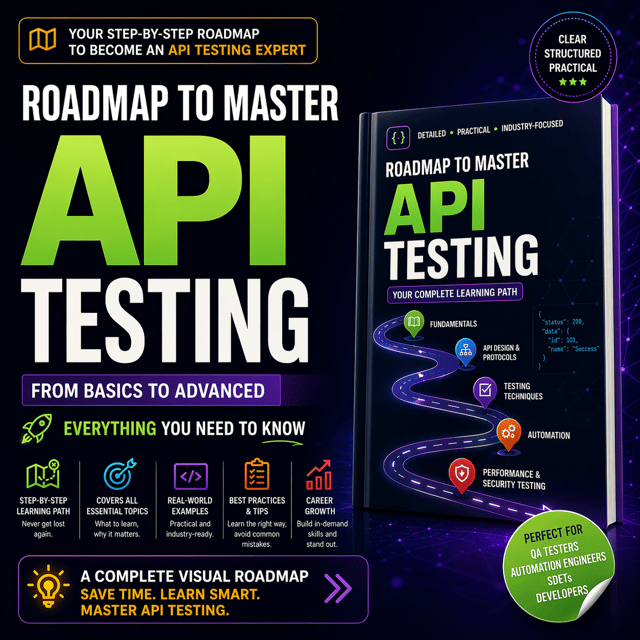
FREE API Testing Roadmap


Master Playwright the Right Way (2026 Roadmap)


Mastering Git & GitHub for SDETs
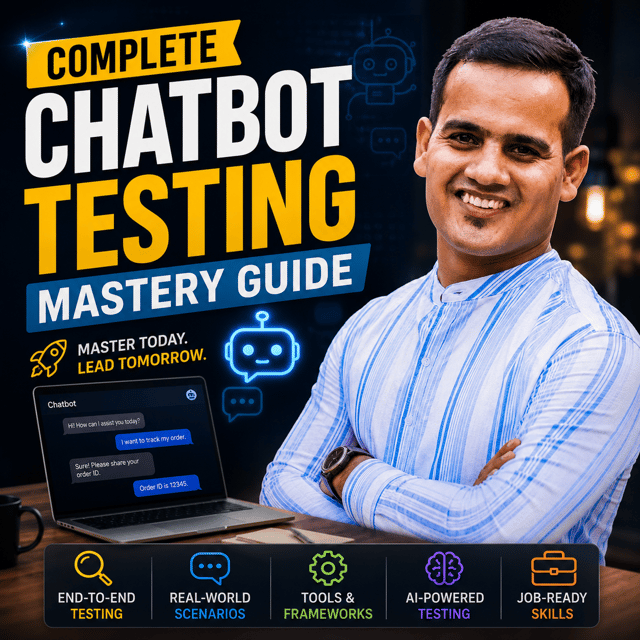
Complete Chatbot Testing Mastery Guide
Ace Your Interview: Preparation & Tips for Success

AI Fundamentals Cheat Sheet for SDETs
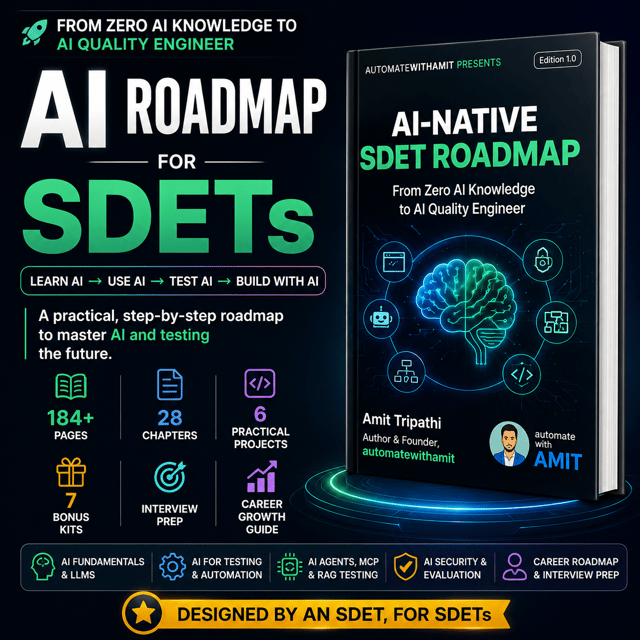
The AI-Native SDET Cohort
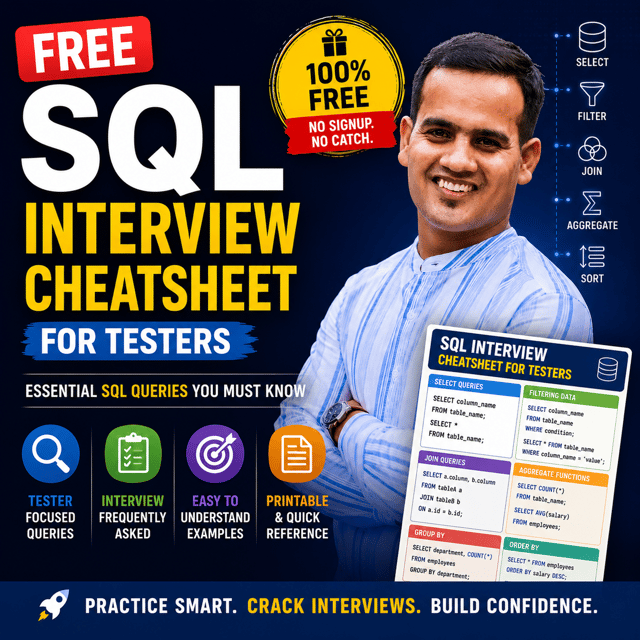
Free SQL Interview Cheatsheet for Testers

Top 10 SDET Interview Questions ( FREE For You )

SDET Career Accelerator Kit 🚀
SQL That Cracks QA & SDET Interviews
Priority DM: Expert Guidance Made Easy
1:1 Call: Personalized Guidance & Expert Solutions
About me
- Youtube Channelhttps://www.youtube.com/@automatewithamit

- Amit Tripathi is praised for his insights, knowledge, and approachable nature, providing clear guidance in Automation Testing.
 AI-generated based on testimonials
Frequently asked questions
What is automation testing in software testing?
Automation testing is the practice of using scripts, tools, and frameworks to execute test cases automatically instead of manually clicking through an application. A tester writes code, commonly in Java, Python, or C#, that opens the application, performs actions, verifies results, and reports failures on its own. It is mainly used for repetitive checks such as regression, smoke, and API testing, helping Indian IT services and product companies release faster with fewer defects. Popular tools include Selenium, Playwright, Rest Assured, and Cypress.
What is the difference between automation testing and manual testing?
In manual testing, a tester checks the application by hand — opening screens, entering data, and comparing actual results against expectations. In automation testing, the same checks are executed by scripts that run faster, can be reused across releases, and handle repetitive regression suites effortlessly. Manual testing is better for exploratory, usability, and one-time scenarios, while automation wins for stable, high-volume test cases. Most Indian companies expect testers to do both and gradually shift repetitive work to automation.
How to learn automation testing as a complete beginner?
Start with one programming language, Java or Python, and build basic coding logic before touching any tool. Then learn manual testing fundamentals, pick Selenium or Playwright for UI automation, learn API testing with Postman and Rest Assured, and finally study framework design with TestNG or pytest, Git, and CI/CD basics like Jenkins. Practice on live demo applications, build two or three small frameworks on GitHub, and prepare with mock interview rounds. Followed consistently for four to six months, this roadmap makes you job-ready for automation testing roles in India.
How to automate testing with AI?
AI is now used across the testing lifecycle: generating test cases from user stories, drafting Selenium or Playwright scripts with tools like ChatGPT and GitHub Copilot, self-healing locators that fix themselves when the UI changes, and visual testing that detects UI anomalies automatically. Emerging workflows like Playwright MCP even let AI agents drive a real browser and generate test scripts by observing the screen. The practical approach is to let AI draft cases and code, then review and refine them manually, since plain AI output still needs human validation.
How to automate API testing using Rest Assured and Postman?
First understand requests, responses, status codes, headers, and authentication, then pick your tool: Postman for quick collections and Newman for command-line runs, Rest Assured with Java or RestSharp with .NET for code-based frameworks. A typical suite validates status codes, response fields, headers, response times, and negative cases like invalid inputs or expired tokens. Finally, integrate the suite into CI/CD so APIs are tested on every build. API automation is one of the fastest-growing skills in India because it is fast, stable, and easier to maintain than UI automation.
What is Selenium testing?
Selenium testing means using the Selenium toolset to automate web browsers and verify that web applications behave correctly. Testers write scripts in languages like Java, Python, or C# that instruct the browser to click buttons, fill forms, navigate pages, and assert expected outcomes. Because Selenium is free, open source, and works across all major browsers, it is the most widely used UI automation tool in India's IT industry, and Selenium skills appear in a large share of QA and SDET job descriptions.
What is Selenium WebDriver and how to use Selenium WebDriver for automation testing?
Selenium WebDriver is the core component of Selenium that directly controls a real browser, such as Chrome, Firefox, or Edge, by sending commands through the browser's driver. To use it, create a project in Java or Python, add the Selenium dependency, launch a WebDriver instance, navigate to a URL, locate elements using IDs, CSS selectors, or XPath, perform actions like click and type, and wrap your checks in assertions. In real projects, WebDriver is combined with a framework like TestNG and a build tool like Maven to keep tests organized and scalable.
What are the most common Selenium interview questions for freshers?
Fresher-level interviews usually cover Selenium architecture and WebDriver basics, locators and building robust XPath, types of waits and handling dynamic elements, handling pop-ups, frames, and dropdowns, differences between close() and quit(), stale element exceptions, and running tests in parallel or across browsers. A small coding round is also common, such as automating a login flow or solving a string or array problem. Explaining a framework you built yourself, even a small one pushed to GitHub, usually creates the strongest impression.
What are the frequently asked automation testing interview questions?
Beyond tool-specific questions, interviewers commonly ask about the difference between manual and automation testing, when to automate and when not to, how you would design a framework from scratch, handling flaky tests, API testing concepts, version control with Git, and CI/CD integration with Jenkins. Scenario-based questions such as "your regression suite takes five hours, how would you optimize it?" are frequent for SDET roles. Preparing two or three real project stories and practising mock interviews significantly improves your chances in Indian service and product company interviews.
What is Playwright automation?
Playwright is a modern open-source browser automation framework from Microsoft used for end-to-end testing of web applications. It supports Chromium, Firefox, and WebKit through a single API, works with TypeScript, Python, Java, and .NET, and ships with features testers appreciate: auto-waiting, built-in parallel execution, network interception, tracing, and rich HTML reports. Indian product companies and startups increasingly adopt Playwright for new projects because it is faster and less flaky than older setups, making it a strong complementary skill after Selenium.
Playwright vs Selenium: which one should I learn for a testing career in India?
Both are excellent, and the right choice depends on your goal. Selenium has the larger job market in India, supports more programming languages, and is deeply embedded in enterprise frameworks, so it remains the safest first skill. Playwright is newer, faster, less flaky, and increasingly demanded by product companies, handling modern web apps, iframes, and shadow DOM more gracefully. A practical approach for 2025–2026 is to master Selenium with Java for the widest opportunities, then add Playwright to stand out, since many SDET job descriptions now list both.
What is Playwright MCP and how to use Playwright MCP with AI tools?
Playwright MCP (Model Context Protocol) is a server that lets AI assistants like Claude or Cursor control a real browser through Playwright. After adding the Playwright MCP package (npx @playwright/mcp) to an MCP-compatible client's configuration, the assistant can open pages, click, fill forms, take snapshots, and even generate test scripts by observing the browser. This means you can describe test steps in plain English and get working browser automation in return. It has quickly become one of the most talked-about AI plus automation testing workflows.
Which automation testing tools should I learn first?
A high-demand stack for the Indian market looks like this: one language (Java or Python), Selenium or Playwright for UI automation, Postman plus Rest Assured for API testing, TestNG or pytest for structuring tests, Maven or pip for builds, Git and GitHub for version control, and Jenkins or GitHub Actions for CI/CD. Add JIRA for defect workflows and, later, JMeter for performance basics. Mastering this core set covers most automation testing job postings, while niche tools like Cypress, Appium, or Katalon can be layered on based on the roles you target.
Are automation testing courses worth it for getting automation testing jobs in India?
A well-structured course can genuinely speed things up, especially if you are switching from manual testing or from a non-CS background, because it saves you from piecing together random tutorials. However, certificates alone rarely fetch interviews in India; recruiters shortlist based on demonstrable skill — a strong GitHub portfolio, live framework projects, and clear interview communication. If you join an automation testing course, pick one with hands-on projects, framework design, API testing, and mentor or doubt-clearing support rather than only recorded videos. Self-learning with a disciplined roadmap works equally well; consistency matters more than the medium.
Which are the best automation testing practice websites?
Popular safe playgrounds include demo e-commerce and banking applications like SauceDemo, DemoQA, ParaBank, the-internet (Herokuapp), and OrangeHRM's live demo, which let you practise forms, logins, tables, alerts, and frames without legal issues. For API practice, public test APIs like Reqres and JSONPlaceholder work well, and for framework practice, automate a complete journey such as search, add to cart, and checkout. Pushing this practice code to GitHub gives you real talking points for interviews, which matters more than the site names themselves.