Testimonials
Services
Clinical Data Management Career Guide
CRA Career Guide
TMF Manager Career Guide
The Centralized Monitor Career Guide
Medical Writer ATS Resume Template Pack
Statistical Programmer Career Guide
Medical Writer Career Guide
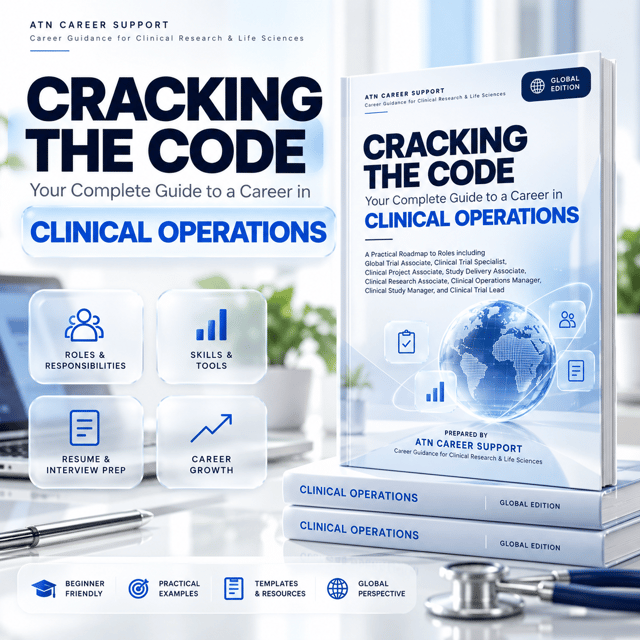
Clinical Operations Career Guide
Pharmacovigilance Career Guide
Clinical Data Management ATS Resume Template Pack
Comprehensive Resume Audit & Review
About me
Frequently asked questions
How to get a clinical data management job in India?
Start with a life sciences, pharmacy, nursing, or biotechnology background, since most employers prefer these degrees. Learn the clinical trial process, ICH-GCP guidelines, and the basics of data entry, data cleaning, query resolution, and EDC systems. Build a role-specific, ATS-friendly resume that mirrors the language used in clinical data management job postings, then apply for entry-level titles like Clinical Data Management Associate or Data Review Associate at CROs, pharma companies, and healthcare IT firms in hubs like Pune, Hyderabad, and Bangalore. Networking on LinkedIn and understanding what hiring managers actually screen for makes a big difference at the entry stage.
Are there clinical data management jobs for freshers in India?
Yes. CDM is one of the more fresher-friendly areas in clinical research because companies regularly hire B.Pharm, M.Pharm, life science, and nursing graduates at the associate level. Common entry roles include Clinical Data Management Associate, Data Entry Specialist, and Data Review Associate, and most openings are concentrated in Pune, Hyderabad, Bangalore, and Mumbai. Freshers who understand the data management lifecycle, basic medical terminology, and EDC concepts tend to clear interviews much faster than candidates who apply with a generic resume.
How to learn clinical data management?
Begin with the fundamentals: phases of clinical trials, GCP guidelines, roles in a clinical trial, and the data management lifecycle, including CRF design, data validation, query resolution, and database lock. You can learn these through online certificate programs, postgraduate diplomas, or structured career guides created by people with hands-on industry experience. Practical familiarity with EDC tools and medical terminology matters more than collecting multiple certificates, so focus on how the job is actually done day to day. Entry-level CDM roles also provide strong on-the-job learning once you get in.
What is the clinical data management salary in India?
The clinical data management salary in India for freshers typically falls between ₹3 and ₹4.5 LPA, depending on the city, company type, and how well you understand CDM concepts at the interview stage. With 3–5 years of experience, professionals usually earn in the range of ₹6–10 LPA, and leads or managers with 8+ years of experience can go well beyond that. CROs, pharma companies, and healthcare IT firms may offer different bands, so compare roles carefully rather than going by title alone.
How much are clinical data management course fees in India?
Clinical data management course fees in India generally range from about ₹20,000 to ₹1,00,000, depending on the institute, duration, and whether the program includes placement assistance. Short certificate programs sit at the lower end, while postgraduate diplomas cost more. Before paying, check whether the syllabus covers practical topics like EDC systems, data validation, and query handling, and whether it maps to actual CDM job descriptions — a course that teaches only theory rarely helps in interviews. Self-study through industry-based career guides is a much cheaper alternative for understanding the role.
What does a clinical research associate do?
A clinical research associate, also called a monitor, is the sponsor's representative at clinical trial sites. Core responsibilities include conducting site initiation, interim monitoring, and close-out visits; performing source data verification; checking informed consent and protocol compliance; managing site queries; and reporting study progress to the sponsor. The role involves significant travel and acts as the communication bridge between the sponsor and the investigators, which is why it is one of the most sought-after field roles in clinical research in India.
How to become a clinical research associate in India?
The usual path is a degree in pharmacy, life sciences, nursing, or medicine, followed by 1–2 years of entry-level experience in clinical research — for example as a clinical trial coordinator, clinical trial assistant (CTA), or in pharmacovigilance or clinical data management. From there, candidates move into CRA roles with CROs or pharma sponsors. Strong knowledge of ICH-GCP, source data verification, and site management, along with a resume tailored to monitoring roles, is what recruiters typically shortlist for.
What is the clinical research associate salary in India?
The clinical research associate salary in India for entry-level CRAs is typically around ₹3.5–5.5 LPA, though many professionals reach this role only after 1–2 years in positions like CTA or site coordinator, which start lower. Experienced CRAs with 3–5 years of monitoring experience commonly earn ₹8–15 LPA, and senior or lead CRAs can earn more. Salaries vary notably between CROs and sponsor companies, and roles requiring extensive travel or specialty therapy experience often pay at the higher end.
How to get a clinical research associate certification in India?
There is no single mandatory certification to become a CRA in India, but relevant credentials do help. Options include postgraduate diplomas or certificate programs in clinical research offered by universities and private institutes, along with ICH-GCP training, which is essential and available as a certificate course online. Some professionals also pursue SOCRA or ACRP certifications, which are internationally recognized and useful for global roles. In practice, a relevant degree plus GCP training plus hands-on clinical experience carries more weight with Indian employers than any standalone certificate.
How to get a pharmacovigilance job after B Pharmacy?
B Pharmacy is one of the most common entry routes into pharmacovigilance in India. Start by learning the basics: adverse event reporting, individual case safety reports (ICSRs), MedDRA coding, and key ICH and GVP guidelines. Then apply for entry-level roles like Pharmacovigilance Associate or Drug Safety Associate at CROs, pharma companies, and healthcare BPOs — Pune, Mumbai, and Hyderabad have the largest concentration of these jobs. An ATS-friendly resume that uses the exact terminology from PV job descriptions, plus clear answers on case processing during interviews, will put you ahead of most B.Pharm applicants.
Is pharmacovigilance a good career in India?
For most pharmacy and life science graduates, yes. Pharmacovigilance offers steady demand because drug safety monitoring is a regulatory requirement for every marketed drug and ongoing clinical trial. The career ladder is clear — associate, senior associate, drug safety specialist, then manager — and there are options to specialize in areas like signal detection, risk management, medical writing, and regulatory submissions. Entry is competitive and starting salaries are modest, but the long-term stability, structured growth, and option to move into related areas like regulatory affairs or clinical data management make it a solid choice.
What is the pharmacovigilance salary in India for freshers?
The pharmacovigilance salary in India for freshers typically ranges from ₹2.5 to ₹4 LPA, depending on the city and whether you join a CRO, a pharma company, or a healthcare BPO. With 3–5 years of experience, professionals generally earn ₹5–8 LPA, and pharmacovigilance managers with 8+ years of experience often cross ₹12 LPA. Night-shift or split-shift roles supporting global safety databases sometimes pay slightly higher than standard day roles.
Are there work from home pharmacovigilance jobs in India?
A few exist, but they are limited. Most pharmacovigilance roles in India are office-based because case data is confidential and companies follow strict data-integrity and audit requirements. That said, some CROs and global safety teams offer hybrid or fully remote arrangements, especially in case processing, medical review, and quality control, and these are usually marked as "remote" or "hybrid" on job portals. Be cautious of anyone charging a fee to arrange a work from home pharmacovigilance job — legitimate employers never ask candidates to pay.
Which cities in India have the most clinical data management and pharmacovigilance jobs?
Pune leads for both functions because many global CROs run large data and safety operations there. Clinical data management jobs in Pune are concentrated around the IT parks where CROs and healthcare IT companies operate, and the same offices hire for pharmacovigilance as well. Hyderabad and Bangalore are the other major hubs, while pharmacovigilance jobs in Mumbai are strong due to the presence of pharma headquarters and safety operations there. Freshers generally get more interview calls in these four cities than anywhere else in India.
How do I make my resume ATS-friendly for clinical research and pharma jobs?
Keep the format simple: standard section headings like Summary, Skills, Work Experience, and Education; no tables, graphics, columns, or photos; and a clean, readable font. More importantly, mirror the exact keywords from the job description — for example, "case processing," "MedDRA," "EDC," "query resolution," or "source data verification" — because ATS software and recruiters filter resumes based on role-specific terms. Describe your experience with numbers where possible, keep it to one or two pages, and tailor it for each role type; a CDM resume and a pharmacovigilance resume should never look identical. Getting it reviewed by someone who understands how these applications are actually screened can quickly reveal what is getting yours filtered out.