Services
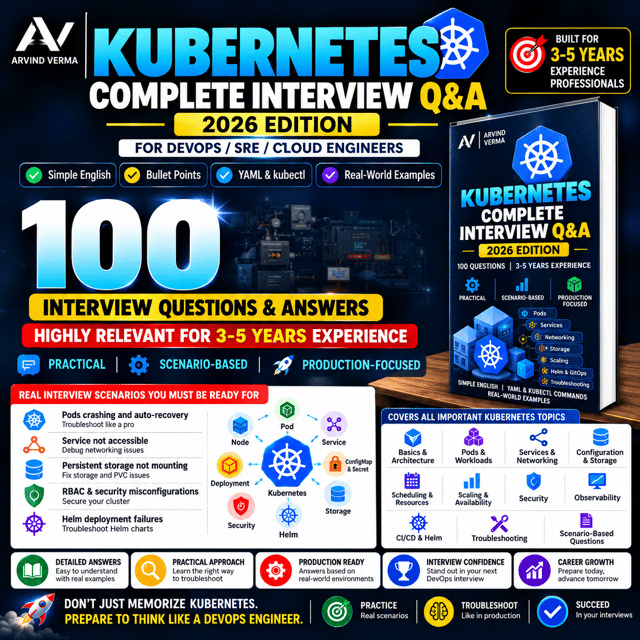
Kubernetes Complete Interview Q&A | 2026 Edition
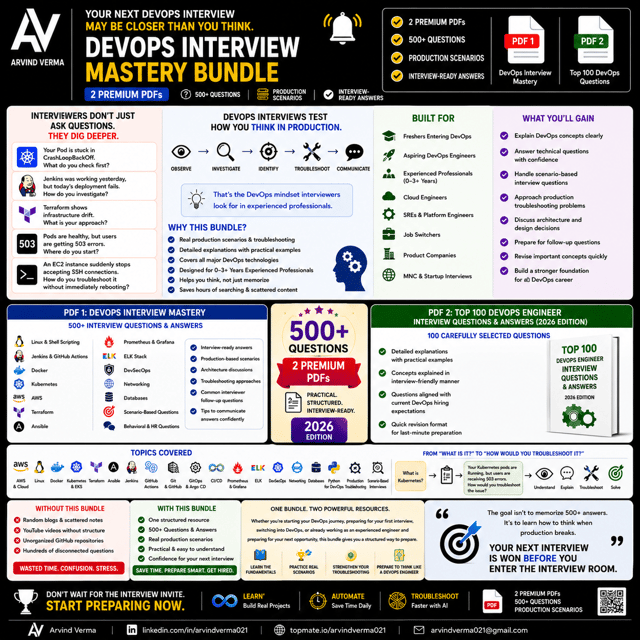
DevOps Interview Mastery Bundle | Freshers to Pro
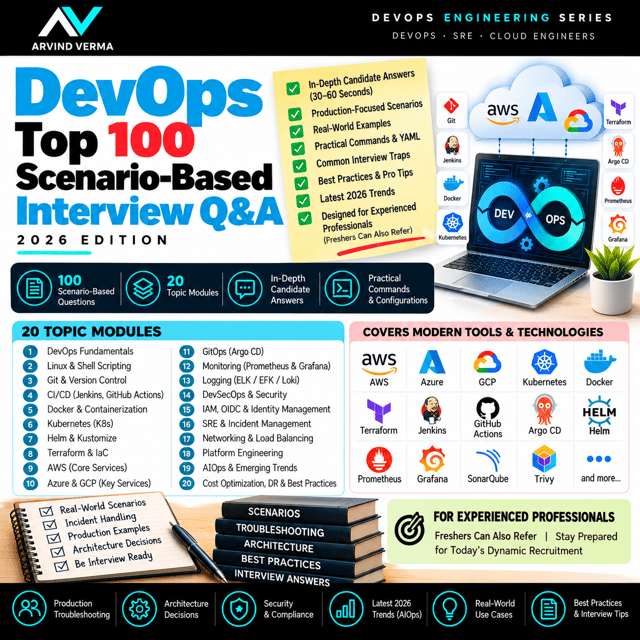
DevOps Top 100 Scenario-Based Interview Q&A 2026
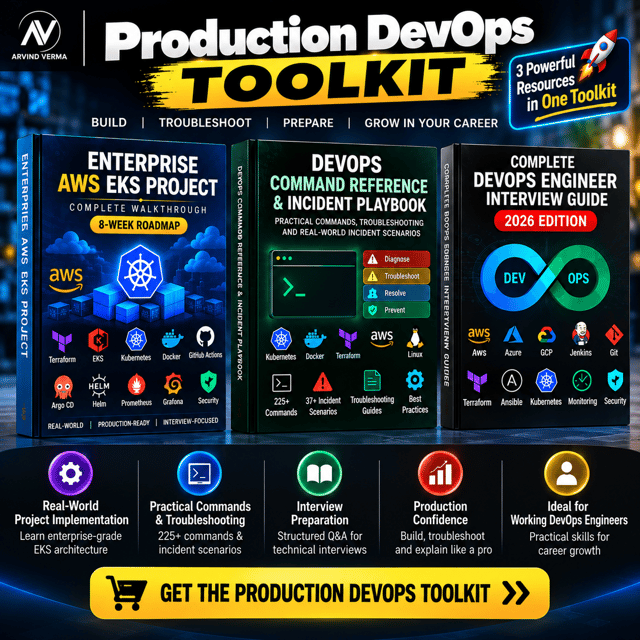
Production DevOps Toolkit: EKS + Troubleshooting
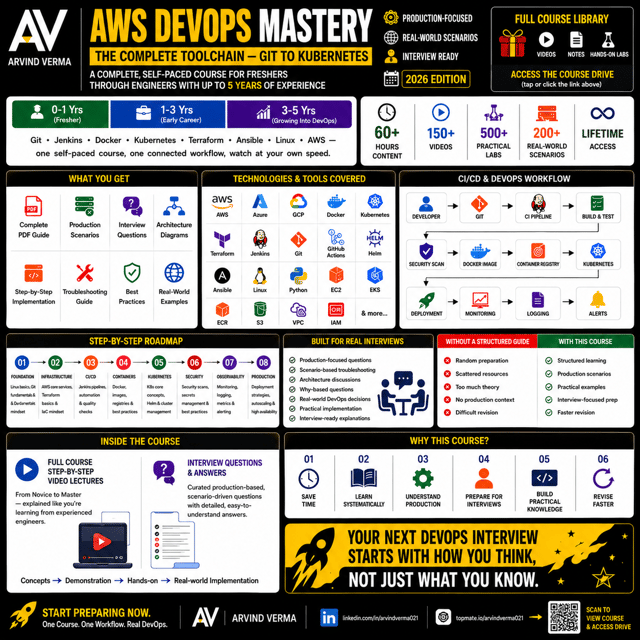
AWS DevOps Full Course | Git to Kubernetes
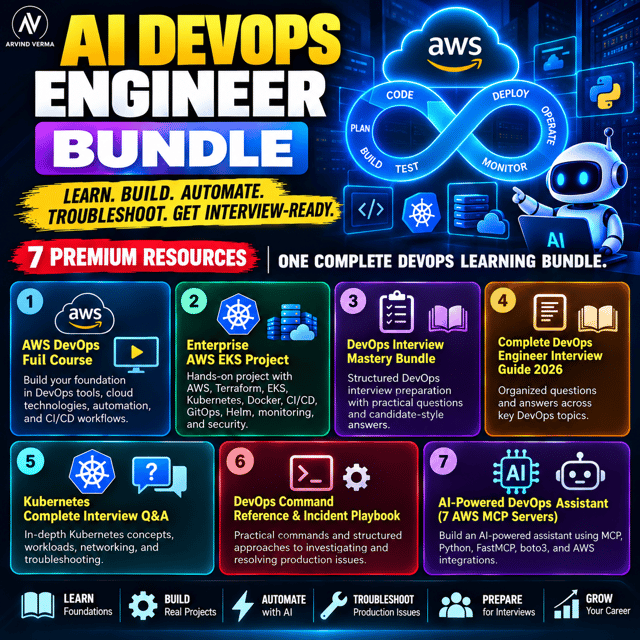
AI DevOps Engineer Bundle
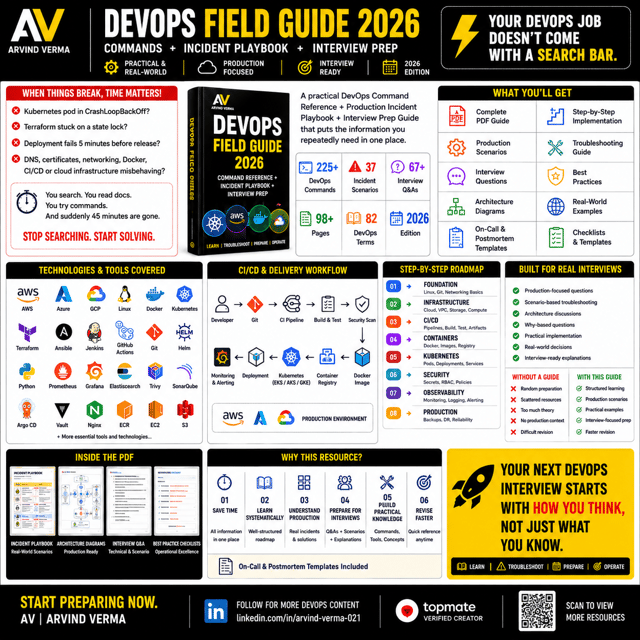
DevOps Command Reference & Incident Playbook
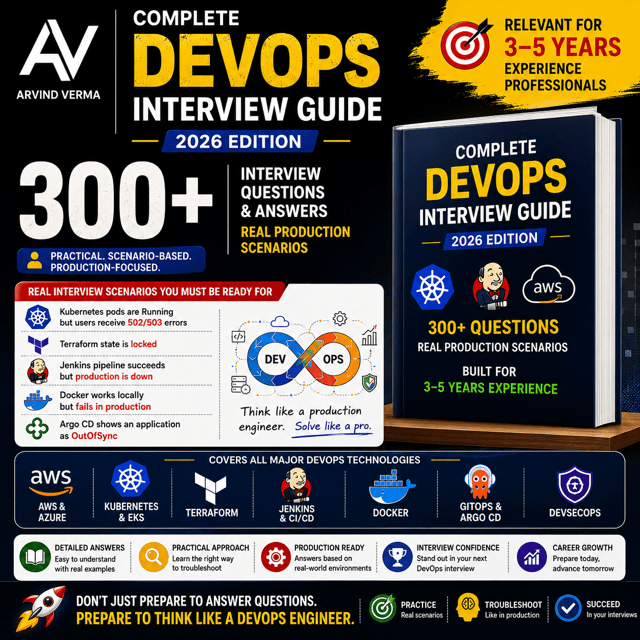
DevOps Interview Guide 2026 | 300+ Ques |3–5 Years
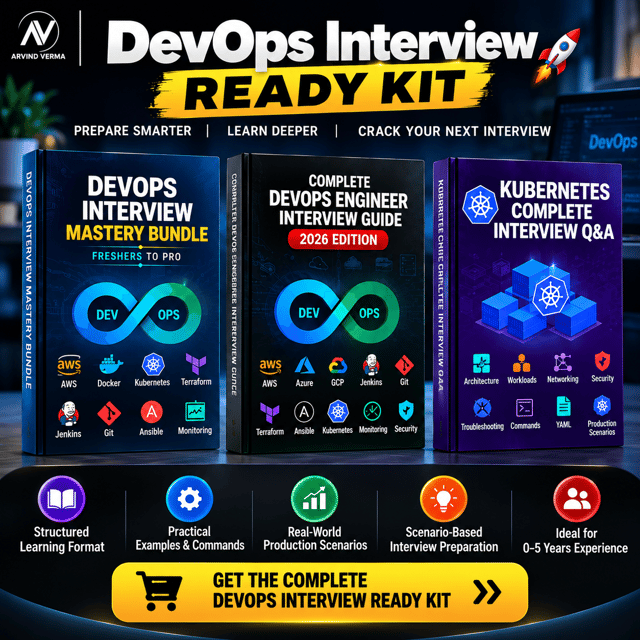
DevOps Interview Ready Kit | 2026
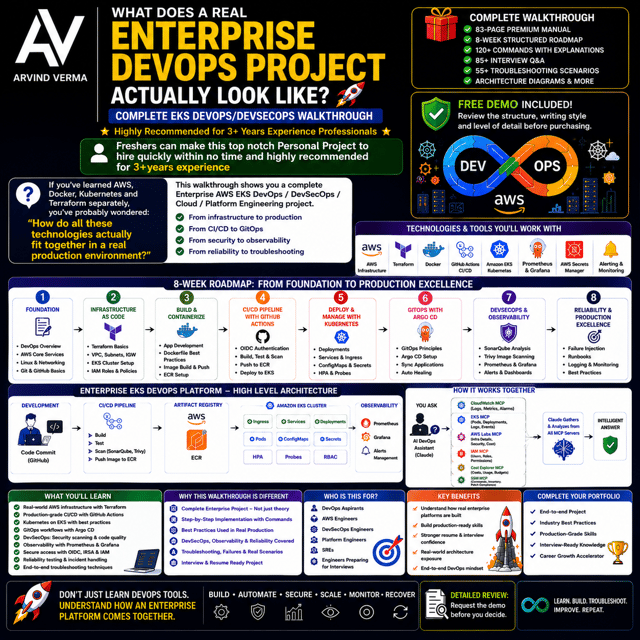
Enterprise AWS EKS DevOps Project | 8-Week Roadmap
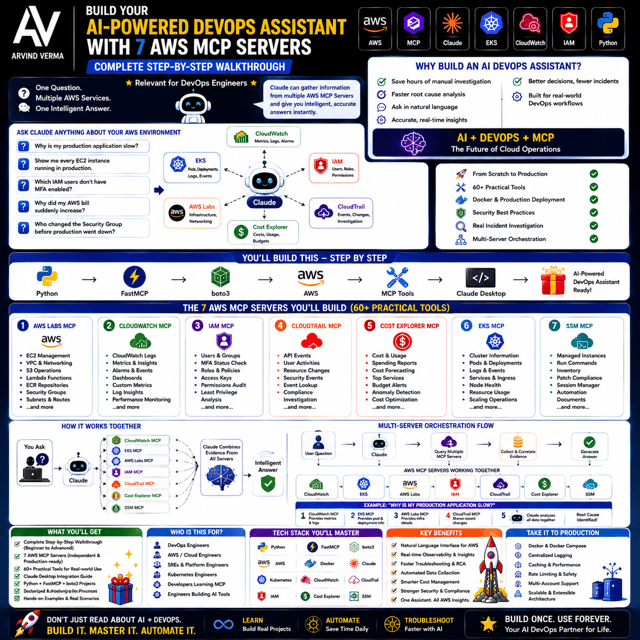
AI DevOps Assistant with 7 AWS MCP Servers
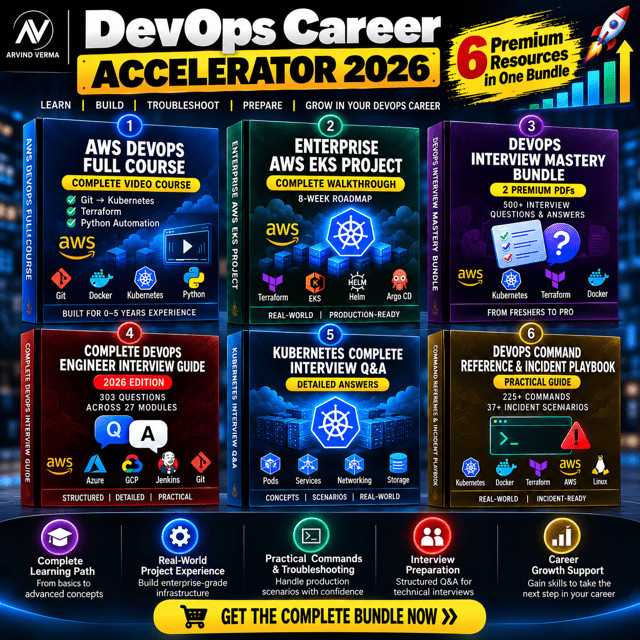
DevOps Career Accelerator 2026
About me
Frequently asked questions
What are the most common DevOps interview questions and answers for freshers?
Fresher-level DevOps interview questions and answers usually stay close to fundamentals: what DevOps is and why it exists, CI/CD basics, containers vs virtual machines, everyday Docker commands, core Kubernetes objects (pod, deployment, service), Git workflows, and simple Linux or shell tasks. Expect one or two light scenario questions, such as how you would roll back a bad deployment. Interviewers check whether you actually understand concepts rather than memorize definitions, so build one small end-to-end project — even a basic app deployed with Docker and a simple pipeline — and be ready to walk through it. A structured path like the DevOps Interview Mastery Bundle (freshers to pro) helps you prepare in the right order instead of hopping between random topics.
What are the most asked DevOps interview questions for 3 years experience?
DevOps interview questions for 3 years experience focus on depth plus real troubleshooting: designing a CI/CD pipeline end to end, Dockerfile optimization, Kubernetes issues like CrashLoopBackOff, ImagePullBackOff and OOMKilled, Terraform state handling, Jenkins declarative pipelines, and AWS fundamentals such as VPC, subnets, security groups and IAM roles. Scenario questions dominate at this level — think "a production deployment failed at 2 a.m., what do you check first?" Be ready to explain the why behind decisions in your own projects, because interviewers probe reasoning, not just tool names.
How do I prepare for DevOps interview questions for 5 years experience?
DevOps interview questions for 5 years experience move from tool usage to design and ownership. Expect architecture discussions — multi-environment setups, scaling Kubernetes, blue-green vs canary deployments, disaster recovery, cost optimization on AWS, and security in pipelines — along with questions about incidents you have led and juniors you have mentored. Prepare two or three detailed stories with measurable outcomes, and practise defending your architecture choices against "what if" follow-ups, which is where senior interviews are won or lost.
Where can I find scenario-based DevOps interview questions and answers for experienced candidates?
You will find scenario-based DevOps interview questions and answers for experienced candidates in curated interview guides, GitHub repositories, and discussion threads on Reddit and Stack Overflow. The most valuable ones walk through situations like failed production deployments, flaky pipelines, expired certificates, node failures and database connectivity issues — with the reasoning explained, not just commands. Whatever source you use, attempt each scenario in writing first; reading answers alone rarely survives a live interview round.
What are the top AWS DevOps interview questions?
AWS DevOps interview questions typically cluster around six areas: core services (EC2, VPC, S3, IAM, RDS), CI/CD tooling (CodePipeline, CodeBuild, Jenkins, GitHub Actions), containers (Docker, ECS vs EKS), Infrastructure as Code (CloudFormation vs Terraform), monitoring with CloudWatch, and deployment strategies such as blue-green, canary and rolling updates. Cost-optimization questions come up constantly, so have a real example of how you kept an AWS bill under control. Anchor every answer to a project you have actually built.
What are the most asked Azure DevOps interview questions?
Azure DevOps interview questions usually cover classic vs YAML pipelines, agent pools and self-hosted agents, service connections and permissions, Azure Artifacts and feeds, Boards for work tracking, and branch policies in Azure Repos. Since many Indian IT service companies run their delivery on Azure DevOps, prepare for questions on migrating pipelines from Jenkins and managing environment approvals across teams. Creating a free Azure DevOps organization and building one real pipeline makes these answers far more convincing.
Where can I get a DevOps interview questions and answers PDF?
Free DevOps interview questions and answers PDF files are easy to find through a quick search and on interview-prep sites — the catch is that most are scattered, outdated, or list questions without solid answers. A better option is a structured, regularly updated guide such as Arvind Verma's DevOps Interview Guide 2026, which compiles 300+ questions with answers for the 3–5 year experience range. Whichever PDF you pick, use it actively: answer each question on paper first, then compare with the model answer.
How to become an AWS DevOps engineer?
The practical path: get solid with Linux and networking, learn Git properly, understand AWS core services deeply, then add Bash/Python scripting, Docker, Kubernetes, Terraform and one CI/CD tool like Jenkins or GitHub Actions. Build two or three real projects — ideally one that deploys a containerized application to EKS through a complete pipeline — because projects, not certificates, dominate interviews. A guided roadmap like the Enterprise AWS EKS DevOps Project (8-week plan) gives you a concrete, portfolio-ready project. Certifications help later, once the hands-on fundamentals are in place.
What is the average AWS DevOps engineer salary in India?
AWS DevOps engineer salary in India varies with experience and company type, but typical ranges look like this: freshers roughly ₹4–8 LPA, engineers with 3–5 years of experience around ₹10–22 LPA, and senior engineers or leads ₹25–40+ LPA. Product companies and funded startups generally pay more than service firms, and cities like Bengaluru, Hyderabad, Pune and NCR offer the highest packages. Skills that push you into the top band include EKS, Terraform at scale, DevSecOps and cost optimization.
How to get AWS DevOps certification?
To get AWS DevOps certification, target the AWS Certified DevOps Engineer – Professional exam: book it through the official AWS certification portal (conducted via Pearson VUE), pay the exam fee, and prepare across its domains — SDLC automation, configuration management and IaC, monitoring and logging, incident and event response, and security and compliance. There is no mandatory prerequisite exam, but going in with 1–2 years of hands-on AWS experience, ideally after clearing the Solutions Architect Associate level, makes the Professional exam far more manageable.
What is AWS DevOps Agent?
AWS DevOps Agent is an AI-powered service from AWS that works like an on-call assistant for your infrastructure. You connect it to your AWS environment and observability data, and when an alarm fires or an incident begins, it investigates — correlating metrics, logs and recent changes to produce a root-cause analysis with suggested remediation steps. It reflects the larger shift towards agentic AI in operations, where engineers supervise AI agents that handle first-response investigation. Experimenting with a custom AI DevOps assistant built on AWS MCP servers is a good way to understand how these systems work under the hood.
What is the best Kubernetes tutorial for beginners?
The best Kubernetes tutorial for beginners is one that gets you typing commands in the very first session instead of drowning you in theory. Look for a flow that starts with Docker basics, then moves through pods, deployments, services, ConfigMaps and Secrets on a local cluster like minikube or kind, and finishes with you deploying a real application end to end. Project-based tutorials beat isolated YAML demos because they show why each object exists — concepts stick when you deploy an actual workload, not when you only read definitions.
Should I learn Docker before Kubernetes?
Yes — learn Docker first. Kubernetes orchestrates containers, so every core concept there (pods, images, deployments) assumes you already understand containerization. A well-designed Docker and Kubernetes tutorial always follows this order: build and run images, manage volumes and networking, write a Dockerfile, and only then move to pods, services and deployments. Attempting Kubernetes without Docker is technically possible but painfully confusing — like studying traffic control before learning what a car is.
Is Kubernetes free for commercial use?
Yes, Kubernetes is free for commercial use. It is an open-source project governed by the Cloud Native Computing Foundation, so you can run it on your own servers or VMs and operate a business on it without paying any licence fee — your real costs are the infrastructure underneath and the people managing it. Managed services like Amazon EKS, Azure AKS and Google GKE charge a control-plane fee, but that pays for convenience and operations, not for permission to use Kubernetes commercially.
Can I get a job after completing an AWS DevOps course?
An AWS DevOps course can absolutely make you employable, but only if it is project-driven. Recruiters in India shortlist on demonstrable work — a Git-to-Kubernetes pipeline, an EKS deployment, Terraform-managed infrastructure — so choose an AWS DevOps course that ends with documented, real projects, then pair it with a strong GitHub profile and a tailored resume. A course watched passively rarely converts into offers; a course plus portfolio usually does. Arvind Verma's AWS DevOps Mastery course, for instance, follows exactly this structure, taking learners from Git fundamentals to Kubernetes deployment on AWS.