Testimonials
Services
Internships 2026 Are LIVE list
30-Minute Career Guidance call
Complete ATS Resume & Job Strategy Kit 2026
About me
Frequently asked questions
What is job interview preparation and when should freshers start it?
Job interview preparation is the process of getting ready for every stage of hiring — aligning your resume with the role, researching the company and its products, practising common questions, and improving how you communicate your projects. For freshers, it works best when it starts before applying, not after an interview is scheduled, because shortlisting depends heavily on how well your resume matches the job description. Ideally, give yourself one to two weeks of focused practice before the actual interview.
How is interview preparation for freshers different from preparation for experienced candidates?
Interviewers evaluate freshers on fundamentals, trainability, and projects rather than past job results, so the focus should be on core subjects, academic or personal projects, internships, and certifications instead of work achievements. Experienced candidates are probed on past roles and metrics, while freshers are probed on concepts, learning ability, and communication. That is why freshers gain more from practising project explanations and basics than from corporate-style achievement stories.
What are the most common interview questions and answers freshers should prepare?
Almost every fresher round covers "Tell me about yourself", your strengths and weaknesses, why you want to join that company, a walk-through of your best project, and HR questions on relocation, salary expectations, and career goals. Prepare each answer in a clear 60–90 second structure — context, what you did, and the result — and practise saying it aloud instead of memorising it word for word. Customise "why this company" for every interview, since generic answers are one of the most common rejection reasons.
Do I need to join an interview preparation course as a fresher?
Not necessarily. If you are disciplined, question banks, company interview experiences, and free practice material are enough for many candidates. A structured course or mentor makes sense when you keep getting rejected after interviews, struggle to structure your answers, or have no one to give honest feedback. Whatever you choose, judge it on whether it includes live mock sessions and personalised feedback — recorded videos and PDFs alone rarely fix weak answers.
Are interview preparation classes near me better than preparing online?
Offline classes near you give a fixed schedule and classroom discipline, but quality varies a lot by city and batch sizes are often too big for personal attention. Online preparation lets you do 1:1 sessions with mentors from any city, at flexible times, and often at a lower cost — which is why many freshers in tier-2 and tier-3 cities now prepare fully online. A practical mix is self-study for theory plus scheduled online mocks for feedback.
Can an interview preparation AI tool replace mock interviews?
An AI tool is useful for generating likely questions, checking your answers, and getting unlimited low-cost practice, but it cannot judge role-specific depth, body language, or how you handle follow-up pressure the way a real interviewer can. Treat AI as a supplement for daily practice and do at least one or two live mock interview rounds with a mentor, senior, or friend before the actual day. The combination works far better than either option alone.
How do I make my resume ATS-friendly?
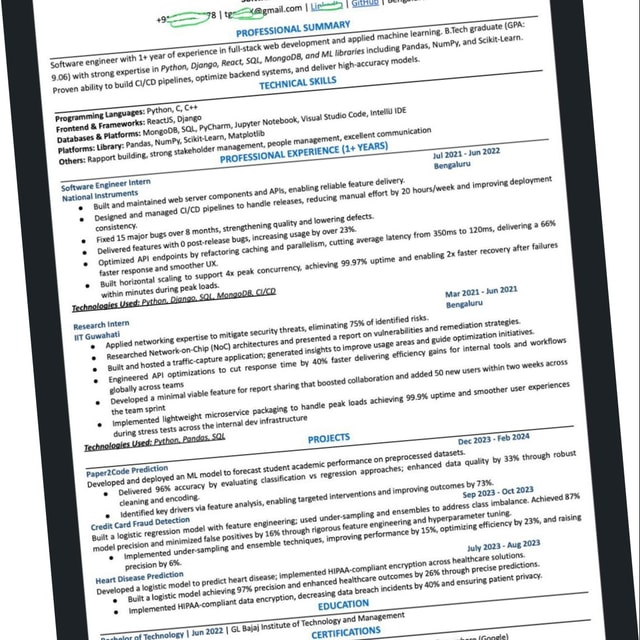
An ATS-friendly resume uses a single-column layout, standard section headings like Education, Skills, and Projects, simple fonts, and no tables, graphics, photos, or text boxes that parsers cannot read. Mirror the exact keywords from each job description in your skills and project bullets, quantify outcomes wherever possible, and keep it to one page as a fresher. Before applying, run it through a free ATS checker to confirm everything is being read correctly.
How do I write a cold email to HR for job opportunities?
Keep the subject line specific (role name plus "Fresher" or "Application"), open in one line with who you are and the role you are targeting, add 3–4 bullet highlights on skills, projects, and certifications, mention your attached resume, and close with a clear ask such as considering your profile for current or upcoming openings. Send it to a relevant HR person rather than mass-mailing everyone, personalise at least the first two lines for each company, and follow up politely after 4–5 working days.
What is LinkedIn profile optimization and why does it matter for job seekers?
LinkedIn profile optimization means improving your headline, About section, skills, experience, and activity so your profile appears in recruiter searches and convinces people to shortlist you. LinkedIn works like a search engine — recruiters find candidates by typing job titles and skills, so a profile without those keywords stays invisible no matter how good the candidate is. For job seekers, this directly affects how many inbound recruiter messages and interview calls they get.
How to do LinkedIn profile optimization as a fresher?
Start with the headline — replace "Student" with your target role and top skills, for example "Aspiring Data Analyst | Python | SQL | Excel". Rewrite the About section around your skills, projects, and the roles you are seeking, add all relevant skills, put your best projects and certifications in the Featured section with links, and use a clear photo with a simple banner. Describe internships and projects with numbers, then stay active by posting or commenting weekly, since activity keeps you visible in recruiter feeds.
How to check LinkedIn profile optimization before applying for jobs?
First, view your profile in public or incognito mode to see what a stranger actually sees. Then search your target job title on LinkedIn and check whether your profile appears anywhere in the results — if it does not, your keywords are weak. Compare your headline, skills, and About section against real job posts for your target role, track your "Search appearances" in analytics over a couple of weeks, and get a quick review from a mentor to catch what you have missed.
Is there a free LinkedIn profile optimization tool?
LinkedIn's own features are the best free starting point — profile completeness prompts, Search Appearances data, and recruiter view statistics tell you what is working. Free AI chatbots can draft headlines and About sections, and some browser extensions give your profile a quick score. The catch is that generic AI output often sounds templated, so use a tool for a first pass and then get feedback from someone who understands hiring for your target role.
Are LinkedIn profile optimization services worth paying for?
They are worth considering when your profile gets views but no recruiter messages, when you are switching fields and do not know how to position yourself, or when months of applying have not produced calls. For freshers on a tight budget, a structured optimization guide plus one expert review is often enough. Before paying anyone, check their recruitment or hiring background and whether the feedback is personalised to your profile and target roles rather than a copy-paste rewrite.
What is LinkedIn Open Profile and should job seekers use it?
Open Profile is a LinkedIn Premium feature that allows anyone on the platform — including recruiters who are not connected to you — to message you directly. During an active job search it increases inbound recruiter messages, which is exactly what most job seekers want, though it also brings more spam and sales pitches. Since it requires a paid subscription, turn it on while you are actively applying and switch it off once you have landed a role.
Is a free resume review actually useful for freshers?
Yes, if it gives specific feedback. A good review catches things you stop noticing — vague project descriptions, missing keywords from job descriptions, formatting that breaks ATS parsers, or a generic objective statement. Expect actionable comments like "rewrite this bullet with the outcome" rather than just "looks good". Apply the fixes before mass applying, and if the problems are bigger, the reviewer can tell you honestly whether a full rework or one-on-one guidance is needed.