Testimonials
Services
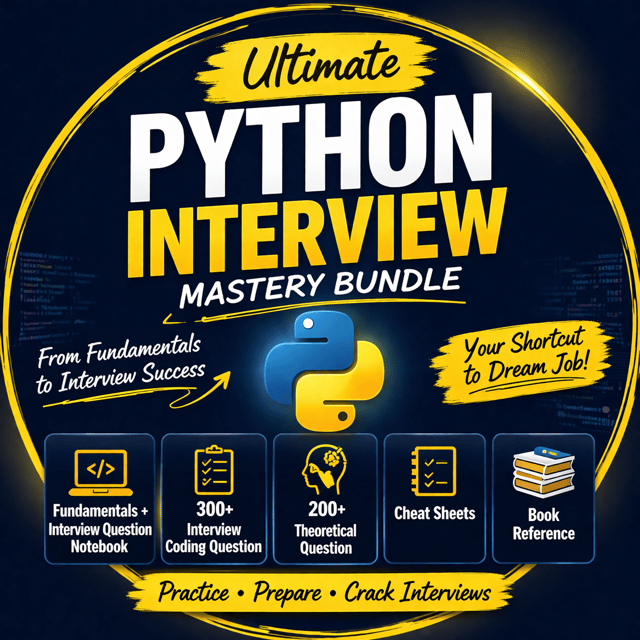
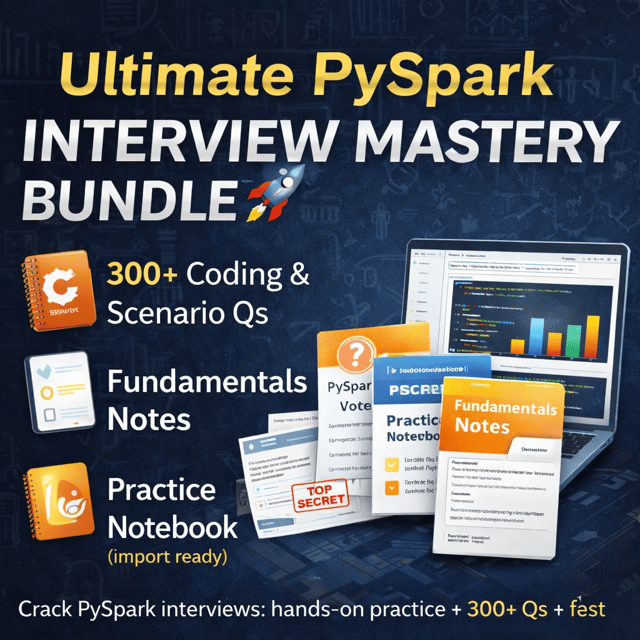
PySpark Power Pack: Interview + Hands-on Kit
Complete SQL,Python and PySpark bundle
1:1 Mentorship
Resume review
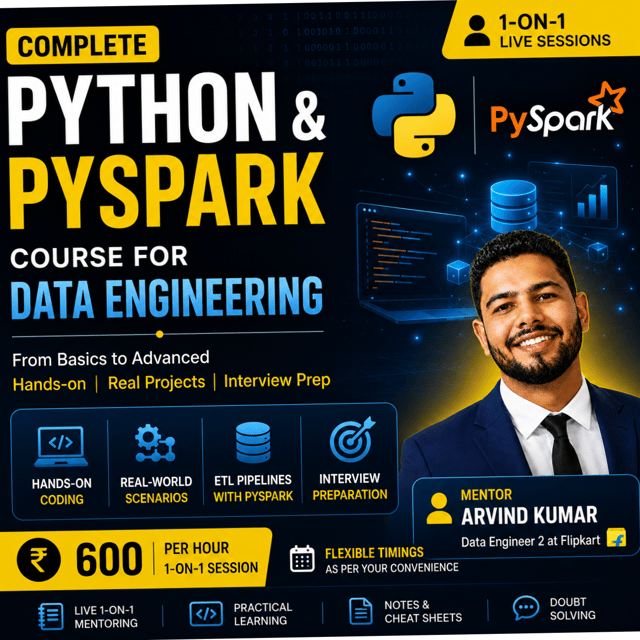
Master Python & PySpark: From Basics to Advanced
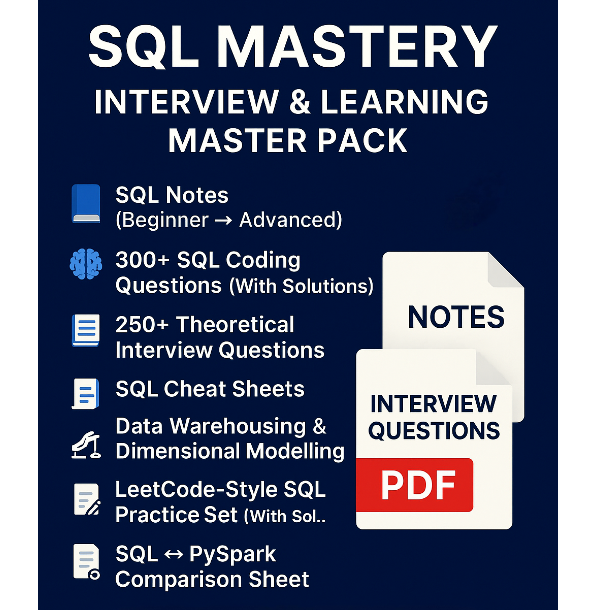
Complete SQL(With DW &DM) Interview Master Pack
Mock interview
Interview prep & tips
Career guidance
About me
Frequently asked questions
How to learn data engineering from scratch?
The biggest mistake people make while figuring out how to learn data engineering is jumping straight to advanced tools without fundamentals. Follow a structured data engineering roadmap: start with SQL and Python, then learn data modeling and warehousing concepts, followed by Apache Spark and PySpark for large-scale processing, and finally a cloud platform like AWS along with Databricks. Reinforce every stage by building small ETL pipelines on real datasets so you understand how data actually flows in production systems.
How to start data engineering with no prior experience?
The simplest way to figure out how to start data engineering is to build SQL skills first, since SQL is the backbone of every data role, and then add Python. From there, learn how databases, data warehouses, and ETL workflows fit together, and practice by transforming a real dataset end to end. Freshers from non-CS backgrounds do break into this field regularly — recruiters care far more about demonstrable hands-on projects than about your degree.
Data engineering vs data science — which career should I choose?
Data engineering focuses on building and maintaining the pipelines and platforms that move and store data, while data science focuses on analyzing that data to generate insights and models. People often frame the choice as data engineering vs data science: pick data engineering if you enjoy SQL, Python, distributed systems, and making things run reliably at scale, and pick data science if you prefer statistics, experimentation, and machine learning. Data engineering also has a clearer entry path for freshers — strong SQL, Python, and PySpark skills with a few solid projects can make you interview-ready.
What does a data engineering role involve day to day?
A data engineering role revolves around designing, building, and maintaining ETL pipelines that collect data from various sources, process it at scale, and make it reliable for analytics and downstream teams. Day to day, this means writing SQL and PySpark jobs, working on platforms like Databricks and cloud services such as AWS, orchestrating workflows, monitoring failures, and optimizing slow or expensive jobs. You also spend significant time collaborating with data scientists, analysts, and backend teams to keep data accurate and available.
What is the data engineering life cycle?
The data engineering life cycle covers every stage data passes through in a system: generation at the source, ingestion, storage, processing and transformation, and finally serving it to dashboards, ML models, and applications. Supporting activities like orchestration, monitoring, security, and governance wrap around these stages. Interviewers love this topic because they want to see whether you think about data end to end, not just how to write isolated queries or Spark jobs.
Are paid data engineering courses worth it, or can I learn everything for free?
Free resources exist, but most learners struggle with scattered content and the gap between tutorials and real industry work. Data engineering courses are worth paying for when they cover production-grade concepts — ETL pipeline design, Databricks, PySpark optimization, and advanced SQL with data warehousing — and include hands-on projects rather than theory alone. Before enrolling, check whether the course teaches how data engineering actually works in real companies, because that is exactly what interviews test.
What kind of data engineering projects should I build to get hired?
The data engineering projects that impress recruiters are the ones that mirror real production systems. Strong examples include an end-to-end ETL pipeline that ingests data from an API or database, processes it with PySpark, stores it in a lakehouse or cloud data warehouse, and serves it for analytics. Document the business problem, the architecture, and your trade-offs — batch versus streaming, partitioning, cost, and how you handled dirty or late-arriving data. One deep, well-explained project beats five tutorial clones.
What skills are required for data engineering jobs in India?
Most data engineering jobs in India expect strong SQL, Python, and Apache Spark or PySpark, along with a cloud platform like AWS or Azure and familiarity with tools such as Databricks and workflow orchestrators. Companies also test your understanding of data warehousing, data modeling, and ETL design. Freshers are evaluated on fundamentals and hands-on projects, while experienced candidates face deeper questions on optimization, architecture decisions, and debugging production pipelines.
What are the most common data engineering interview questions?
Most data engineering interview questions cluster around a few areas: advanced SQL (joins, window functions, aggregation puzzles), Python and PySpark coding rounds, Apache Spark internals like lazy evaluation and shuffle, and ETL or data modeling design questions. Experienced candidates should also expect scenario-based rounds where they debug a failing pipeline or design a system for large-scale data. Preparing these areas systematically, ideally with mock interviews, works far better than reading random question lists.
What topics do Spark interview questions usually cover?
Spark interview questions usually start with core concepts — architecture (driver and executors), RDDs versus DataFrames, transformations versus actions, and lazy evaluation — before moving into caching, broadcast joins, skew handling, partitioning, and performance tuning. Interviewers often ask how you would speed up a slow job or handle a dataset that does not fit in memory. Explaining these concepts with examples from actual big data processing work makes you stand out immediately.
What are the most asked PySpark interview questions for data engineers?
PySpark interview questions for data engineers focus heavily on DataFrame operations — joins, aggregations, window functions, and handling nulls or nested data — along with optimization topics like partitioning, caching, and broadcast variables. You will often be asked to write code live, such as deduplicating records or computing running totals on large datasets. Interviewers want to see whether you can translate a business requirement into efficient distributed code, so practice writing PySpark by hand instead of only reading solutions.
How do I practice scenario-based PySpark interview questions?
Scenario-based PySpark interview questions test your thinking process, so memorized answers will not help. Take realistic problems — a skewed join slowing down a job, late-arriving data corrupting results, duplicate records across millions of rows — and practice explaining your approach out loud: what you would check first, what could be causing the issue, and how you would verify the fix. Building a few real pipelines yourself gives you genuine war stories, which is exactly what interviewers want to hear in these rounds.
What are the most commonly asked SQL interview questions and answers for freshers?
SQL interview questions and answers for freshers usually revolve around SELECT queries, multi-table JOINs, GROUP BY and HAVING aggregations, subqueries, basic window functions, and concepts like primary keys and normalization. Instead of memorizing answers, practice writing each query yourself, because interviewers can instantly tell when someone has only read solutions. Explaining why you chose a particular join or grouping is what turns a correct answer into a strong one.
How is a SQL interview different for experienced candidates?
Expectations scale sharply with experience. SQL interview questions for 5 years of experience typically go beyond writing queries — you will face query optimization, complex window functions, indexing strategies, handling very large datasets, and data warehousing or data modeling design questions. Interviewers at this level also want specific examples of how you used SQL to solve real business problems, so prepare detailed stories from your work rather than only practicing puzzles.
How to prepare for SQL interview questions?
If you are unsure how to prepare for SQL interview questions, use a three-step routine: first revise core concepts such as joins, window functions, and aggregations, then solve a high volume of SQL interview questions and answers under timed conditions, and finally practice explaining your query logic out loud. Cover a mix of easy, medium, and hard problems, and add data-warehousing and schema-design questions if you are targeting data engineering roles. Consistent daily practice beats last-minute cramming because SQL rounds reward both speed and accuracy.