Testimonials
Services
Snowflake Interview Prep
Personalized Discovery Session
Spark Interview Preparation
Mock Interviews
System Design HLD
Data Engineering Concepts
Creation Service : Resume and LinkedIN
1:1 Mentorship
Spark Advanced
10-Session LLD System Design Mastery Package
Career Guidance
Comprehensive Spark package
E2E Data Engineer interview prep
Leet code sessions
EM in Data Engineering Interview Guide and Mocks
Product Sense & Data Modelling Interview Scenarios
DE3-Intervieew GuideAndMocks
ARchitect/PE in Data engineering Intervw Prep Mock
Data Engineering Questions With Scenarios
SQL Interview QuestionAnswers(BasicToIntermediate)
Akka Actor System [Scala/Java]
DBT [Getting Started]
Quick chat-Networking Opportunity
Spark For Beginners/Intermediate
System Design LLD
Data Structures And Algorithms Approach
Review and Discussion: Resume & LinkedIn
Data Engineering Interview Prep
Interview Preparation Tips and Strategies
Akka Streams with Java/Scala
Akka Http [Scala/Java]
Data Structures And Algorithms Course
Mastering Kafka
Kafka Fundamentals
Scala/Java : DS And Algorithms Approach
10-Session HLD System Design Mastery Package
Kafka: From Begineer to Advanced
Data Lake Design Patterns for Interviews
DE2- InterviewPrepAndMOCKGuides
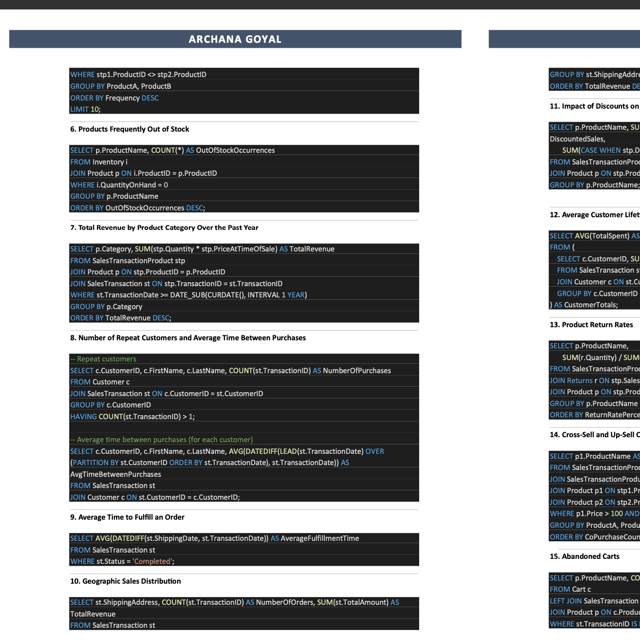
Data Modeling & AdvancedSQL Scenario-Sol. Approach
Behavioral Interviews for Principal Data Engineers
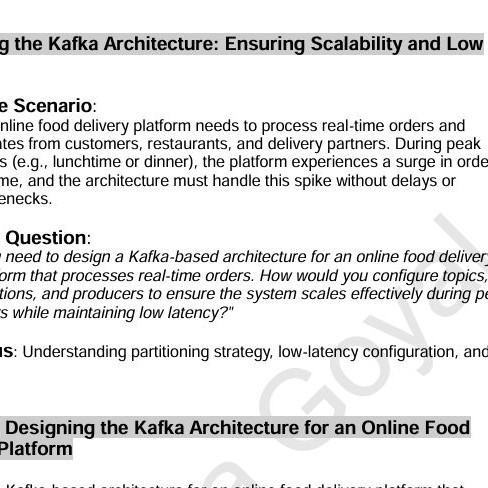
SQL Interview Mastery:FAANG-Style Question Bank
About me
- Archana's expert mentorship and personalized guidance enhance confidence, skills, and professional presence. Highly recommended for her knowledge, responsiveness, and impactful sessions.
 AI-generated based on testimonials
Frequently asked questions
How to crack a data engineer interview?
The playbook for how to crack a data engineer interview is fairly consistent: build depth in SQL, Python or Scala, data modelling, and ETL fundamentals first, because most data engineering interview questions are built around these. Add one distributed framework done properly — Spark or Kafka — along with 2–3 end-to-end pipeline projects you can defend in detail. Spend the final weeks on timed SQL and coding practice, company-specific questions, and mock interviews, and rehearse a clear walkthrough of your current project, since that is where most experienced candidates slip.
What are the common data engineering interview questions for freshers?
Data engineering interview questions for freshers stay close to fundamentals: SQL joins, GROUP BY, window functions, normalisation, keys and indexes, basic Python, and simple DSA problems. Expect conceptual questions on ETL vs ELT, batch vs streaming, OLTP vs OLAP, and star schema, plus one small design task such as modelling tables for a food-delivery or cab-booking app. Interviewers also probe your resume project heavily, so know every choice you made. Plan your data engineering interview preparation at least two to three months before applications open.
What do data engineering interview questions for experienced candidates usually cover?
Data engineering interview questions for experienced candidates move from definitions to depth: designing batch and streaming pipelines for large-scale data, optimising slow Spark jobs, modelling warehouses and lakehouses, handling schema drift, ensuring data quality, and controlling cloud costs. A typical loop includes SQL/coding, data modelling, pipeline or system design, and deep dives into your current project — why you picked a tool, what broke in production, and how you fixed it. Cloud exposure (Azure, AWS, or GCP) and the ability to quantify impact become the real differentiators at senior levels.
How to crack the Netflix data engineer interview?
If you are studying how to crack the Netflix data engineer interview, prepare across three layers: hands-on engineering depth, data system design, and communication. Rounds typically test advanced SQL and Python, ETL and data modelling at scale, distributed processing with Spark, and designing reliable, observable pipelines, followed by strong behavioural evaluation. Bring real metrics from your projects — data volumes, latencies, failures handled — and align your stories with ownership, candour, and impact. Taking a few mock interviews with senior data engineers beforehand is the fastest way to find gaps.
How do I answer "Why do you want to be a data engineer" in an interview?
A strong answer to "Why do you want to be a data engineer" connects your personal story to what the job actually involves. Use this structure: one specific moment that pulled you toward data, one line on why you enjoy building systems that turn raw data into decisions, and one line linking the role to your long-term goal in scalable data platforms. Avoid clichés like "data is the new oil", tailor the answer to the company's data scale and stack, and keep it under 90 seconds.
Where can I find a good data engineering interview questions and answers PDF?
A well-made data engineering interview questions and answers PDF is useful for last-week revision, but treat any free download as a checklist rather than a study plan, because most PDFs list definitions without scenarios. Prepare each topic hands-on — write the SQL, run a Spark job, produce to a Kafka topic — and then use the PDF for quick revision. For scenario-based and company-style questions, curated question banks and mock guides from mentors who conduct real interviews are far more reliable than random compilations.
What are the most common Spark interview questions for experienced data engineers?
Spark interview questions for experienced data engineers focus on internals and performance rather than syntax. Expect deep dives into lazy evaluation, transformations vs actions, the Catalyst optimiser, shuffle and partitioning, data skew, broadcast joins, salting, the small-files problem, checkpointing, and Structured Streaming. Most Spark interview questions and answers at this level test whether you can debug a slow job or justify a tuning decision with real numbers — executor memory, parallelism, shuffle spill, and the improvement you achieved. Prepare two or three production stories where you diagnosed and fixed a Spark workload.
What are scenario-based Spark interview questions and how do I answer them?
Scenario-based Spark interview questions present a production problem instead of a definition — for example, a job that suddenly slows down, joins causing OOM errors, skewed data on one partition, or incrementally processing millions of new records daily. To answer well, clarify requirements first, quantify the data, state the likely root cause, and propose a concrete fix with the config or code change (broadcast join, salting, AQE, repartitioning) along with its trade-offs. Practise 10–15 such scenarios on a real cluster, because interviewers judge how you think more than whether your first guess is right.
Where can I find good Spark interview questions on GitHub and Medium?
There is no shortage of Spark interview questions on GitHub — community-maintained interview-preparation repositories compile commonly asked questions on RDDs, DataFrames, shuffles, skew handling, and Structured Streaming. Many senior engineers also publish Spark interview questions on Medium along with detailed tuning walkthroughs from real jobs. Use these lists to understand patterns, but reproduce every answer on a local Spark setup or a free cloud workspace, because interviewers can instantly tell memorised answers from hands-on understanding. One well-worked repository plus practice beats ten bookmarked lists.
What topics do Kafka interview questions and answers usually cover?
Most Kafka interview questions and answers revolve around core architecture: brokers, topics and partitions, producers and consumers, consumer groups, offsets, replication and ISR, and delivery guarantees such as at-least-once and exactly-once. Beyond theory, expect scenario questions on consumer lag, duplicate messages, ordering guarantees, rebalancing issues, and partition key selection. For senior roles, Kafka Connect, Kafka Streams, schema evolution with Schema Registry, and retention or compaction come in. Be ready with one real production issue you handled — that single story often carries the entire round.
Which Kafka interview questions for 3 years of experience are most commonly asked?
Kafka interview questions for 3 years of experience sit between basics and architecture. Interviewers expect fluency in producer settings (acks, retries, idempotence), consumer group behaviour and rebalancing, offset management, ordering within partitions, and how you monitored lag in your project. You will usually get one debugging scenario — duplicates after a restart, lost messages, or a consumer stuck in a rebalance loop — and one design question such as ingesting high-volume events. Frame every answer around something you actually handled, since at this level hands-on detail outweighs textbook theory.
Which Kafka interview questions for experienced Java developers are asked most often?
Kafka interview questions for experienced Java developers go deeper into the JVM client layer. Expect questions on the KafkaProducer and KafkaConsumer APIs and their thread-safety differences, commit strategies, retry and error handling in code, custom serializers and deserializers, Avro with Schema Registry, and integrating Kafka into Spring Boot services. Java-heavy teams also test how you tune producers for throughput versus latency and how you make consumers idempotent. Keep code-level examples ready from your own projects, because interviewers will push until they find the edge of your hands-on knowledge.
What are the most common Delta Lake interview questions?
The most common Delta Lake interview questions cover ACID transactions on data lakes, Delta tables versus plain Parquet, time travel, schema enforcement and evolution, MERGE-based upserts, and OPTIMIZE with Z-ordering to fix the small-files problem. Scenario questions are equally likely — building a medallion (bronze/silver/gold) architecture, handling late-arriving data, managing concurrent writes, and running streaming and batch on the same table. Since Delta Lake sits at the centre of the modern Databricks stack, tying your answers to real pipeline problems like slow merges or schema drift makes you stand out.
How do I prepare for a low level design interview?
A low level design interview tests whether you can convert vague requirements into clean, extensible class design. Strengthen object-oriented fundamentals — encapsulation, inheritance, polymorphism, SOLID principles — and commonly used patterns such as factory, strategy, observer, and singleton. Practise classic LLD problems like parking lot, elevator system, Splitwise, BookMyShow, LRU cache, and chess, and always begin by clarifying requirements before drawing classes. Write actual working code in Java, Python, or Scala instead of only sketching diagrams, as many product companies in India now expect compilable code in LLD rounds.
What is dbt in data engineering?
dbt (data build tool) is an open-source framework for writing, testing, and documenting SQL-based data transformations inside your warehouse, with version control, dependency management, and automated tests built in. Instead of scattered SQL scripts, teams get modular models, lineage, and documentation, which is why dbt now appears as a core skill in many analytics engineering and data engineering job descriptions. To get started, learn advanced SQL and Git first, pick a warehouse with a free tier such as BigQuery or Snowflake, build a small project with staging and mart layers, and add tests and documentation to it.