Testimonials
Services

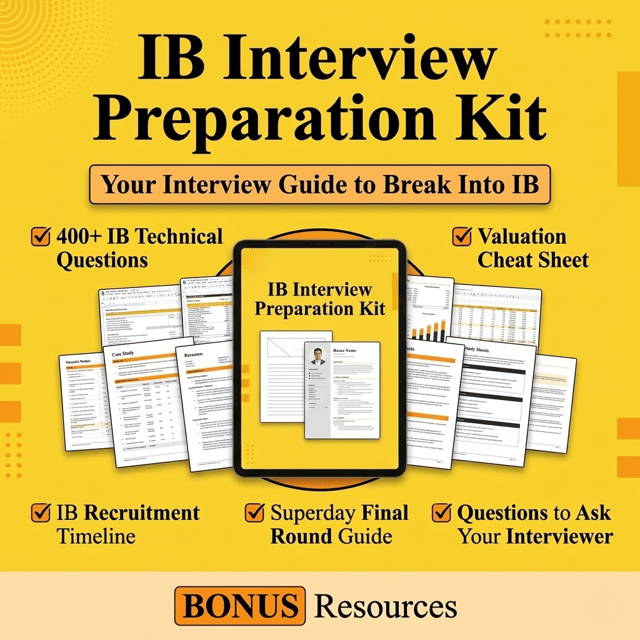
Investment Banking Interview Preparation Kit
IIM Bangalore Doubts
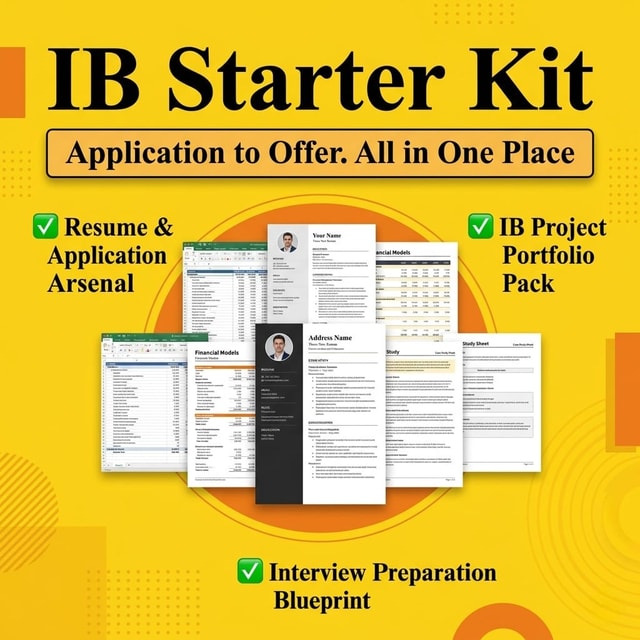
The Investment Banking Starter Pack
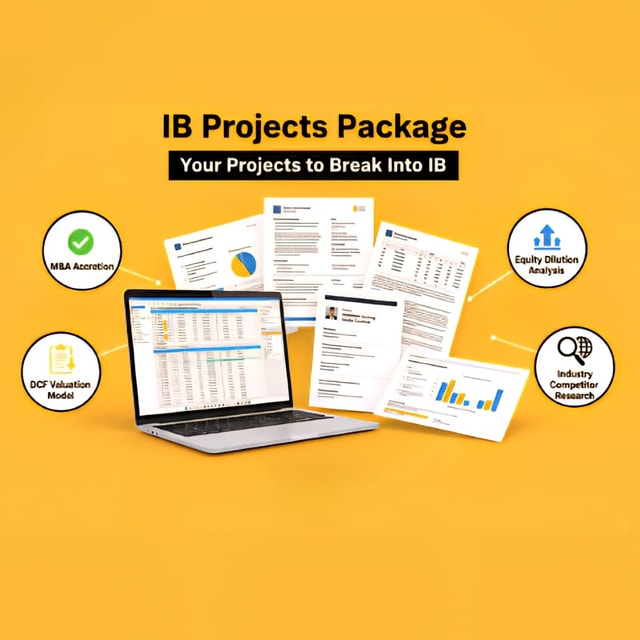
Investment Banking Projects Package
700+ Elite Resume Templates (Lifetime Access)

Frequently asked questions
How to prepare for an investment banking interview as a fresher?
Work in layers: start with accounting basics (the three financial statements and how they link), move to valuation (DCF, trading comparables, precedent transactions), then follow two or three live deals and market news daily so you can talk like a banker. Prepare your story — why investment banking, why this firm — and build one stock pitch you can defend. Finish with Excel modelling practice and two or three mock interviews. Freshers who start six to eight weeks early almost always outperform last-minute crammers.
How to crack an investment banking interview without a finance background?
Interviewers rarely filter by degree — they test whether you can think like a banker. Close the gap with focused self-study: accounting fundamentals, valuation methods, Excel modelling, and daily market reading. Then turn your background into an edge, whether that's quantitative comfort from engineering or business acumen from commerce. Back it up with proof — a stock pitch, a small modelling project, or an internship at a boutique firm — because tangible evidence beats a degree label in most Indian IB interviews.
What are the most common investment banking interview questions for freshers?
They usually fall into four buckets: fit questions ("Walk me through your resume", "Why investment banking?"), technicals (the three statements, DCF vs comparables, WACC, how a change in depreciation flows through the accounts), market awareness (a recent deal, a stock you'd pitch, where the indices are trading), and India-specific guesstimates or current-affairs questions. Practise answering out loud in 60–90 seconds instead of memorising long written answers, because interviewers always probe one level deeper.
What is an investment banking interview like for freshers in India?
Expect two to four rounds: a shortlisting or aptitude stage, one or two technical rounds, and a final HR or fit conversation. Boutiques often add practical Excel or modelling tasks, while larger banks go deeper on valuation and deal discussions. Rounds typically last 30–45 minutes and mix technicals with personality checks — Indian interviewers love guesstimates and questions on recent IPOs or market moves. It feels intense, but the structure is predictable enough that well-prepared candidates are rarely caught off guard.
Can I rely on an investment banking interview questions and answers pdf for preparation?
A good question-bank pdf tells you what gets asked, so it's a useful starting point — but it won't get you an offer on its own. Interviews test how you think aloud, handle follow-up questions, and defend your numbers, which no static document can teach. Use the pdf to build answer skeletons, then practise out loud, record yourself, and do mocks with seniors or peers. Also update the material with recent Indian deals and market data, because interviewers instantly spot candidates reciting outdated content.
How to get an investment banking internship in India as a college student?
Most IB internships in India are filled off-campus, so outreach matters more than portals. Shortlist bulge brackets, boutique investment banks, Big 4 deal advisory teams, and early-stage VC funds, then send cold emails and LinkedIn messages to analysts and associates with a one-page resume and a clear ask. Alumni referrals from your college dramatically improve reply rates. Build proof before you pitch — financial modelling skills, CFA Level 1, a stock pitch or a small live project — and target Mumbai for the deepest deal flow, with Bangalore strong for VC and fintech-adjacent roles.
How competitive is an investment banking internship for freshers in India?
Extremely competitive at the top — structured summer programmes at global banks take a handful of students per intake while hundreds apply. The practical route for most freshers is to start at a boutique advisory firm, Big 4, or a small VC where selection is less brutal, then use that deal experience to upgrade later. A referral almost always beats a cold portal application, and candidates with modelling skills or a finance society leadership role stand out even before the interview.
What do investment banking internships pay in India?
It varies enormously. Small boutiques may pay a token stipend — often ₹5,000 to ₹20,000 a month — and some take unpaid interns purely for the exposure. Big 4 and mid-market advisory teams usually pay moderately better, while structured summer programmes at global investment banks in India are the most lucrative, frequently crossing ₹1 lakh a month. Don't pick purely on money for your first internship; the deal exposure and brand from a boutique can be worth more than a slightly better-paying back-office role.
What does an investment banking intern do on a day-to-day basis?
Mostly support work on live deals: building comparable-company tables, pulling financial data, researching companies and sectors, updating valuation models, and formatting pitch decks and presentations. You'll sit in on team and client calls taking notes and be asked for quick turnarounds on small analyses. Expect heavy Excel and PowerPoint usage, long hours, and evaluation based on accuracy, speed, and reliability rather than big ideas.
Can I get an investment banking internship with work from home in India?
Fully remote roles are rare in core investment banking because deal teams work long, collaborative hours, but they do exist — boutique advisory firms and VC funds sometimes offer remote or hybrid internships, especially for research-heavy support. Be cautious of paid "virtual internship" programmes that only hand out certificates; real learning comes from supporting live transactions. A practical approach is to offer a boutique firm a short low-stipend remote trial on research or modelling work, which many are open to when budgets are tight.
What should an investment banking resume for freshers include?
One page, led by education with your CGPA or marks if they're strong, followed by internships, live finance projects, and certifications such as CFA Level 1 or a financial modelling course. Every experience bullet should be quantified and deal-specific — "built a comparables table across 15 listed peers" lands far better than "assisted the team". Add Excel and PowerPoint skills, positions of responsibility, and achievements. Skip photos, hobby filler, and anything that pushes you past one page.
What investment banking resume format do recruiters prefer?
A single-column, reverse-chronological, one-page layout with clear section headers — education first for students, then experience, projects, skills, and achievements. Use a plain font at 10–12 pt, bold only for headings and role titles, and start every bullet with an action verb followed by a number. Avoid tables, text boxes, graphics, and skill bars, because they break parsing software and look gimmicky to bankers who are used to dense, clean pages.
Is it worth using an investment banking resume template?
Yes, if it's a banking-style template — a clean structure saves you from formatting mistakes and gets you to the content faster. What a template can't fix is weak bullets, so customise every line with your own quantified work. Avoid design-heavy templates with columns, bright colours, and icons; bankers prefer plain, dense, black-and-white layouts that resemble what they use internally. Free university or career-cell templates work perfectly well once the structure matches banking norms.
How to put investment banking experience on a resume when I've only done internships?
Label the role honestly — "Investment Banking Intern" or "Summer Analyst" — and describe the transaction work, not the errands: name the deal type (M&A, fundraise, IPO), your specific contribution, the tools you used, and the outcome, ideally with numbers. Even a one-month boutique stint can yield three or four strong bullets this way. If you also have stock pitches, modelling case competitions, or live finance projects, place them under a separate Projects section so your relevant depth is visible at a glance.
What font for an investment banking resume looks most professional?
Times New Roman and Garamond are the traditional banking choices, while Calibri and Arial are widely accepted modern alternatives — any of these is safe. Keep body text between 10 and 12 pt, use 14–16 pt only for your name and section headers, and keep spacing consistent across the page. What matters more than the specific typeface is consistency; a resume in one clean font with uniform formatting always looks more professional than a creative font mix.