Testimonials
Services
Next-Gen AI-Powered SDET Program 2026
Mock interview
Quick chat
Automation Testing with Selenium + Java
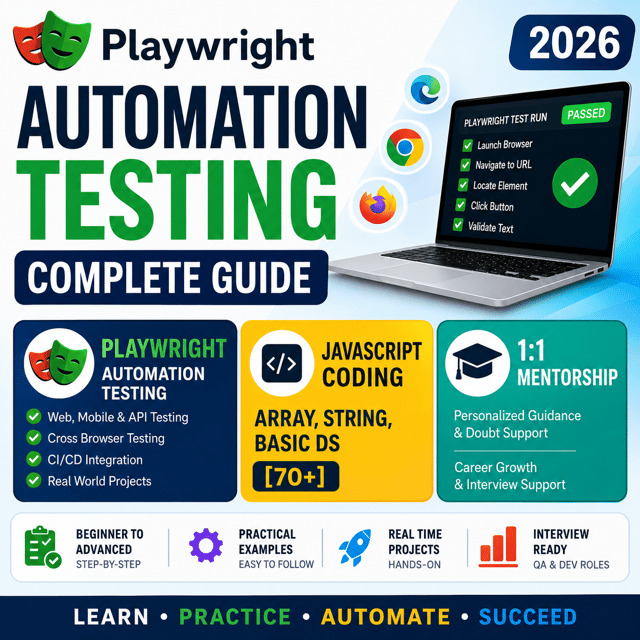
JavaScript Coding Array, String, Basic DS [70+]
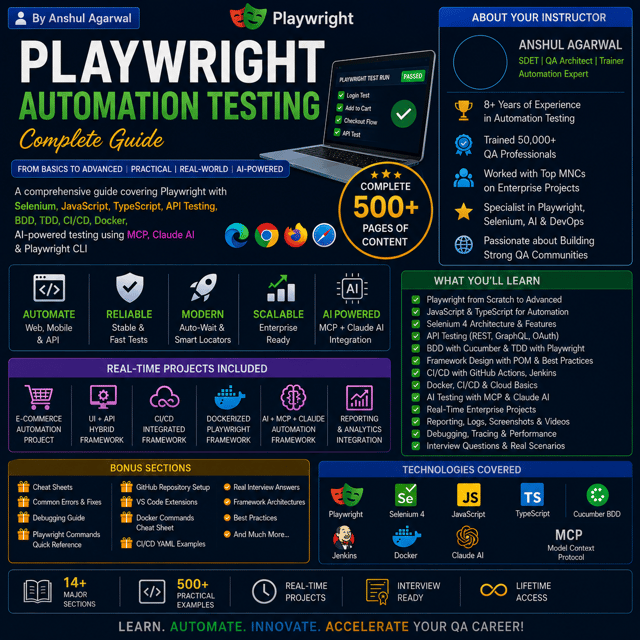
📚 Playwright Automation Testing – Complete Guide
Doubt Clearing Session
1:1 Mentorship
100+ Most Asked Java Problems for SDET Interviews
Automation Testing with Cypress+JavaScript+CICD ✅
Locator Hunter & Expert 🕵️♀️💻
About me
- Highly recommended for insightful, clear guidance and deep SDET/Automation Testing knowledge, Anshul Agarwal ensures seamless career transitions with expert, tailored support.
 AI-generated based on testimonials
Frequently asked questions
What is automation testing and manual testing?
Automation testing is the practice of using scripts and tools like Selenium, Playwright, or Cypress to execute test cases automatically, while manual testing is when a tester checks the application by hand without any tools. Automation is ideal for repetitive, high-volume checks such as regression and smoke testing, whereas manual testing works better for exploratory, usability, and ad-hoc scenarios. Most teams use a mix of both, with automation handling stable and repetitive flows.
What is automation testing with an example?
Automation testing means writing scripts that launch an application, perform actions, and verify results without human effort. For example, a script can open a login page, enter valid and invalid credentials, click submit, and assert that the correct message appears — and the same script can be reused on every new build. A practical example is running a 500-test regression suite overnight with Selenium or Playwright connected to Jenkins so bugs are caught before release.
How to learn automation testing?
Start with one programming language — Java or Python are the most in demand in India — then learn a web automation tool like Selenium or Playwright, followed by API testing, Git, and CI/CD basics like Jenkins. Build a small framework around real projects such as login flows or an e-commerce checkout and push the code to GitHub so recruiters can see it. Practising locator writing and taking mock interviews early significantly shortens the learning curve.
How do I switch from manual testing to automation testing?
Use your existing QA knowledge as the foundation — you already understand test design, the bug life cycle, and business logic, which many automation engineers lack. Learn Java or Python, then one UI tool like Selenium or Playwright, plus API automation and basic CI/CD, and convert your existing manual test cases into automated scripts as portfolio projects. Update your resume to highlight frameworks and tools instead of only test execution, and prepare for live coding rounds since most SDET interviews include hands-on programming.
How to automate testing with AI?
AI is now used to generate test scripts from plain-English prompts, create self-healing locators that adapt to UI changes, produce test data, and review automation code. Common approaches include using LLM-based assistants to draft Selenium or Playwright scripts, AI-powered platforms for visual and self-healing testing, and frameworks like RAGAS to evaluate LLM-based applications themselves. The practical way to start is by adding AI assistance to your existing framework and validating everything it generates, since AI output still needs human review.
How to automate API testing?
Pick a tool based on your stack — Rest Assured for Java, Pytest with requests for Python, or Postman with Newman for a no-code start — and write scripts that send requests and assert on status codes, response bodies, and response time. Cover authentication, negative cases, and data-driven scenarios, then hook the suite into a CI pipeline like Jenkins or GitLab so APIs are validated on every build. API automation is faster and more stable than UI automation, which is why it is usually the first layer teams automate.
Which automation testing tools should I learn first?
For web testing, start with Selenium or Playwright — Selenium has the largest job volume in India, while Playwright is growing fast in product companies. Add Appium if you want to move into mobile testing, and Postman or Rest Assured for API automation. Learning one tool deeply with Java, Python, or JavaScript is far more valuable than knowing five tools superficially.
What are the most asked automation testing interview questions?
Expect questions on locators and XPath, implicit versus explicit waits, handling dropdowns, alerts and pop-ups, the Page Object Model, framework types like data-driven and hybrid, Git, and CI/CD integration with Jenkins. Interviewers also ask candidates to write code live, such as automating a small scenario, so practise hands-on coding rather than only theory. Scenario-based questions like "how would you handle a flaky test?" are extremely common for experienced roles.
What are the top SDET interview questions and answers to prepare?
SDET interviews at product-based companies go deeper than tool knowledge — prepare coding problems on arrays, strings, and collections, Java concepts like OOPs and exception handling, REST API testing, SQL queries, and framework design questions such as building an automation framework from scratch. Scenario-based questions on handling dynamic elements or designing a test strategy for a new feature are also frequent. Working through 100+ frequently asked coding problems and doing mock interviews before applying makes a measurable difference.
What are the most common Selenium testing interview questions?
The most common ones cover the difference between implicit and explicit waits, types of locators and writing robust XPath, handling stale element exceptions, switching between windows and frames, managing pop-ups, the Page Object Model, and assert versus verify. You should also be ready to explain your framework architecture and how Selenium is integrated with Maven, Git, and Jenkins in your current project. These questions repeat across most service-based and product-based company interviews in India.
What is the Selenium testing tool used for?
Selenium is an open-source framework used to automate web browsers — it can fill forms, click buttons, and verify page content exactly like a real user, across Chrome, Firefox, Edge, and Safari. Teams mainly use it for regression testing, cross-browser testing, and smoke tests running inside CI/CD pipelines. It supports Java, Python, C#, and JavaScript, which is why it remains the default choice for web automation in most Indian companies.
Which are the best automation testing practice websites?
Use demo e-commerce applications and dedicated locator playgrounds to practise form filling, dropdowns, alerts, frames, and dynamic elements in a safe environment. The ideal practice routine combines UI practice on demo sites, API practice on public test APIs, and coding practice on platforms like LeetCode for SDET rounds. Practising on realistic applications matters because interviews often ask you to automate a live scenario on the spot.
Should I learn Selenium testing with Java or Python?
In India, Java has the largest number of Selenium testing jobs, especially in service-based companies, so Java is the safer choice for maximum openings. Python is easier to learn and is increasingly used in product companies and AI-related testing roles. Pick one based on your target companies and stick with it — adding a second language later is quick once your automation fundamentals are strong.
Are automation testing courses worth it for freshers?
Yes, if the course is hands-on — a good syllabus covers a programming language, a UI tool like Selenium or Playwright, API testing, Git, and CI/CD, with projects you can showcase on GitHub. Certificates alone rarely get interviews in India, but demonstrated framework projects and mock interview practice do. Freshers who can code and confidently discuss a real project consistently outperform candidates with only tool-level knowledge.
Where can I find automation testing jobs for freshers in India?
Naukri and LinkedIn carry the highest volume of automation testing jobs, followed by Instahyre and the career pages of product startups. Freshers should search titles like QA Engineer, SDET, or Test Automation Engineer, and target both service-based companies, which hire in bulk, and product startups, which pay more but expect stronger coding. A GitHub portfolio with an automation framework plus referrals from QA communities significantly improves shortlisting chances.