Testimonials
Services
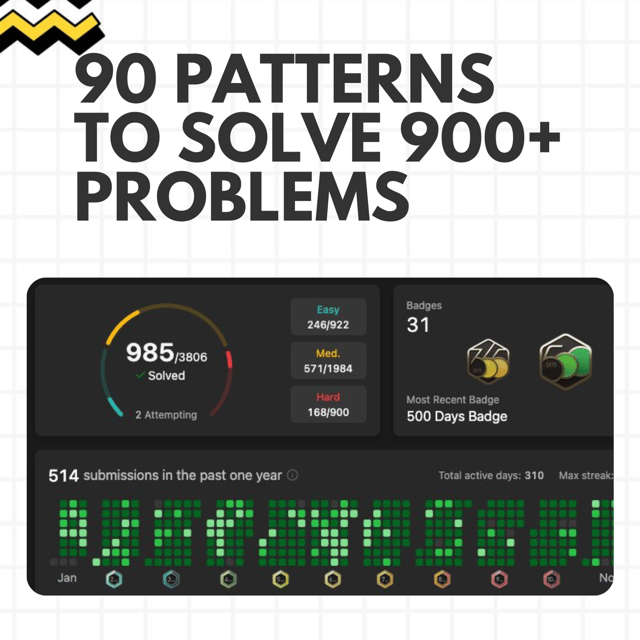
Mock interview
1:1 Mentorship
Project Idea for Resume
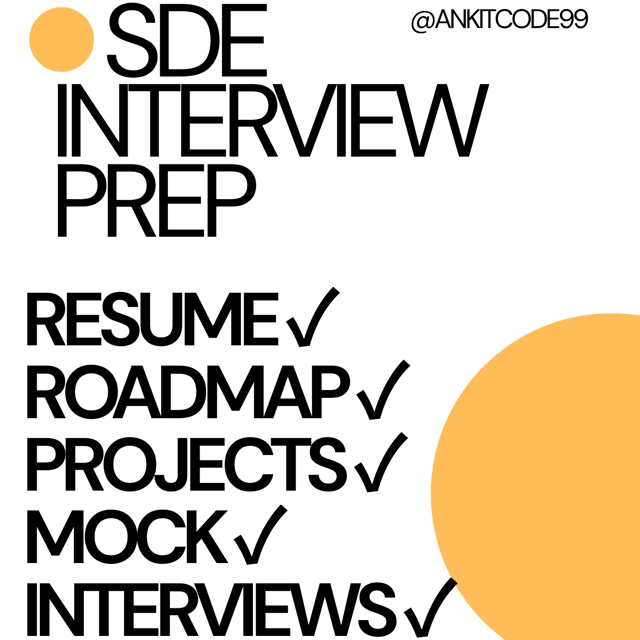
SDE Interview Prep Bundle
Resume review
Personalized Roadmap Planning
Interview preparation & Tips
About me
- Ankit Pandey is a knowledgeable and friendly mentor, offering clear, structured guidance and honest feedback, especially in backend engineering and system design, significantly aiding career clarity a
 AI-generated based on testimonials
 - Ankit – Mediumhttps://ankitpandeycu.medium.com

Frequently asked questions
What are system design interview questions?
System design interview questions are open-ended problems where you design a large-scale system — common examples include a URL shortener, a chat app like WhatsApp, a food delivery platform, or a rate limiter. Instead of one correct answer, the interviewer evaluates how you gather requirements, estimate scale, choose databases and caches, handle failures, and justify trade-offs. They are a core round for SDE-2 and senior roles at product companies, while freshers are more often tested on low-level design (LLD).
How to prepare for a system design interview?
Start with fundamentals — scalability, load balancing, caching, indexing, sharding, replication, message queues, and CAP theorem. Then study 15–20 classic problems (URL shortener, chat app, news feed, payment system) and practise drawing the complete architecture within 35–45 minutes. Reading one standard book, solving case studies, and getting feedback through mock design interviews over 4–8 weeks is usually enough to become interview-ready.
How to approach a system design interview?
Follow a clear framework: clarify functional and non-functional requirements, estimate scale (users, QPS, storage), define the API, sketch the high-level design, and then deep-dive into data models, caching, and bottlenecks. Keep talking throughout because communication and trade-off reasoning carry as much weight as the final diagram. Never jump straight to a solution — spending the first five minutes on scoping questions sets the tone for the entire round.
Which system design interview book should I read?
The System Design Interview by Alex Xu is the most widely recommended starting point — Volume 1 covers the core building blocks and Volume 2 goes deeper into real-world systems like distributed message queues and proximity services. Once comfortable, move to Designing Data-Intensive Applications for a stronger grasp of databases, consistency, and fault tolerance. Reading one book completely beats skimming three.
What is Grokking the System Design Interview?
It is a popular structured course (originally on Educative, now also on DesignGurus) that teaches system design through step-by-step solutions to classic problems such as URL shortener, Instagram, WhatsApp, and Netflix-style systems. It is useful for beginners because it provides a repeatable framework instead of jumping straight into advanced theory. Pair it with hands-on practice — drawing designs yourself and defending them in mock interviews — since reading alone rarely converts into interview performance.
How to prepare for a DSA interview?
Build a topic-wise plan: arrays and hashing first, then two pointers, sliding window, stacks, linked lists, binary search, trees, graphs, heaps, and finally dynamic programming. Solve around 150–250 quality problems over 6–10 weeks, revise patterns at fixed intervals, and simulate real conditions by timing yourself. Tracking mistakes in a notebook and redoing failed problems is far more effective than chasing problem count.
How to answer DSA interview questions?
Begin by clarifying the problem and constraints, state the brute-force approach with its complexity, and then optimise using the right data structure or pattern. Think out loud so the interviewer can follow your reasoning, write clean code, and finish by dry-running the solution against edge cases like empty input, duplicates, and large values. Interviewers score structured communication as heavily as the final correct answer.
What are the most common DSA interview questions and answers for freshers?
Freshers are most frequently tested on arrays, strings, hashing, linked lists, stacks and queues, and basic tree and graph traversals — typical problems include Two Sum, Reverse a Linked List, Valid Parentheses, and level-order traversal. Expect follow-ups on time and space complexity for every solution you give. Entry-level rounds focus more on clean logic and fundamentals than obscure hard problems, so mastering these core patterns matters more than memorising answers.
What are the most commonly asked DSA interview questions in Java?
Along with standard problems on arrays, strings, trees, and graphs, Java-focused interviews often probe HashMap internals, String immutability, equals vs ==, and the Collections framework, since many product companies in India conduct interviews in Java. Practise implementing solutions with the right structures — PriorityQueue, Deque, HashSet — and know their time complexities. If Java is on your resume, be ready for at least one question on JVM or concurrency basics.
How to crack the Amazon SDE interview?
Work on three pillars together: DSA (pattern-based LeetCode practice with focus on Amazon-tagged questions), Amazon's Leadership Principles (prepare 8–10 STAR stories covering conflict, failure, and customer focus), and system design or LLD if you are applying for SDE-2. Shortlisting also depends on a resume that shows measurable impact, so tighten it before applying. Simulating the loop through mock interviews that recreate real pressure and feedback is the fastest way to close gaps before the actual rounds.
Is the Amazon SDE interview hard?
Yes, it is demanding — the coding rounds involve medium-to-hard DSA problems under time pressure, and the Bar Raiser round plus deep Leadership Principles probing raises the bar further. That said, it is very crackable with 8–12 weeks of structured preparation because Amazon's process is consistent and well understood. Most candidates who fail do so due to weak behavioural preparation or unstructured problem solving, not lack of coding skill alone.
What is the Amazon SDE interview process?
It usually starts with an online assessment (coding questions plus a work-style survey), followed by one or two phone screens, and then a full loop of 3–4 interviews covering coding, system design or LLD for SDE-2 roles, and a Bar Raiser round. Leadership Principles are evaluated in almost every round, not just the behavioural one. After the loop, interviewers meet in a debrief where the Bar Raiser's feedback carries significant weight before an offer is made.
What are the most frequently asked Amazon SDE interview questions?
The most repeated Amazon SDE interview questions on the coding side involve graph traversals, trees, arrays, strings, and dynamic programming — problems like LRU Cache, Word Ladder, and Number of Islands appear again and again. On the behavioural side, questions map directly to Leadership Principles, such as "Tell me about a time you disagreed with your manager" or "a time you failed." For SDE-2 candidates, add system design prompts like designing a URL shortener, a ticket booking system, or a video streaming pipeline.
What does the Amazon SDE interview experience look like?
Each round typically runs 55–60 minutes on a shared coding document, with the interviewer asking layered follow-ups while you code and weaving in behavioural questions. Candidates often describe the Bar Raiser round as the most intense because it probes both technical depth and Leadership Principles alignment. The pressure is real, but interviewers are generally professional and the format stays consistent across loops, which makes simulated mock practice highly effective preparation.
How many Amazon SDE interview questions on LeetCode should I solve?
Around 150–200 well-understood problems are usually enough if you cover the core patterns and prioritise the Amazon-tagged list, rather than grinding thousands randomly. Make sure you can solve most mediums within 25–30 minutes while explaining your approach aloud. Remember that Amazon SDE interview questions on LeetCode are only part of the battle — Leadership Principles stories and system design or LLD preparation decide a large part of the final outcome.