Testimonials
Services
Data Engineering Interview Preparation Plan
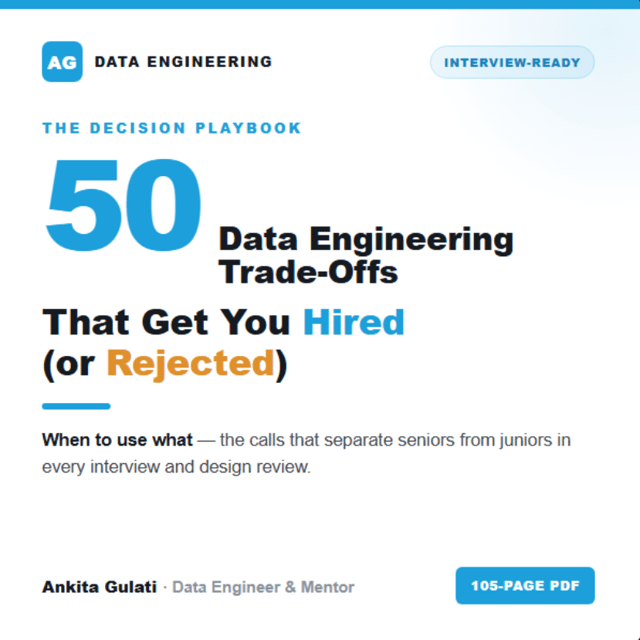
50 DE Trade-Offs That Get You Hired (or Rejected)

When Theory Ends: Production Scenarios
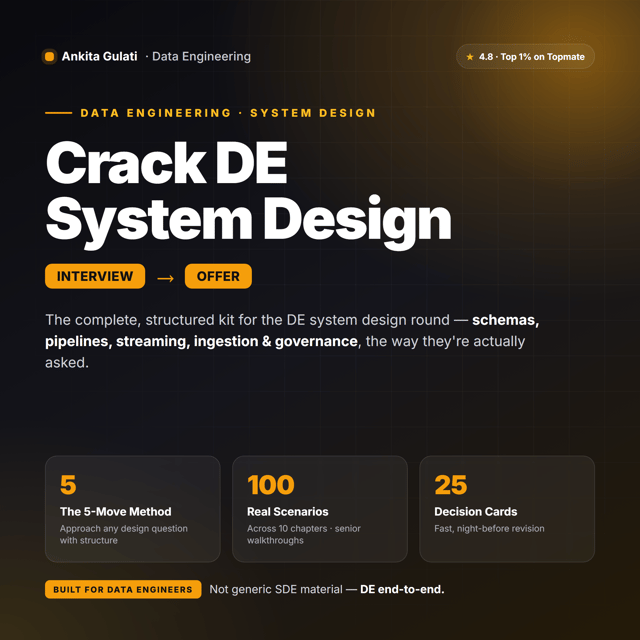
Unlock DE System Design — Interview to Offer
Building AI agents that ships to production
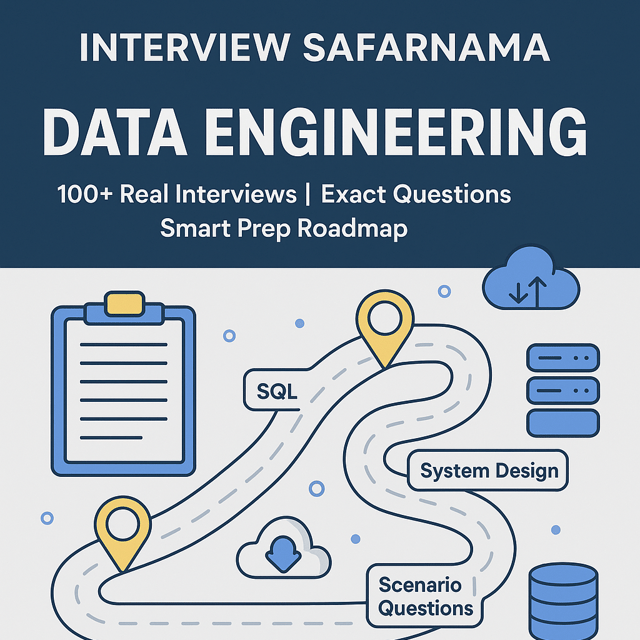
Interview Safarnama: Data Engineering
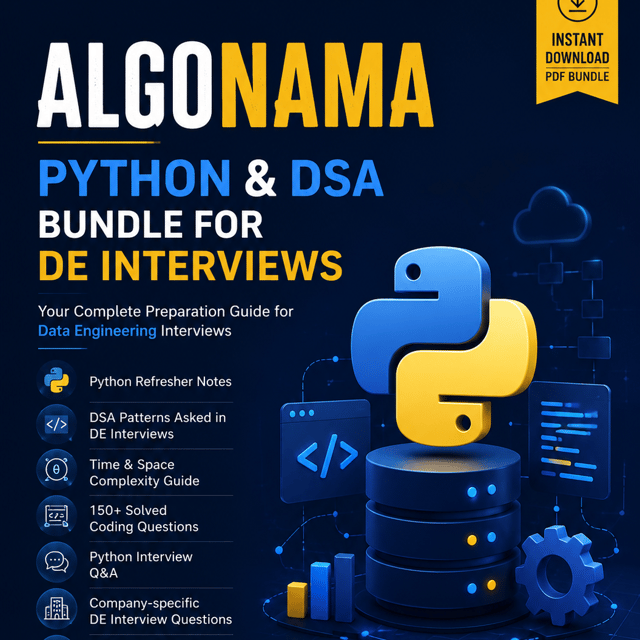
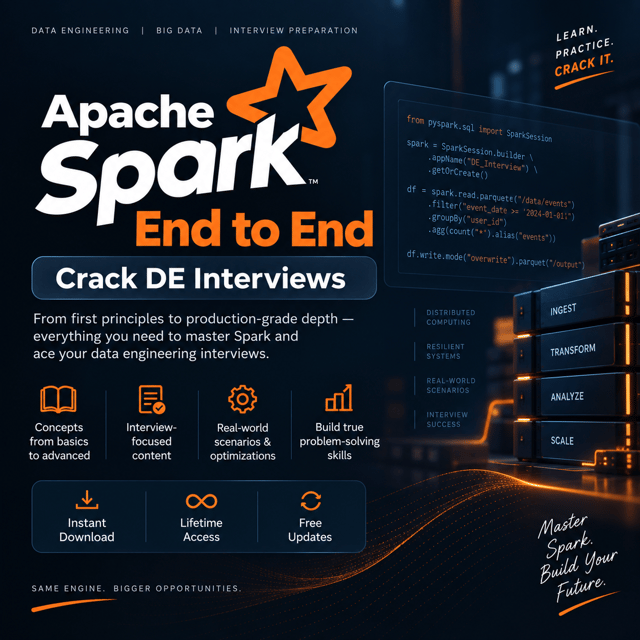
Algonama: Python & DSA Bundle for DE Interviews
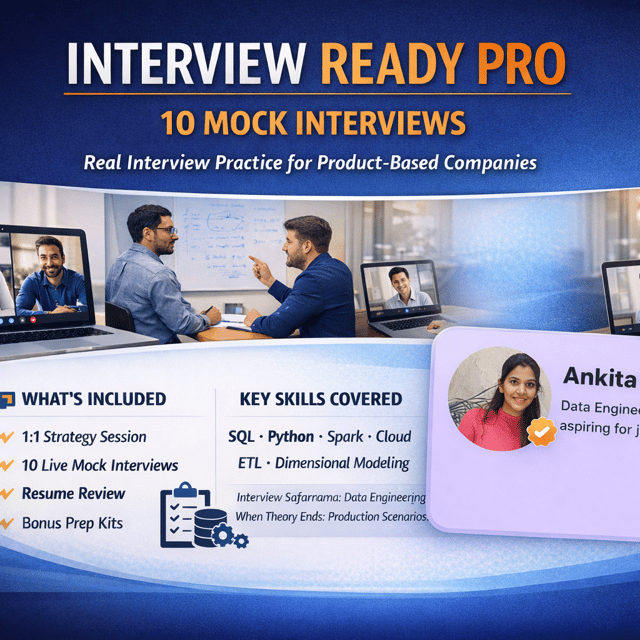
Interview Ready Pro – 10 Mock Interviews
Data Engineering Guidance - 6 Months
About me
- Ankita excels in Data Engineering guidance with structured, insightful sessions and effective interview prep.
 AI-generated based on testimonials
 - Change the World With Your Time. Come and Join Us!https://topmate.io/join/ankita_gulati

Frequently asked questions
How to crack a data engineer interview?
Focus on the four areas almost every company tests: SQL (joins, window functions, query optimization), Python with basic DSA, data modeling and warehousing concepts, and one or two end-to-end pipeline projects you can explain in depth. Add ETL/ELT, orchestration and system design basics on top, then practise under time pressure. Most candidates who "almost" make it lose marks on follow-up questions, so take a few mock interviews in the final stretch to find and fix weak spots before the real one.
How long does data engineering interview preparation take?
Data engineering interview preparation usually takes 2 to 3 months for freshers who are already comfortable with SQL and Python, and 4 to 6 months for working professionals switching into the field. What matters more than duration is consistency — daily SQL practice, one deep topic per week (Spark, warehousing, Airflow, etc.) and steady project work. A structured plan with weekly targets keeps you from drifting between random tutorials.
What are the most common data engineering interview questions for freshers?
Expect SQL-heavy questions on joins, GROUP BY, HAVING and window functions, Python questions on strings, lists and hashing, small Pandas or PySpark exercises, and concept questions on ETL vs ELT, OLTP vs OLAP, normalization and star schema. Interviewers also go deep into whatever project is on your resume, so be ready to explain your data flow, transformations and design choices line by line.
Which data engineering interview questions for experienced professionals come up most often?
At the experienced level, interviews shift from definitions to scenarios: debugging a slow pipeline, handling late-arriving or duplicate data, choosing incremental vs full loads, CDC, Spark partitioning and tuning, Airflow orchestration, data quality checks and cloud cost optimization. You will also face architecture trade-off discussions ("why this design?"), and if you are moving into a lead role, questions on mentoring, code reviews and stakeholder handling.
How to prepare for a data engineering system design interview?
First get comfortable with the core data engineering system design concepts — batch vs streaming, partitioning, idempotency, exactly-once vs at-least-once delivery, schema evolution, file formats and the latency-vs-throughput trade-off. Then practise a repeatable framework: clarify requirements, estimate data volume and freshness, choose storage, and design ingestion, processing, serving, monitoring and cost controls. Speak your designs aloud in 10–15 practice runs, ideally with feedback from someone who has sat on the interviewer's side.
What are the most common data engineering system design interview questions?
Typical prompts include designing a real-time analytics dashboard, a recommendation or personalization data pipeline, a fraud-detection stream, or an incremental reconciliation system for payments. The follow-ups matter as much as the prompt — how you handle late-arriving events, duplicates, backfills over historical data, small-files problems, schema changes and exactly-once guarantees is what the interviewer is really grading.
What does the data engineering roadmap for beginners look like?
Start with SQL until it is genuinely strong, then Python and basic DSA, Git, and database fundamentals. Next move to warehousing concepts, Spark, an orchestrator like Airflow, dbt and one cloud platform (AWS, GCP or Azure), while building two or three end-to-end projects that take raw data and serve clean, queryable tables. The data engineering roadmap for 2026 also adds cloud-native tooling and GenAI-aware data workflows, so basic familiarity with LLM-powered pipelines is becoming a real differentiator.
How do I answer "Why do you want to be a data engineer" in an interview?
Interviewers use this question to check whether your interest is genuine, so ground your answer in a specific moment — a project, dataset or problem where you enjoyed building the data foundation. Show you understand the role: data engineers make analytics and ML possible by keeping pipelines reliable, scalable and clean. Keep it to 60–90 seconds, connect it to your career path, and skip clichés like "data is the new oil".
How to crack the Netflix data engineer interview?
Treat it as a high-bar version of a standard DE loop: advanced SQL on large datasets, Python coding, data modeling, pipeline and system design at scale, plus a serious behavioral round. Prepare by practising SQL on very-large-dataset problems, designing both batch and streaming architectures, and rehearsing answers that show ownership and pragmatism. Because top companies probe depth relentlessly, doing company-focused mock interviews beforehand is one of the highest-ROI steps you can take.
Is it worth preparing from a data engineering interview questions and answers PDF?
A good PDF is useful for structured revision and a last-week recap, but it should not be your main preparation, because interviews are decided by follow-up questions rather than memorized answers. Use it as a checklist of topics, then practise writing the SQL, PySpark and design reasoning yourself. If you can explain every answer in your own words and handle a "why" after each one, you are interview-ready.
What tools do data engineers use?
The everyday stack starts with SQL and Python, then Spark (PySpark) for large-scale processing, Kafka for streaming, Airflow for orchestration and dbt for transformations. On the storage side, warehouses like Snowflake, BigQuery and Redshift dominate, usually running on AWS, GCP or Azure. Git is non-negotiable, and Docker basics plus awareness of at least one BI tool round out the profile for most roles.
What is data engineering?
Data engineering is the discipline of designing and building the systems that collect, store, move and process data reliably at scale. Data engineers build pipelines and infrastructure that turn raw events, logs and records into clean, trustworthy tables that analysts, scientists and applications depend on. It sits upstream of data analysis and data science — without it, dashboards and models run on broken or messy data.
Which data engineering system design book should I read?
There is no single official textbook, but Designing Data-Intensive Applications is the most commonly recommended for distributed data fundamentals, and Fundamentals of Data Engineering is helpful for the end-to-end lifecycle view. Read them for concepts, not as a syllabus — system design rounds test applied thinking, so pair the reading with 10–15 practised pipeline designs and honest feedback on your approach.