Testimonials
Services
Excel sheet template for qPCR analysis
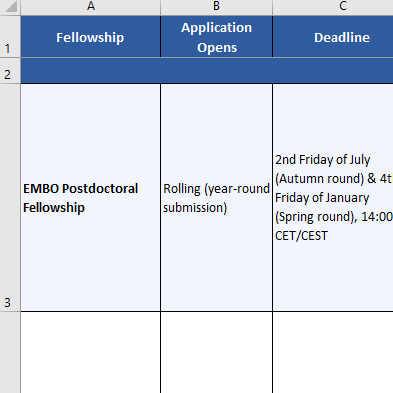
Postdoc Fellowships Tracker: EMBO, MSCA & 10 more
AI & Plagiarism Report (Drillbit)
Surviving PhD Without Burning Out!
My successfull ANRF–ITS Travel Grant Application
Research Paper Writing & Editing (Life Sciences)
Content Creation Consultation
Priority DM
MSCA Guidelines and Templates
Thesis_Track_Template
Scientific Poster Template
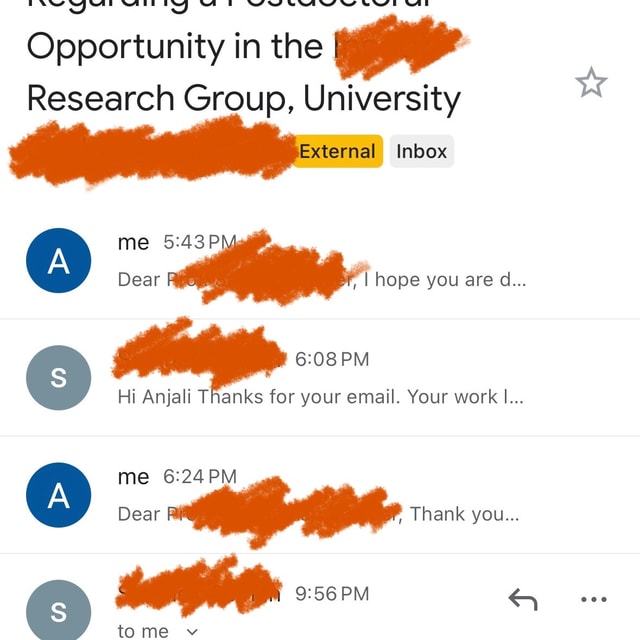
Email for PhD / Postdoc Applications
Email + CV that got me replies from abroad
PhD to Postdoc Guide (Emails, CV & Fellowship)
📄 CV, SOP & Professor Email Review (1:1 Call)
Study Abroad for PhD & Research
ASK YOUR DOUBTS !!
PhD & Research Career Clarity Call
Frequently asked questions
How to start CSIR NET Life Science preparation?
Start by downloading the official syllabus and breaking it into subject units, then honestly map your strong and weak areas against it. Begin with high-weightage units, build concepts from standard reference books, and start solving previous years' question papers early instead of saving them for the end. Add daily Part A aptitude practice, weekly revision, and a fixed study timetable to stay consistent.
What are the best CSIR NET preparation books for Life Sciences?
Most successful candidates rely on a small set of standard references rather than many books — Lehninger for biochemistry, Alberts for cell biology, Griffiths or Pierce for genetics, Kuby for immunology, Gilbert for developmental biology, Prescott for microbiology, and Futuyma for evolution. Use each book only for the syllabus topics it maps to, and pair your reading with previous year papers and a good question bank for revision. Reading every book cover to cover is neither possible nor necessary.
What is the best CSIR NET preparation strategy?
The strategy that works for most aspirants is unit-wise preparation followed by aggressive question practice: finish a unit, immediately solve topic-wise previous year questions, and take a full mock test every two weeks once roughly 60% of the syllabus is done. Keep separate, regular time for Part A because it is common for all candidates and highly scoring. Realistically, a focused CSIR NET preparation time of 6 to 9 months with 4–6 hours of daily study is enough for most people.
How to improve research paper writing skills?
Read papers in your field actively and note how the introduction is framed, how results are narrated, and how the discussion links back to the literature. Write regularly — even short summaries of papers you read — and get feedback from supervisors or peers on structure, clarity, and flow. Learn the issues reviewers most commonly flag, such as vague research questions, weak links between results and discussion, and poor figure captions, and fix them deliberately in every draft. Editing in multiple passes, structure first and language later, improves writing faster than perfecting a single draft.
What is the correct research paper writing format?
Most journals follow the IMRaD structure — Introduction, Methods, Results, and Discussion — along with a title, abstract, keywords, and references. The introduction narrows from broad context to your specific research gap, the methods should be detailed enough for reproducibility, the results present findings without interpretation, and the discussion interprets them against existing literature. Always check your target journal's author guidelines, because referencing style, word limits, and formatting rules vary across journals.
Is it safe to use AI for research paper writing?
Using AI for research paper writing is fine for polishing grammar, improving sentence clarity, and restructuring text, but generating the scientific content itself is risky. Universities and journals now screen manuscripts with plagiarism and AI-detection tools, and undisclosed AI-generated text can lead to rejection or even misconduct proceedings. Never paste unpublished data into public AI tools, and always run a plagiarism and AI-detection report before submitting a manuscript anywhere. Treat AI as an editing assistant, not an author.
Are research paper writing services in India safe to use?
It depends on what you use them for. Services that provide editing, proofreading, formatting, and feedback on your own manuscript are widely used by research scholars and are broadly acceptable. However, getting a paper written from scratch and submitting it as your own work is academic misconduct and is easily caught by plagiarism and AI-detection software. If you take outside help, remain the author of the science, verify every claim yourself, and run a final originality check before submission.
How to do bioinformatics analysis for my thesis data?
Start with a clear biological question and work backwards to the data and tools you need. A typical workflow is: retrieve your data from repositories like NCBI, clean and quality-check it, run the relevant analysis such as sequence alignment, phylogenetics, or differential expression, and then validate and visualize the results. Beginners can start with point-and-click tools like Galaxy and MEGA before moving to command-line work in R or Python. Document every step so your analysis is reproducible when your reviewer asks for it.
Which bioinformatics analysis tools should beginners learn first?
Start with BLAST for sequence similarity searches, Clustal Omega or MEGA for alignments and phylogenetic trees, and NCBI or UCSC Genome Browser tools for exploring data. Once comfortable, learn basic Linux commands and one scripting language — Python with Biopython or R with Bioconductor — because most advanced analysis tools are command-line based. Galaxy is an excellent browser-based platform for practising complete workflows without needing to code on day one.
What is a bioinformatics analysis pipeline?
A bioinformatics analysis pipeline is a fixed sequence of computational steps that converts raw biological data into a final, interpretable result. For example, a sequencing pipeline typically moves through quality checking, trimming, alignment, quantification or variant calling, and ends with visualization and statistical testing. Pipelines can be run manually or automated with workflow tools, and their main purpose is reproducibility, consistency, and scalability when many samples must be processed the same way.
How is bioinformatics analysis of NGS data done?
It usually begins with quality assessment of the raw reads using tools like FastQC, followed by adapter and quality trimming. The cleaned reads are then aligned to a reference genome, after which the workflow branches by application — variant calling for resequencing data, gene expression quantification for RNA-seq, or peak calling for ChIP-seq. The final stages involve statistical analysis, functional annotation, and visualization in tools like IGV, with quality metrics monitored at every step.
How to become a bioinformatics analyst in India?
A common path is a B.Sc. and M.Sc. in bioinformatics, biotechnology, or life sciences, combined with self-learned skills in Python, R, and Linux. Employers across pharma companies, genomics startups, and research institutes look for hands-on project experience with real datasets such as NGS data, so build a small portfolio of projects, for example on GitHub. Internships or dissertation projects in computational labs give you the practical exposure that sets candidates apart. Certificates help, but demonstrated projects and problem-solving in interviews matter far more.
What is phylogenetic analysis in bioinformatics?
Phylogenetic analysis is the study of evolutionary relationships among genes, proteins, or species, usually represented as a branching tree. The standard workflow involves collecting homologous sequences, aligning them, choosing an appropriate evolutionary model, and building the tree using methods like maximum likelihood or Bayesian inference, with bootstrap values showing branch support. It is widely used in species classification, tracing disease outbreaks, identifying gene families, and studying molecular evolution.
How do I write an email to a professor for PhD admission?
Keep the email short, specific, and professional. Use a clear subject line, open with who you are and why you are writing, briefly mention your academic background, and — most importantly — explain why that professor's specific research interests you, ideally referring to one of their recent papers. Attach a one-page CV and close with a polite request to discuss possible openings. Avoid mass-mailing identical emails; professors can spot generic messages instantly and rarely reply to them.
How can I get a travel grant for an international conference?
Start by checking whether the conference itself offers student or early-career researcher travel awards, since most major international conferences do. In India, government research bodies also run International Travel Support schemes that fund meritorious researchers presenting accepted work, and many universities have departmental or doctoral research grants for conference travel. Applications typically need your accepted abstract, a justification statement, and cost estimates, so apply as soon as your paper is accepted — funds are limited and deadlines usually fall well before the conference dates.