Testimonials
Services
Free Data PDF'S
POWER BI GUIDE
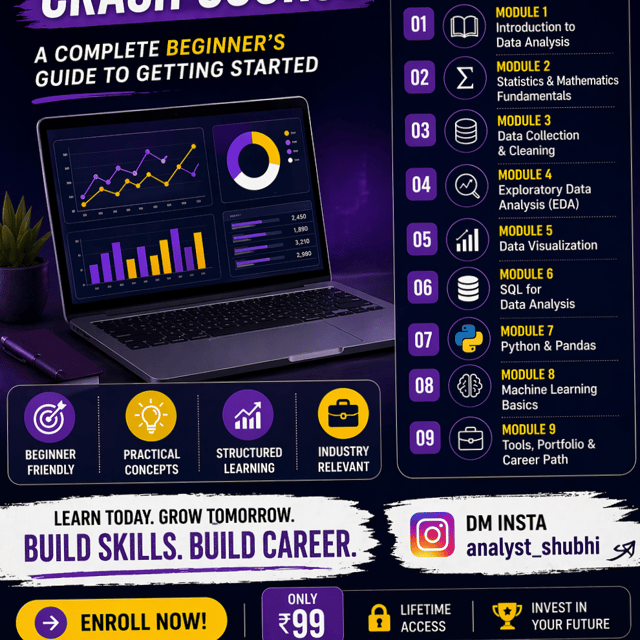
Data Analysis Crash Course (Beginner to Job-Ready)
DATA ENGINEERING NOTES
Premium Resource📊📈
All Data Analytics Resource Bundle
Direct Chat for Data Analytics Mentorship
PL SQL PROJECT GUIDE
Full Python Notes
AI Crash Course for Beginners
Snowflake Complete Notes 🖇️
Career guidance and Mentorship
Career Guidance + Queries (30-Min Strategy Call)
Mock Interview
About me
Frequently asked questions
How to become a data analyst in India?
If you are wondering how to become a data analyst, the proven path for Indian freshers is: strengthen Excel first, then learn SQL deeply (the most-tested skill in interviews), then Power BI for dashboards, followed by basic Python and statistics. Build two or three end-to-end projects on real datasets, turn them into a one-page resume and portfolio, and start applying while preparing for interviews. With consistent effort of 4–6 months, freshers from any stream can become job-ready without an expensive degree.
What should a data analyst roadmap for freshers include?
A practical data analyst roadmap for freshers should move in this order: Excel (formulas, pivot tables, charts) → SQL (joins, aggregations, window functions) → Power BI (dashboard building, DAX basics) → statistics fundamentals → Python with pandas as an add-on. The final stage must be 2–3 portfolio projects plus resume and interview preparation. Avoid the common mistake of learning five tools at once — depth in SQL and one visualisation tool beats surface-level knowledge of many.
Is the data analyst roadmap 2026 different from earlier years?
The core of the data analyst roadmap 2026 is still Excel, SQL, Power BI and Python, but hiring expectations have risen. Employers increasingly want familiarity with cloud data platforms such as Snowflake, comfort using AI tools to work faster, and the ability to explain insights to non-technical business teams. Freshers who combine the classic skill set with one cloud warehouse and strong data storytelling stand out noticeably in 2026 applications.
Is a data analyst roadmap PDF enough to become job-ready?
A data analyst roadmap PDF works well as a checklist, but a PDF alone will not get you hired. The roadmap only tells you what to learn; job-readiness comes from executing it — writing SQL queries daily, building dashboards on real datasets, and getting feedback on your projects from mentors or peers. Pair the PDF with consistent hands-on practice so you spend your months building skills instead of just collecting resources.
Can I follow the data analyst roadmap after 10th?
Yes — starting the data analyst roadmap after 10th gives you a multi-year head start. Begin with school-level maths and statistics, then Excel, and gradually basic SQL and Python. Since most analyst jobs in India require a bachelor's degree, use your 11th, 12th and college years to build projects and certifications. You will then graduate with a portfolio most freshers simply do not have.
How to crack a data analyst interview without work experience?
If you want to know how to crack a data analyst interview without experience, replace experience with proof: be able to write SQL queries live, walk through one project end-to-end (problem → data → cleaning → analysis → business insight), and practise guesstimates and case questions out loud. Interviewers do not expect freshers to have corporate exposure — they evaluate fundamentals, structured thinking, and honesty about what you have not used yet.
How long does data analyst interview preparation take?
Focused data analyst interview preparation usually takes 6–8 weeks. Spend 3–4 weeks on daily SQL practice (this is where most candidates get eliminated), 1–2 weeks revising Excel, Power BI and statistics, one week turning your projects into impact stories, and the final week on mock interviews and company research. Skipping mock interviews is the most common reason well-prepared candidates still get rejected.
What are the most common data analyst interview questions?
Common data analyst interview questions fall into five buckets: SQL (joins, GROUP BY, window functions, handling nulls and duplicates), Excel (VLOOKUP/XLOOKUP, pivot tables, data cleaning), Power BI (measures vs calculated columns, DAX basics, dashboard design), statistics (averages, distributions, correlation, A/B testing), and project deep-dives where you explain your work and its impact. Many companies in India also add a guesstimate or case-study round to test business thinking.
What are common data analyst interview questions and answers for freshers?
Most data analyst interview questions and answers for freshers stay close to fundamentals — types of SQL joins, WHERE vs HAVING, primary key vs foreign key, cleaning a messy dataset, and a walkthrough of your best project. What interviewers actually judge is how you structure answers: state your approach first, add the details, finish with the result. Memorised answers fall apart under follow-up questions, so practise explaining concepts in your own words.
What are common data analyst interview questions for 3 years of experience?
Data analyst interview questions for 3 years of experience shift from definitions to ownership. Expect advanced SQL (window functions, query optimisation), why you designed a dashboard the way you did, the measurable business impact of your analysis, how you handled conflicting stakeholder requirements, and why you want to switch. Prepare two or three detailed project stories with numbers — at this level, impact decides offers more than tool knowledge.
Is it enough to prepare from a data analyst interview questions and answers PDF?
A data analyst interview questions and answers PDF is useful for revision and for spotting question patterns, but it is not enough on its own. Interviews test live performance: writing SQL without references, thinking aloud through a case, and communicating clearly under pressure. Use the PDF to shortlist topics, then practise on an actual SQL editor, answer questions out loud, and complete at least a few mock interviews before the real one.
How to make a data analyst resume that gets shortlisted?
If you are unsure how to make a data analyst resume that gets shortlisted, follow this structure: a skills section at the top (SQL, Excel, Power BI, Python), two or three projects written as "action + tool + measurable result" bullets, then education and certifications. Mirror keywords from each job description so your resume clears ATS filters, keep it to one page as a fresher, and quantify everything — "cut reporting time by 30%" beats "responsible for reporting".
How to make a data analyst resume with no experience?
Wondering how to make a data analyst resume with no experience? Treat projects as your experience — academic projects, self-built dashboards on public datasets, internships, and certifications all count. A strong data analyst resume for freshers opens with skills, leads with quantified project outcomes, and ends with education and certifications. Publish your dashboards (Power BI service, GitHub, Tableau Public) and add links so recruiters can actually verify your work.
Should I use a data analyst resume template?
Yes — a data analyst resume template saves formatting time, but choose the right kind. Pick a simple, single-column, ATS-friendly layout with standard section headings; avoid graphic-heavy templates with photos, icons, tables or multiple columns, because ATS software often misreads them and rejects the file before a human ever sees it. Use the template only for structure — your keywords, projects and numbers must be customised for every application.
What should a data analyst resume for 3 years of experience highlight?
A data analyst resume for 3 years of experience should highlight business impact over tool lists — for example, "automated weekly reporting in SQL, saving 10 hours a week" or "built Power BI dashboards used by 200+ users". Show end-to-end ownership of projects, advanced skills such as window functions, Snowflake or Python automation, and stakeholder management. Remove college projects and coursework, cap the resume at two pages, and lead every bullet with a number wherever possible.