Testimonials
Services
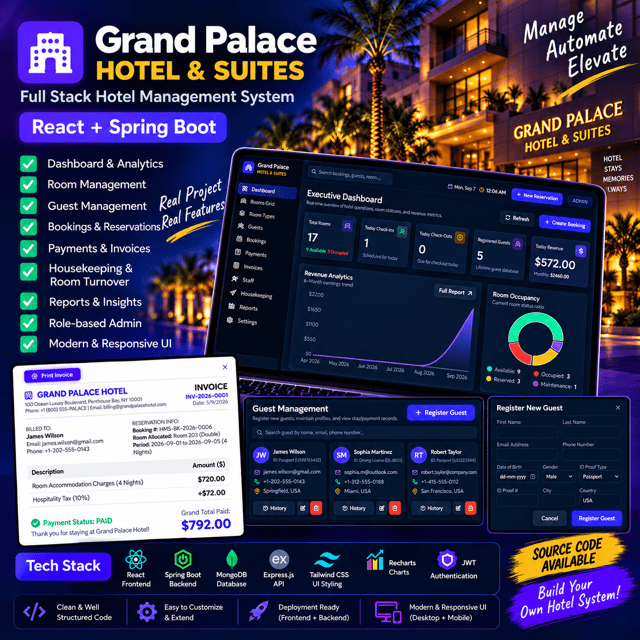
Full Stack Hotel Management – React + Spring
Java Backend Interview Success Kit
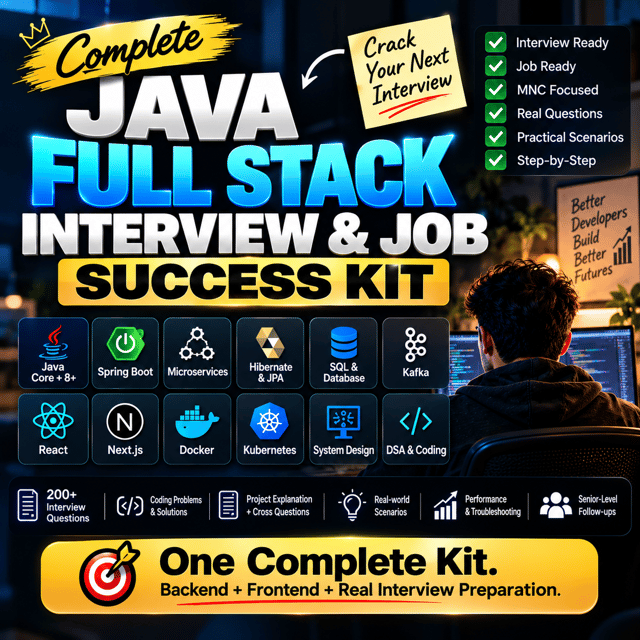
Java Full Stack Interview & Job Success Kit
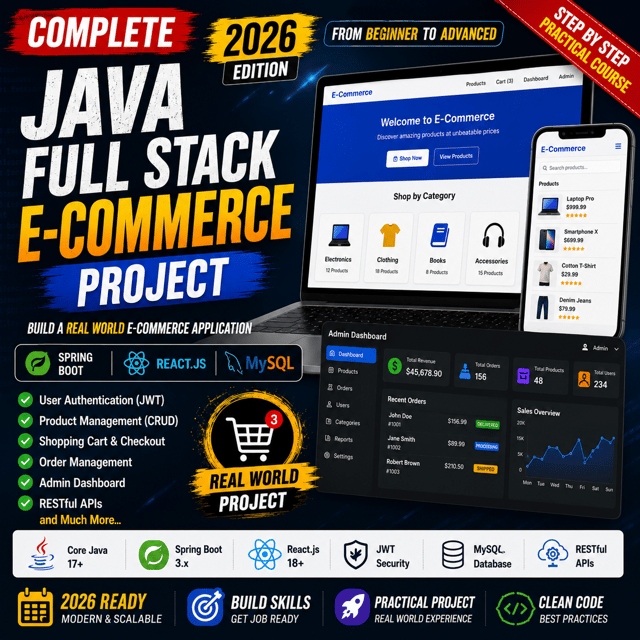
🚀 Java Full Stack E-Commerce: Zero to Production
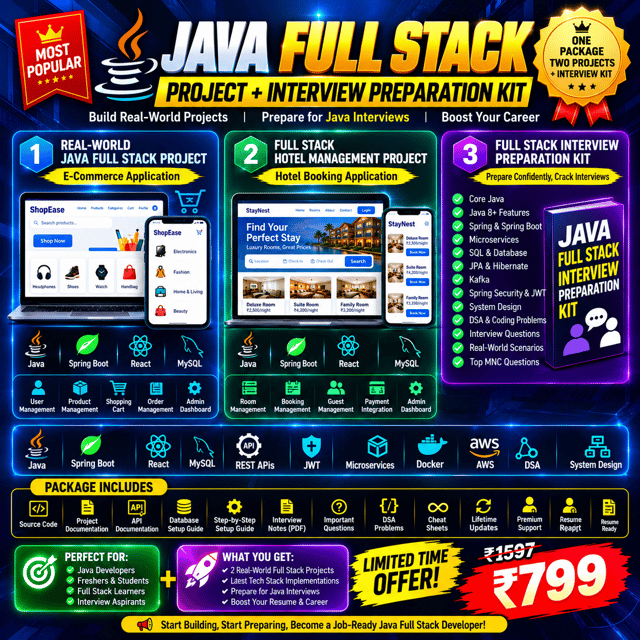
JAVA FULL STACK PROJECT + INTERVIEW PREPARATION
About me
Frequently asked questions
What is a Java full stack developer?
A Java full stack developer builds both the front end (what users see) and the back end (server logic, APIs, database) of web applications using Java-centric technologies. In India, this typically means Core Java, Spring Boot, REST APIs, Hibernate/JPA, and MySQL or PostgreSQL on the back end, plus HTML, CSS, JavaScript, and a framework like React or Angular on the front end. Because one person can handle an application end-to-end, these developers are in steady demand across both service-based and product companies in India.
How to become a Java full stack developer in India?
Start with Core Java (OOPs, collections, exception handling), then move to SQL, JDBC, Hibernate, Spring, and Spring Boot along with REST API development, and finish with one front-end stack like React or Angular. Build at least 2–3 real, deployable projects — for example an e-commerce app with authentication, payments, and CRUD — push them to GitHub, and practise DSA basics, since Indian interviews test all three. With a structured roadmap and mentor feedback, this can take around 6–9 months; without guidance, it usually takes longer.
Which Java full stack developer skills should I learn first?
Begin with Core Java and SQL, because every other skill builds on them. Next, learn Spring Boot, REST APIs, Hibernate/JPA, and Git, then pick one front-end framework — React or Angular — along with HTML, CSS, and JavaScript. Add supporting tools like Maven and a cloud platform for deployment, and build a small project at every stage, because interviewers in India test these skills mainly through project deep-dives rather than theory alone.
What is a realistic Java full stack developer roadmap for beginners?
A practical timeline is: months 1–2 for Core Java, OOPs, collections, and basic DSA; months 3–4 for SQL, JDBC, Hibernate, Spring Core, and Spring Boot while building small REST APIs; months 5–6 for one front-end framework and a full-stack capstone project with login, payments, and cloud deployment. The final phase is interview preparation — revising Java and Spring Boot theory, practising coding questions, and doing mock interviews — which is exactly where most self-learners stall without feedback.
Is joining a Java full stack developer course worth it, or can I learn on my own?
You can self-learn using free documentation, YouTube, and tutorials, but many beginners in India stall because they collect certificates without building interview-worthy projects or getting their code reviewed. A Java full stack developer course is worth it only if it is project-based, covers Spring Boot in depth, includes interview preparation, and gives personal feedback on your resume and code. If you have the discipline to follow a roadmap and build projects independently, self-learning works; if you need structure and accountability, guided training gets you there faster.
How to learn Java full stack development for free?
Use free, high-quality resources: official Java and Spring documentation, full-length YouTube courses, freeCodeCamp and GeeksforGeeks tutorials, and GitHub for project ideas. Follow an order — Core Java → SQL → Spring Boot and REST APIs → one front-end framework → build and deploy 2–3 projects. The free route genuinely works, but you must be strict about building rather than just watching, and actively seek feedback from communities, because recruiters in India shortlist primarily on real projects and clear project explanations, not certificates.
Are there enough Java full stack developer jobs in India for freshers?
Yes — Java remains one of the most demanded stacks in India, with consistent openings in service giants like TCS, Infosys, Wipro, and Accenture as well as product startups hiring for backend and full stack roles. The catch is that freshers with only certificates struggle to get shortlisted; companies look for deployable projects, solid Core Java and SQL, and Spring Boot fundamentals. Expect roughly 3–6 months of focused preparation to land the first offer, and treat the first job as a source of real project exposure rather than a brand name.
What are the top Java full stack developer interview questions?
Expect a mix across four areas: Core Java (OOPs, String immutability, HashMap internals, exception handling, multithreading), Spring and Spring Boot (dependency injection, annotations, auto-configuration, bean lifecycle), databases (SQL joins, Hibernate/JPA, the N+1 problem), and your own projects (architecture, challenges, and why you chose each technology). Freshers should also prepare basic DSA and SQL queries. The real differentiator in Indian interviews is depth on your resume projects, so be ready to justify every technology you have listed.
What are the most common Java interview questions for freshers?
Freshers are mostly tested on fundamentals: JDK vs JRE vs JVM, why Java is platform-independent, OOPs pillars with real examples, String immutability, ArrayList vs LinkedList, how HashMap works, equals and hashCode, exception handling, final/finally/finalize, and simple programs like reversing a string or finding duplicates. Most freshers fail not because they skip these topics but because they memorise answers without understanding — interviewers quickly add a "why" follow-up. Practising Java interview questions for freshers out loud, with reasoning, beats silently reading question banks.
Do Java interview questions and answers for experienced developers differ from what freshers face?
Yes, significantly. Java interview questions and answers for experienced candidates move beyond definitions into JVM internals, garbage collection, concurrency, collections internals, design patterns, microservices, Spring internals, and system design rounds, along with deep grilling on real projects — bottlenecks you fixed and trade-offs you made. Freshers get tested on basics and straightforward coding, while experienced rounds judge how you have actually applied Java in production. That is why mid-career candidates cannot rely on fresher question banks alone.
What are the most asked Spring Boot interview questions?
The recurring ones are: what Spring Boot is and how it differs from Spring, auto-configuration, the internals of @SpringBootApplication, dependency injection and IoC, bean scopes and lifecycle, @RestController vs @Controller, embedded servers, Spring Data JPA, exception handling with @ControllerAdvice, and securing APIs with Spring Security and JWT. For backend roles in India, interviewers almost always follow up with "where did you use this in your project?", so anchor every Spring Boot interview answer to something you have actually built.
How to prepare for a Spring Boot interview?
Prepare in three layers: theory (annotations, auto-configuration, bean lifecycle, REST best practices), hands-on work (build and be able to defend at least one REST/CRUD project with a database and validations), and scenario questions (error handling, performance, security with JWT). Keep revising Core Java alongside, because Spring Boot interviews in India almost always loop back to Java fundamentals. In the final week, do mock interviews and practise explaining your project architecture in two minutes — if you cannot summarise it simply, you are not ready yet.
How to explain a Spring Boot project in an interview?
Use a fixed structure: (1) one line on the app's purpose and the problem it solves; (2) the architecture — layers, modules, and why you separated them; (3) the tech stack with reasons — why Spring Boot, why MySQL or PostgreSQL, why JWT; (4) two or three key features walked end-to-end from controller to service to repository; (5) one real challenge and how you debugged or optimised it. Interviewers judge clarity, not project size, and they will probe whatever you mention, so never name a technology you cannot defend — and rehearse the explanation in a mock setting with a mentor or peer before the real interview.
What is Spring Boot and how does it work?
Spring Boot is an opinionated framework built on top of Spring that removes boilerplate configuration so you can create production-ready Java applications quickly. It works through auto-configuration (it inspects your classpath and configures beans automatically), embedded servers like Tomcat (so you skip manual WAR deployment), and starters — dependency bundles like spring-boot-starter-web that pull in everything needed for a given task. With annotations like @SpringBootApplication, Spring Boot wires up the entire Spring context for you, which is why it has become the default choice for Java backend development in India.