Testimonials
Services
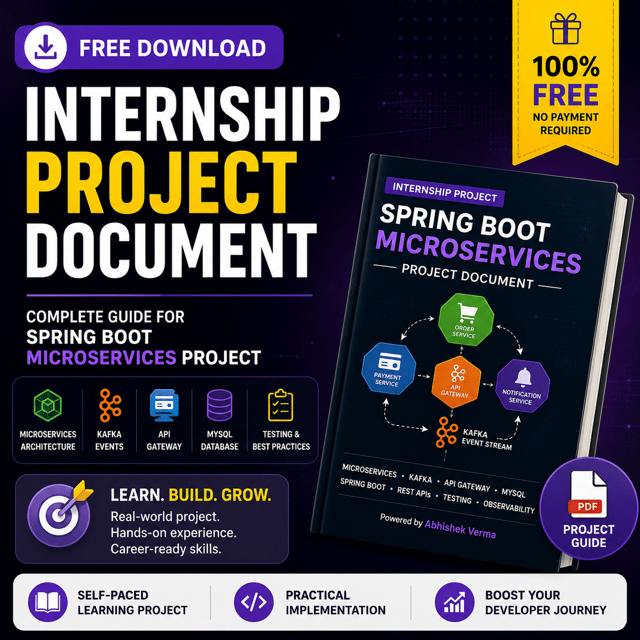
Spring Microservices Internship Project
Spring Microservices with Spring Boot
CV/Resume Review
Advanced Java
Java Database Connectivity (JDBC)
Spring Basics with Spring Boot
Interview Questions
Spring REST with Spring Boot
Spring REST Internship Experience
List of annotations in Java
Quick Chat
Java Developer Roadmap
Maven
Hibernate
Spring Data JPA with Spring Boot
About me
- Abhishek has been a reliable and dependable team member, consistently exceeding deadlines and providing essential support in resolving production-related issues. His continuous stream of breakthrough ideas and his dedication to the team's success set him apart. He collaborates readily with colleagues and offers support whenever needed, reflecting his commitment to both individual tasks and overall team progress.AI-generated from recommendations on

Frequently asked questions
What is Spring Boot and how does it work?
Spring Boot is an opinionated framework built on top of the Spring ecosystem that lets you create stand-alone, production-ready Java applications with minimal setup. It works through three core mechanisms: starters, which are curated dependency bundles (such as spring-boot-starter-web) that pull in everything needed for a task; auto-configuration, where Spring Boot inspects your classpath and configures the required beans automatically; and an embedded server like Tomcat, which means you run the application as a simple jar instead of deploying a war externally. With @SpringBootApplication as the entry point, everything gets wired together automatically, which is what makes development so much faster.
What is Spring Boot and what are its advantages?
Spring Boot is a framework designed to simplify building Java applications, and its main advantages are: it removes most manual configuration through auto-configuration and sensible defaults; starter dependencies keep your pom.xml or build.gradle clean; the embedded server lets you launch the app with a single command; Actuator provides production-ready features like health checks and metrics out of the box; testing is simplified with built-in support; and it has become the standard choice for building microservices in Java. This is also why Spring Boot now appears in almost every Java backend job description.
What is Spring Data JPA used for?
Spring Data JPA is used for simplifying database access in Java and Spring Boot applications. Instead of writing repetitive DAO boilerplate, you declare a repository interface (for example, extending JpaRepository), and Spring Data JPA automatically generates the standard CRUD operations along with pagination and sorting. It also supports derived query methods, where the query is generated from the method name, and custom queries through the @Query annotation. In short, it is the standard way to talk to a relational database in a Spring Boot project because it removes boilerplate and reduces errors.
Spring Data JPA vs Hibernate: what is the difference?
They operate at different layers and are not competing options. JPA (Java Persistence API) is a specification that defines how Java objects should be mapped to database tables. Hibernate is an implementation of that specification that performs the actual ORM work. Spring Data JPA is a Spring project that sits on top of a JPA provider — Hibernate by default — and further reduces boilerplate by generating repository implementations for you. So in a typical Spring Boot application you actually use all three together: Spring Data JPA for repositories, JPA as the API, and Hibernate underneath as the persistence provider.
How to add the Spring Data JPA dependency in Spring Boot?
In a Maven project, add the spring-boot-starter-data-jpa dependency to your pom.xml; in Gradle, add it as an implementation dependency. You do not need to specify a version because the Spring Boot parent manages it. This starter brings in Spring Data JPA, the JPA (Jakarta Persistence) API, and Hibernate as the default provider. Along with it, add the JDBC driver for your database — such as mysql-connector-j for MySQL or the PostgreSQL driver — and then configure the datasource URL, username, and password in application.properties.
How to use Spring Data JPA in a Spring Boot project?
Follow a simple sequence: add the spring-boot-starter-data-jpa starter and your database driver; configure the datasource details in application.properties; create an entity class annotated with @Entity and mark the primary key with @Id and @GeneratedValue; then create an interface for that entity extending JpaRepository with the entity and its ID type. After that, inject the repository into your service layer and call methods like save(), findById(), findAll(), and deleteById(). Spring Boot auto-configures the EntityManagerFactory and transaction manager, so no extra setup is needed — just use @Transactional on service methods that perform multi-step writes.
What are Spring Data JPA query methods and how do they work?
Query methods, also called derived query methods, are repository methods whose names Spring Data JPA parses to generate SQL automatically. For example, findByEmail(String email) produces a select with a where clause on the email column, and findByLastNameAndFirstName combines two conditions with the And keyword. Supported keywords include Or, Between, GreaterThan, LessThan, Like, Containing, In, IsNull, OrderBy, and Top or First for limiting results, along with countBy, existsBy, and deleteBy prefixes. When a method name becomes too long or you need joins and aggregations, switch to @Query with JPQL or a native SQL query instead.
What are the most commonly asked Spring Data JPA interview questions?
Interviews usually focus on a few core themes: the difference between JPA, Hibernate, and Spring Data JPA; CrudRepository vs JpaRepository; how derived query methods work; FetchType.LAZY vs EAGER; the N+1 select problem and its fixes using fetch joins and @EntityGraph; how @Transactional works and its common pitfalls; pagination using Pageable; and optimistic locking with @Version. Preparing a short code example for each of these makes a far stronger impression than memorized one-line definitions.
What is the full form of Spring Data JPA?
JPA stands for Java Persistence API — the Java specification for object-relational mapping. After Java EE moved to the Eclipse Foundation as Jakarta EE, the specification was renamed Jakarta Persistence, though JPA remains the term used everywhere in practice. So in Spring Data JPA, the JPA refers to that specification: Spring Data JPA itself is neither the specification nor a provider like Hibernate, but a repository abstraction layered over a JPA provider.
What are the most important Java interview questions for freshers?
Freshers are mainly tested on core fundamentals: the four OOP pillars with real examples; String immutability and the String pool; the difference between == and equals() along with the hashCode() contract; Collections, especially ArrayList vs LinkedList and the internal working of HashMap; exception handling including checked vs unchecked exceptions; static, final, and this keywords; JVM vs JRE vs JDK; basic multithreading; and simple programs like reversing a string, checking anagrams, or printing the Fibonacci series. Crisp two-to-three-line answers paired with small code snippets work best.
What are the top Java interview questions and answers for experienced candidates?
For candidates in the 3–10 years experience range, interviews go deeper than definitions: JVM internals such as memory areas, classloading, and garbage collection; concurrency topics like volatile, synchronized vs ReentrantLock, ConcurrentHashMap, and thread pools; Collections internals and fail-fast vs fail-safe iterators; Spring and Spring Boot internals including bean lifecycle, dependency injection, auto-configuration, and @Transactional pitfalls; JPA and Hibernate performance issues like lazy loading, caching, and the N+1 problem; microservices patterns; and increasingly, system design plus DSA rounds. Anchor every answer to a real problem you solved in a project, and test your readiness with a mock interview before the actual one.
What should a good Spring Boot tutorial for beginners cover?
A solid beginner path should cover: creating a project with Spring Initializr and understanding its structure; building REST APIs with @RestController, handling path variables, request bodies, and status codes; connecting to a real database with Spring Data JPA; validation and centralized exception handling; Spring Security basics; and finishing with a small end-to-end CRUD project you can put on your GitHub and resume. Tutorials that only list annotations without building a working application leave serious gaps, so always prefer ones that build something complete.
Should I learn Spring Boot from a Spring Boot tutorial in Hindi or in English?
Choose whichever language keeps you learning consistently, because consistency matters more than the medium. Hindi tutorials are genuinely helpful for building intuition quickly when a concept feels heavy in English. One caution though: interviews, official documentation, error logs, and most codebases are in English, so note every technical term in English — dependency injection, auto-configuration, repository, bean — even while following a Hindi tutorial. A practical combination is to learn concepts in the language you are most comfortable with, then practice and read documentation in English.
Is a Spring Boot tutorial PDF enough to learn Spring Boot?
A PDF is useful for revision — annotation cheat sheets, configuration snippets, and question banks are handy to study offline. As your only learning source, it falls short because Spring Boot evolves quickly: versions change, packages move to Jakarta, and features get deprecated, so a PDF can become outdated within a couple of releases. The effective approach is to learn from an up-to-date video tutorial or the official documentation, and then use a PDF for quick revision of annotations, common configurations, and notes before interviews.