Testimonials
Services

Sreyashi's Content Marketing Suite: 3 in 1
SaaS Content Marketer Handbook
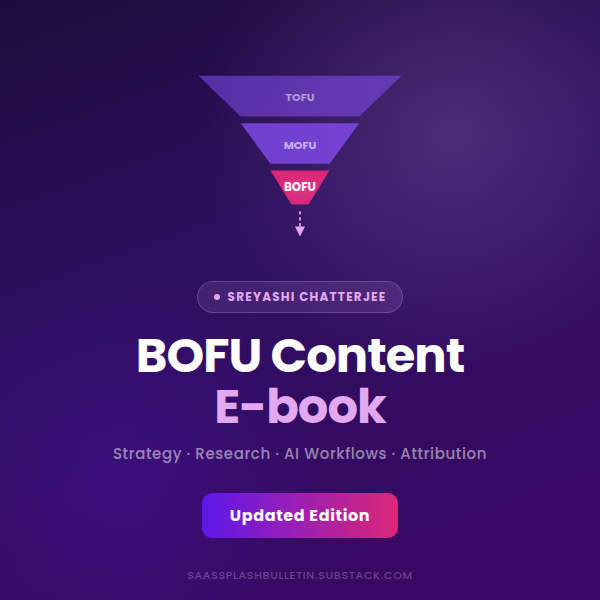
Sreyashi's BOFU Content E-book (Updated)
About me
Frequently asked questions
What is B2B SaaS content marketing?
B2B SaaS content marketing is the practice of creating content — blog posts, case studies, comparison pages, playbooks, and LinkedIn content — to attract, educate, and convert business buyers for software products. It differs from general content marketing because SaaS buying involves longer sales cycles, multiple decision-makers, and bottom-funnel actions like demo requests and trial signups. The goal is pipeline and revenue, not traffic for its own sake.
What is SaaS in marketing?
In marketing, SaaS stands for Software as a Service — software sold on a subscription basis instead of a one-time license. SaaS marketing therefore focuses on the entire subscription journey: creating awareness, driving free trials or demos, onboarding users, and retaining and expanding accounts. Because buyers experience the product before and after paying, content plays a much bigger role in SaaS marketing than in most other industries.
How to create a B2B content strategy that drives pipeline?
Start with positioning before production: define who your ideal customer is, what problem you solve better than alternatives, and what evidence proves it. Then map content to funnel stages, prioritize bottom-funnel topics tied to real sales conversations, set goals linked to pipeline rather than pageviews, and choose a publishing cadence your team can actually sustain. Most teams fail because they chase volume first — a B2B content marketing strategy only works when clarity comes before content.
Which B2B content strategy framework works best for early-stage SaaS teams?
Early-stage teams do best with a simple five-part framework: (1) define your ICP and positioning, (2) map the buyer journey, (3) shortlist a small set of BOFU and MOFU topics drawn from sales conversations, (4) produce fewer, deeper pieces consistently, and (5) review pipeline impact monthly. If you're looking for a B2B content strategy template, remember that a template only helps once these strategic inputs are filled in — otherwise it becomes just a content calendar with extra columns.
What should a B2B content strategy for 2026 look like?
Leaner and more revenue-focused. With AI-generated content flooding search results, generic top-of-funnel posts are losing visibility, so effective strategies now lean on original insights, first-hand experience, and BOFU content that answers the exact questions buyers ask before a demo. Getting cited by AI search tools and LLM assistants, along with content that directly supports sales, will matter far more than publishing volume.
What is the difference between TOFU, MOFU and BOFU content?
The three terms describe stages of the buyer journey. TOFU content builds awareness for people just discovering a problem, MOFU content educates buyers comparing possible approaches, and BOFU content helps buyers who are ready to choose a specific solution. The intent behind each stage is different, which is why many SaaS teams see weak pipeline when nearly all their content sits at the TOFU level.
What is BOFU content and why does it matter for SaaS companies?
BOFU (bottom-of-funnel) content targets buyers who are actively evaluating solutions and close to a decision — the people comparing vendors, pricing, and proof. It matters because this small set of pages is usually what drives demos, trials, and revenue, yet many SaaS teams invest almost everything in top-of-funnel blogs and starve the stage where deals are actually won.
How to write BOFU content that actually converts?
Start from real sales conversations: list the objections, questions, and competitor comparisons buyers raise, and address each one directly on the page. Be specific about use cases, pricing, and trade-offs instead of vague claims, and back every point with proof such as customer results or data. For BOFU content examples worth studying, look at "X vs Y" comparison pages, case studies with hard numbers, migration guides, and ROI-focused breakdowns.
What does a B2B content strategist do?
A B2B content strategist decides what content a company should create, why, and how it supports business goals — covering audience and positioning research, topic prioritization, funnel mapping, content briefs, distribution planning, and measurement. The role is different from a writer who executes briefs: a strategist ensures every piece maps to a buyer stage and a revenue outcome. In early-stage SaaS teams, the role often extends into messaging and sales enablement as well.
How to measure SaaS content marketing?
Move beyond pageviews and track signals tied to the funnel: organic demo requests and signups from content pages, rankings for bottom-funnel keywords, content-influenced pipeline and revenue through CRM attribution, and conversion rates from article to trial. A practical method is to tag every piece by funnel stage and review monthly which stage actually produces pipeline — if TOFU traffic grows while conversions stay flat, the mix needs rebalancing toward BOFU.
What are the most common SaaS content marketing mistakes?
The biggest ones are publishing high volumes of generic posts without clear positioning, copying competitor keywords instead of owning a niche, skipping BOFU content entirely, writing for search traffic instead of buyers, and judging success by impressions rather than pipeline. Almost all of these trace back to one root cause — creating content before the strategy is clear. A focused content strategy audit usually exposes these gaps quickly because it tests content against revenue goals, not publishing targets.
Should I hire a SaaS content marketing agency in Bangalore or work with a remote consultant?
Location matters far less than fit. Working with a SaaS content marketing agency in Bangalore can suit teams that want full execution bandwidth and in-person collaboration, while a remote consultant often works better for early-stage teams that need strategy, positioning, and BOFU content rather than bulk production. Whatever you choose, judge the SaaS content marketing agency or consultant on hands-on SaaS experience and how clearly they connect content to pipeline — not on city or headcount.
What are some SaaS content marketing examples worth studying?
Study SaaS companies that own high-intent search real estate: comparison and alternatives pages, case studies built on concrete customer outcomes, educational content that solves a problem the product itself addresses, and practitioner-led content on LinkedIn that builds trust before any pitch. The strongest SaaS content marketing examples share one trait — they answer the exact questions a buyer types before booking a demo, instead of chasing broad, crowded keywords.
Is a SaaS content marketing course worth it?
It depends on your stage. A structured SaaS content marketing course or handbook helps when you're starting out and need the fundamentals — funnel mapping, content briefs, measurement — organized in one place instead of scattered across blogs and videos. If you already work in content but are stuck on strategy problems specific to your product, a live 1:1 session with a practitioner who has actually executed usually beats another recorded course, because you get feedback on your real situation.