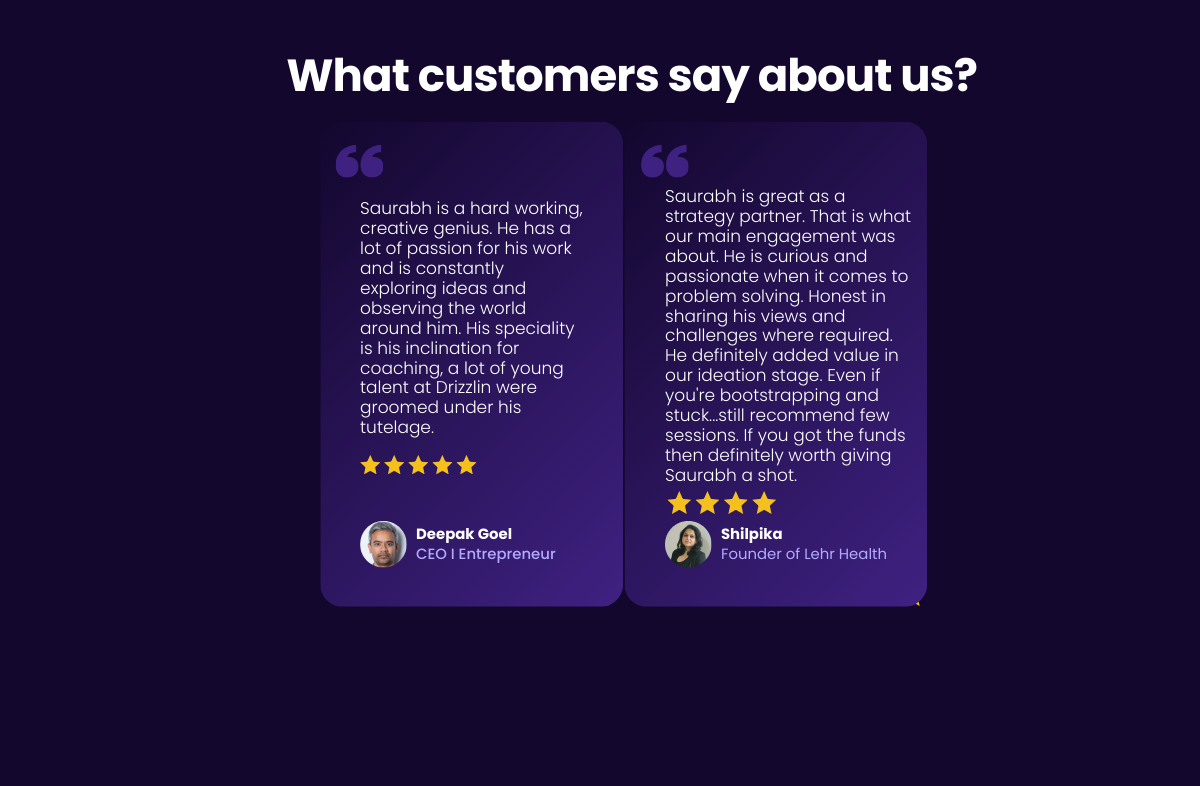
Testimonials
Services
3 x 1:1 Consultation Package (75 mins each) ☕️ 🧠
Comprehensive Mentoring 🧠
1:1 Consultation or Mentorship 💬 🧠
Microconsultation 🧠 : The Affordable Solution
Workshop - AI, Marketing, Crisis Communication...📈
About me
- I've worked with many branding and marketing experts across my career, but Saurabh has been one of the best I've ever seen.Recommended by Ananya Gambhir on

- Live Q&A- Using Jugaad or Creativity to solve business problems - Saurabh Parmar - YouTubehttps://www.youtube.com/watch?v=J3OkzYNqhVw

- ROI delivered 🎯 - Completely Unedited testimonialshttps://socialjuice.io/p/altstrategy-consultations/wall
Frequently asked questions
What does fractional CMO mean?
A fractional CMO is a senior marketing leader who works with a company for a fraction of the time a full-time CMO would — typically a few days a month — while serving multiple clients. You get CMO-level thinking on brand, digital, growth, and team direction without paying a full-time salary, which is why startups and growing businesses increasingly prefer this model.
What are fractional CMO services?
Fractional CMO services usually cover owning the marketing function part-time: shaping brand positioning, building go-to-market and growth plans, setting budgets, managing agencies or in-house teams, and mentoring junior marketers. Most engagements run on a monthly retainer or a fixed number of days per month, with the scope agreed upfront so you know exactly what you are paying for.
When should a startup hire a fractional CMO instead of a full-time CMO?
If you need senior marketing direction — positioning, go-to-market, budget discipline — but don't yet have the scale or budget for a full-time leadership hire, fractional CMO services make more sense. A full-time CMO is usually justified once marketing becomes a daily, team-led function. Many startups use a fractional CMO to build the foundation first, then hire full-time leadership later.
What is a typical fractional CMO salary in India?
There is no fixed figure, because a fractional CMO salary in India depends on experience, scope, and engagement model — monthly retainer, per-day rate, or project-based. Since you are paying for a slice of a senior leader's time rather than a full-time package, the monthly outgo is normally far lower than a full-time CMO's, while leaders with 15+ years of experience price higher than junior consultants.
How do I become a fractional CMO?
Most people become a fractional CMO after 10–15 years of hands-on marketing leadership across brand, digital, and growth — often as a head of marketing or a founder. The shift means moving from one employer to several clients: define a clear positioning for yourself, document the outcomes you have driven, build a network of founders and investors, and start with one or two engagements before going fully independent.
How do I find fractional CMO jobs?
Fractional CMO jobs are rarely advertised like full-time roles. They come through founder and investor networks, LinkedIn, operator communities, and platforms where independent consultants list their services. Many are remote, so geography matters less — the fastest route is direct outreach to funded startups that have traction but no senior marketing leadership yet.
How do I hire a fractional CMO in India?
Shortlist people whose experience matches your stage and sector, and judge them on outcomes rather than titles. A fractional CMO in India typically starts with a paid consultation or a small trial scope before moving to a monthly retainer. Be clear on the days committed per month, whether they will execute or only advise, and how success will be measured.
What is a go to market strategy?
A go to market strategy is the plan for taking a product to a specific market: who the target customer is, how the product is positioned and priced, which channels will reach buyers, and what success looks like. It aligns product, sales, and marketing on one launch plan instead of each team working in silos.
How do I create a go to market strategy?
To create a go to market strategy, start with the customer and the problem you solve, then work through positioning and messaging, pricing and packaging, sales and marketing channels, a launch timeline, and the few metrics that define success. Validate your riskiest assumptions with a handful of pilot customers before committing budget — a one-page plan tested with real buyers beats a heavy document.
What goes into a go to market strategy framework?
Most versions of a go to market strategy framework cover the same blocks: market segmentation and target customer, competitive positioning, pricing, channel and sales motion, launch plan, and success metrics. Frameworks differ in sequencing and depth, but if yours clearly answers "who is it for, why will they buy, how will they find us, and how do we know it worked," it is complete enough to act on.
What is a good go to market strategy example?
Take a B2B SaaS tool launching for HR teams: the go to market strategy example would define mid-sized companies as the target segment, position it as "compliance-ready dashboards without a data team," price per employee with a free pilot, and use LinkedIn content, HR communities, and consultant partnerships as channels — aiming for ten paying pilots in 90 days. The specifics change by product; the logic stays the same.
Where can I find a good go to market strategy template?
A useful go to market strategy template is usually shorter than people expect: one page covering target segment, positioning, pricing, channels, timeline, and metrics. Startup playbooks and accelerator resources offer free templates, but adapt them to your market instead of filling in blanks — a template cannot know your customer, your pricing logic, or your channel economics.
Should I take a go to market strategy course or learn by doing?
A go to market strategy course is helpful for learning frameworks and vocabulary quickly, but GTM judgment comes from applying them to a real product. A practical path: learn one framework, apply it to your own or a friend's product, and get feedback from someone who has actually launched products before. A course without real application tends to stay theoretical.
What is growth hacking in digital marketing?
Growth hacking in digital marketing is an experimentation-led approach to growth: instead of relying on large ad budgets, you run quick, measurable experiments across the funnel — acquisition, activation, retention, and referral — and scale only what works. It emerged from startups that needed rapid growth with limited spend, and it leans heavily on analytics and product changes, not just campaigns.
What are some growth hacking strategies that actually work?
Growth hacking strategies that consistently work include referral loops that reward both sides, onboarding fixes that lift activation, content and SEO built around high-intent queries, community-led distribution, and CRM or WhatsApp re-engagement flows. Well-known growth hacking examples include products that grew through built-in invites and user-generated content. The common thread: each experiment targets one metric and is judged within weeks, not quarters.