Testimonials
Services
Systematic Mean Reversion & Cointegration Trading
Options Trading in Equities and Index options
Quant Trading Mock Interview
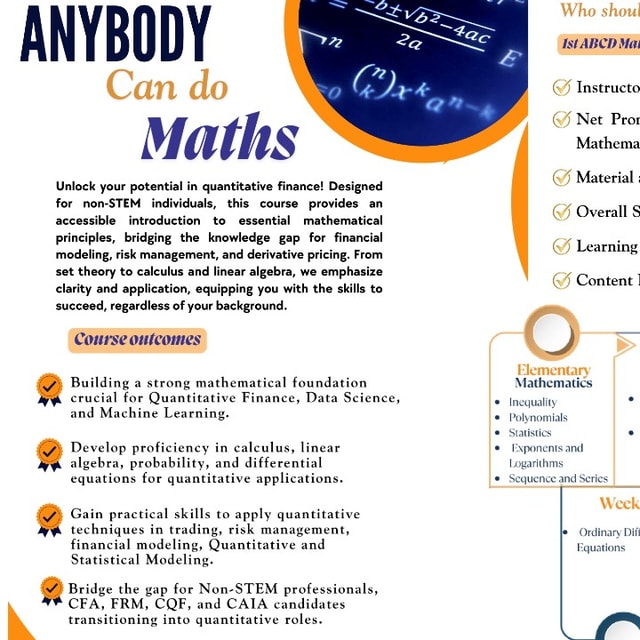
ABCD MATHS Primer for Quant Finance, DS & ML
Quant Insider Stack

MasterClass - Derivative Pricing by Somdip Datta
Quant Insider Career Catalyst
Resume Writing / Review
Quant Job Search Assistance
Discovery Chat
Commodities Options trading & Market Making
Building Volatility Strategies with BEV

ABCD MATHS Primer for Quant Finance, DS & ML

BUY SIDE MOCK INTERVIEW
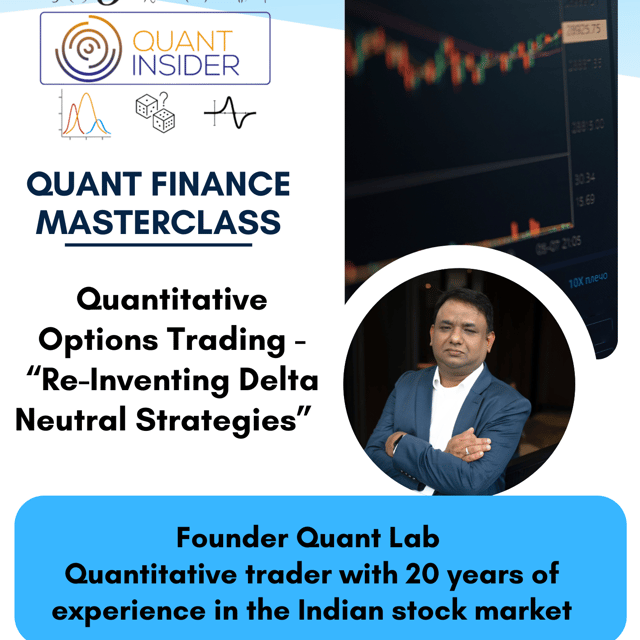
Options Trading -Reinventing Delta Neutral
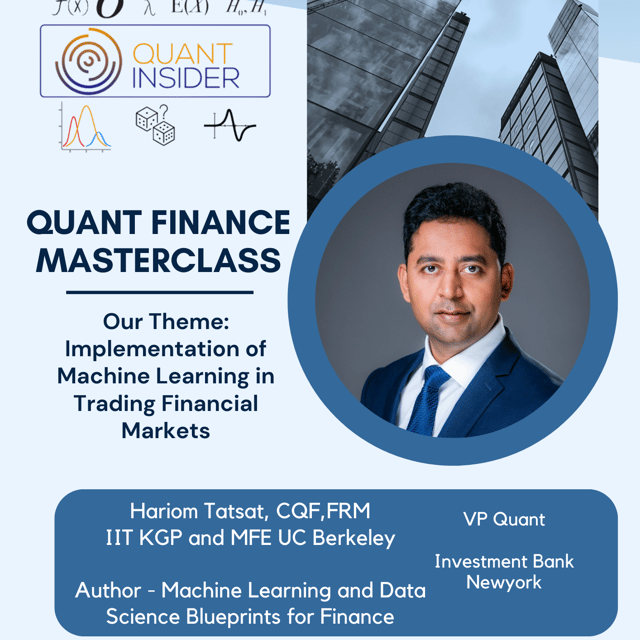
1:1 Consultation
Mock Interview
Long term Mentorship
Inquiry
About me
- Change the World With Your Time. Come and Join Us!https://topmate.io/join/quant_insider

Frequently asked questions
What is high frequency trading in simple terms?
The high frequency trading meaning is easiest to grasp through its name: it is trading executed by computers running algorithms that place, modify, and cancel thousands of orders within microseconds or milliseconds. Instead of holding positions for days, HFT strategies earn tiny margins from bid-ask spreads, small arbitrage gaps, and short-term order-flow patterns, repeated across enormous volumes. Because every microsecond counts, HFT firms invest heavily in colocation servers at exchanges, low-latency code (usually C++), and strict risk controls. In India, this activity happens mainly on NSE and BSE.
How to learn high frequency trading?
Build your base in four layers: first, mathematics — probability, statistics, linear algebra, and mental math under time pressure; second, programming — C++ or Rust for low-latency systems and Python for research and backtesting; third, market microstructure — order books, matching engines, and how market makers earn the spread; fourth, practice — solve probability puzzles and quant interview questions, backtest simple strategies, and attempt mock interviews that replicate real HFT rounds. Self-study can work, but structured high frequency trading courses, question banks, and mentors who have cleared these interviews shorten the learning curve significantly.
How to build a high frequency trading system?
A typical architecture has five blocks: a market data handler that parses exchange feeds, a strategy or signal engine, an order execution gateway, pre-trade risk checks such as position limits and fat-finger filters, and a backtesting or simulation environment. Speed comes from colocation near the exchange, kernel-bypass networking, lock-free data structures, and tightly optimised C++. If you are a student, start small — build a paper-trading bot on broker APIs, then study exchange specifications and low-latency design, since this is exactly the skill set prop firms test in their hiring rounds.
Which are the top high frequency trading firms in India?
Well-known names include Graviton Research Capital, Tower Research Capital, Quadeye, AlphaGrep Securities, iRage, and APT Portfolio, along with the quant desks of global hedge funds and investment banks. The largest cluster of high frequency trading firms in Mumbai sits close to the exchanges, with strong hubs in Bengaluru and Gurgaon as well. These firms hire quant traders, quant researchers, and low-latency developers through probability-, coding-, and speed-heavy interview processes.
What skills do you need for high frequency trading jobs?
The core stack is strong probability and statistics, fast mental math, data structures and algorithms (usually in C++ or Python), and a working understanding of market microstructure. Interviews typically include rapid-fire math puzzles, probability brain teasers, coding rounds, and sometimes trading games that test your intuition for expected value and risk. A background in computer science, electronics, maths, or physics is common, but what actually decides selection is problem-solving speed and depth of fundamentals.
How much is the high frequency trading salary in India?
It is among the highest-paying entry points in the country. Fresher packages at top proprietary trading firms commonly fall in the range of roughly ₹30–60 lakh, and at the most competitive firms total compensation with bonuses can cross ₹1 crore, while experienced quants and profitable traders earn multiples of that. The exact high frequency trading salary varies with the firm, city, role — trader, researcher, or low-latency developer — and individual performance.
How to use machine learning for trading?
Practical applications include predicting short-term price moves, classifying trade signals, optimising execution, ranking portfolios, and extracting sentiment from news and order data. A sound workflow is: define a clear hypothesis, clean the data while guarding against look-ahead and survivorship bias, train simple models first (regressions and gradient boosting before deep learning), backtest out-of-sample with realistic costs, and validate in paper trading. Treat machine learning as a statistical edge that needs constant monitoring, not a guaranteed money machine, because financial data is noisy and non-stationary.
How to make a machine learning trading bot?
Work in stages: pick one market and a reliable data source, define the prediction target (for example, next-period direction), engineer features, train a simple model, and backtest with transaction costs and slippage included. Only after the strategy survives out-of-sample testing should you connect it to a broker API and run it in paper-trading mode, with hard limits on position size and drawdown. Most bots fail because of the gap between backtest and live markets, so capital preservation and monitoring for model decay matter more than model complexity.
Which machine learning for trading book should a beginner start with?
Popular starting points include Machine Learning for Algorithmic Trading by Stefan Jansen, which is hands-on and code-driven, and Advances in Financial Machine Learning by Marcos López de Prado, which is better once you already understand backtesting pitfalls. If your Python, statistics, or market basics are weak, fix those first or the material will not stick. Keep in mind that a machine learning for trading book creates real value only when paired with projects you build and backtest yourself — which is also what quant interviews actually probe.
What is derivative pricing?
Derivative pricing is the process of calculating the fair value of contracts such as options, futures, and swaps whose payoff depends on an underlying asset. The foundation is the no-arbitrage idea: if you can replicate a payoff with a portfolio of tradable assets, the derivative must cost the same as that portfolio. From this single principle come risk-neutral valuation, binomial trees, the Black–Scholes model, and Monte Carlo simulation — the toolkit used on trading desks, in risk teams, and in valuation roles at banks, hedge funds, exchanges, and the Big 4.
How to price derivatives?
Learn it as a sequence: master probability and stochastic processes (especially Brownian motion), understand no-arbitrage and replication, work from binomial trees up to the Black–Scholes formula, study the Greeks and delta-hedging, and finish with Monte Carlo and finite-difference methods for exotic payoffs. Implement every model yourself in Python or C++ — deriving and coding a pricer teaches you far more than memorising formulas, and it is exactly how derivative pricing questions are tested in quant interviews.
What are the most common derivative pricing models?
The workhorses are Black–Scholes for European options, binomial and trinomial trees for American-style early exercise, Monte Carlo simulation for path-dependent exotics, and finite-difference PDE methods; Black's model covers options on futures, while interest-rate models like Vasicek and the LIBOR market model handle fixed-income derivatives. For equity options you will also encounter local volatility (Dupire) and stochastic volatility models such as Heston. In interviews you are rarely asked to merely quote a formula — expect questions on the assumptions behind each model and where it breaks down.
What is option pricing?
Option pricing is the task of determining the fair premium of a call or put before trading it. The value depends on the spot price, strike, time to expiry, interest rates, dividends, and above all volatility, and it splits into intrinsic value plus time value. Models like Black–Scholes, binomial trees, and Monte Carlo convert these inputs into a price, while put-call parity and implied volatility help you sanity-check market quotes. India's index options market is among the most active in the world, which makes these concepts directly relevant for NSE traders and quant aspirants alike.
What kind of derivative pricing jobs are available in India?
Global investment banks such as Goldman Sachs, JP Morgan, and Barclays run large pricing, model validation, and risk quant teams in India, and similar derivative pricing jobs exist at hedge funds, proprietary trading firms, exchanges, and the quantitative and valuation practices of the Big 4. Typical titles include pricing analyst, model validation quant, market risk quant, and derivatives structuring analyst. Preparation usually revolves around stochastic calculus, pricing models, C++/Python coding, and probability puzzles rather than generic finance questions.
What is a derivative pricing rule?
In most textbooks and interviews, a derivative pricing rule refers to the governing principle used to fix a derivative's fair value — and the central one is the no-arbitrage, or law-of-one-price, rule: two portfolios with identical payoffs must have identical prices today. Applying this rule gives you replication-based pricing, risk-neutral valuation, cost-of-carry for futures, and put-call parity for options. If you can price a forward or a simple option from first principles using this rule alone, you can handle most interview follow-ups on the topic.