Testimonials
Services
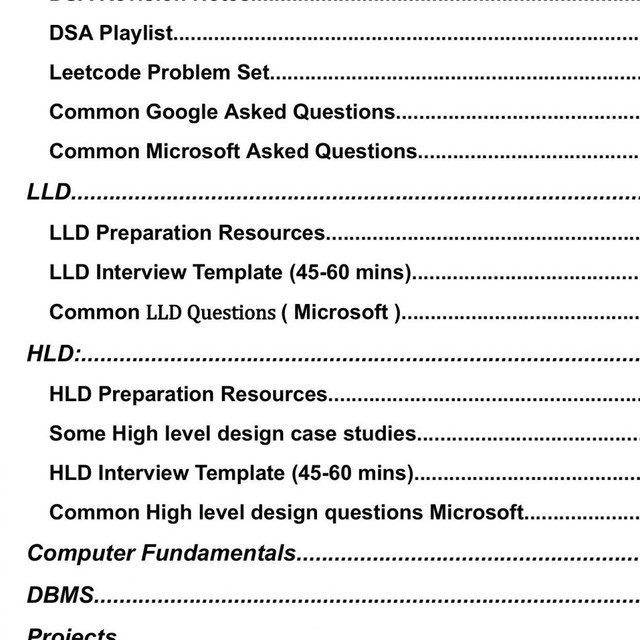
A-Z, FAANG Preparation Material
Mock interview\Mentorship
1:1 Mentorship
About me
- Test Engineer to Youngest Principal Engineer Microsoft - YouTubehttps://www.youtube.com/watch?v=-mDGTNwlCPg&list=LL&index=4&t=165s

Frequently asked questions
How to prepare for a FAANG interview?
The best way to prepare for a FAANG interview is to work in four stages: first strengthen DSA fundamentals (arrays, strings, linked lists, trees, graphs, dynamic programming), then solve 150–300 quality problems by pattern instead of randomly, add LLD and system design depending on your experience level, and finally rehearse behavioral stories in the STAR format. Close the loop with at least 4–5 mock interviews, because calibrated feedback from someone who has actually interviewed candidates is what most self-prep misses.
How long does it take to prepare for a FAANG interview?
Most candidates need 3–6 months of consistent effort at 1–2 hours a day to prepare for a FAANG interview, while students or beginners starting from scratch may need 6–9 months. The real variable is your starting level — if you already solve medium problems comfortably, 2–3 focused months can be enough. A single mock interview with an experienced interviewer will tell you more about your actual gap than blindly following anyone else's timeline.
What is a good FAANG interview preparation roadmap?
A practical FAANG interview preparation roadmap runs like this: months 1–2 for DSA fundamentals and easy-to-medium problems, months 3–4 for pattern-based mediums, graphs, dynamic programming and LLD practice, month 5 for system design (if you have 2+ years of experience) and behavioral prep, and the final month for company-specific mocks. Candidates in India should also revise OS, DBMS and computer networks, since many product-company interviews here test core CS fundamentals alongside DSA.
Is a FAANG interview preparation course worth it?
A FAANG interview preparation course is worth it only if you need structure, accountability and doubt-clearing — otherwise disciplined self-study with free problem sets works just as well. Recorded content alone rarely cracks interviews; live mocks and personalized feedback do. If you already follow a strict routine, spend on mock interviews with real interviewers instead of another course, but if you keep losing direction, a mentor who has sat on the interviewing side can shortcut months of trial and error.
How do I start FAANG interview prep in India?
Start FAANG interview prep in India by locking one language and building DSA depth first, because loops at Microsoft IDC, Google India and Amazon India are heavily DSA-focused at every level. Practise topic-wise, maintain a mistakes journal, and begin off-campus applications and referral outreach early, since referrals carry real weight in the Indian market. Once you can solve mediums consistently, add regular mock interviews — that is the fastest way to convert applications into offers.
How to prepare for a system design interview?
The practical way to prepare for a system design interview is to build concepts first — load balancing, caching, sharding, replication, message queues and CAP trade-offs — then study classic designs like URL shorteners, news feeds, chat apps and rate limiters, and finally practise designing one system a week out loud against a timer. Reading alone will not get you through, because interviewers grade how you reason and defend trade-offs, so get a mentor or peer to critique your live designs.
How to approach a system design interview?
Approach a system design interview as a structured 35–40 minute discussion: clarify functional and non-functional requirements, do quick back-of-envelope capacity estimates, define the API and data model, sketch a high-level design, deep-dive into one or two critical components, and finish with bottlenecks and trade-offs. Keep talking throughout and invite the interviewer's input — going silent while drawing is the most common reason candidates fail even with a correct design.
What are the most common system design interview questions?
The system design interview questions that appear most often include designing a URL shortener, a Twitter or Instagram feed, a WhatsApp-style chat, a YouTube-style video platform, a rate limiter, a web crawler and a notification system. For LLD rounds, expect parking lots, Splitwise, BookMyShow, elevators and tic-tac-toe — the last few show up constantly in Indian product-company interviews. Build a reusable framework per category rather than memorising individual solutions.
What is Grokking the System Design Interview?
Grokking the System Design Interview is a widely used online course that breaks popular design problems into repeatable templates, making it a good first step for learning HLD vocabulary and standard architectures. Its limitation is that reading solved designs feels far easier than designing under pressure, so treat it as a foundation and follow it with live practice — explaining your design aloud in mock sessions is where the actual skill develops.
Which is the best system design interview book?
The most recommended system design interview book is System Design Interview – An Insider's Guide (Volumes 1 and 2) by Alex Xu, thanks to its clear diagrams, standard question bank and trade-off discussions; senior candidates can pair it with Designing Data-Intensive Applications. Whichever book you pick, convert each chapter into practice by re-designing the same system yourself from scratch without peeking.
How to prepare for a DSA interview?
The best way to prepare for a DSA interview is in stages: master one language's standard library, learn core structures (arrays, linked lists, stacks, queues, trees, heaps, graphs) with time and space complexity, then move to pattern-based practice — two pointers, sliding window, binary search, BFS/DFS and dynamic programming. Aim for 150–250 problems solved with full understanding rather than 500 rushed ones, revisit every mistake after a week, and shift to timed practice as the interview nears.
How to answer DSA interview questions?
To answer DSA interview questions well, follow a fixed sequence: restate the problem and clarify constraints, explain a brute-force solution out loud, identify its bottleneck, improve it with the right data structure or algorithm, state time and space complexity, and then write clean code while testing edge cases. Interviewers score communication and reasoning as heavily as the final answer, so thinking silently and jumping to code is riskier than starting with a suboptimal idea.
What are the most common DSA interview questions and answers for freshers?
DSA interview questions and answers for freshers usually revolve around arrays and strings (reversal, anagrams, two sum), linked lists (detect and remove loops), stacks and queues, binary search, tree traversals, recursion and sorting complexities. Product companies push freshers toward medium-level graphs and DP, while many mass recruiters and service companies stay at easy-to-medium plus MCQ rounds. In every case, stating complexity clearly and handling edge cases is what earns the offer, not just a working solution.
How should I practice DSA interview questions in Java?
Practise DSA interview questions in Java by first mastering the collections you will rely on — ArrayList, HashMap, HashSet, PriorityQueue, Deque and StringBuilder — since writing them fluently saves crucial minutes in timed rounds. Solve everything in Java itself instead of switching languages, watch Java-specific pitfalls like integer overflow and autoboxing overhead, and reuse the same language for LLD practice because many companies in India ask object-oriented design in Java. One deeply prepared language beats splitting focus between Java and C++.